Dispatch: L’Internationale Climate Assembly at tranzit.ro/Bucuresti and The Experimental Research Station for Art and Life
L'Internationale colleague Jye O'Sullivan sends a dispatch in the form of sound, text and images from the recent Climate Assembly in Romania, hosted by tranzit.ro.
Covered in moss and twigs we lay down in the grass. We bathed in the orange light of the setting sun – still toasty. We listened to Oto Hudec rhythmically pluck his guitar, drenched in reverb and we thought – this is what it means to be hosted, to hold space and to make feel welcome a group of no-longer strangers.
Field recording of Oto Hudec, 30 May 2026
On the 29 and 30 of May, 2026, tranzit.ro/Bucuresti and The Experimental Research Station for Art and Life hosted the cultural workers of L’Internationale and their comrades as part of their Climate Assembly. Their hosting was generous, considered and sincere and whilst the remainder of this dispatch will largely focus on the artistic and theoretical work that was done during those two days, it is essential to state that none of it would have been possible – an ‘imperfect solidarity’ could not have been built – if it were not for this gracious hosting.1
On the morning of the 29th, a range of folks met in the parking zone of the Piața Victoriei, nestled between socialist housing and Pepsi advertisements, the different workers connected – some knew each other from previous collaborations, the rest by the odd gathering of people next to a minibus. With no formality, plenty of familiarity and a fair bit of yawning, we got into two minibuses to drive from Bucharest to The Station (which includes tranzit’s permanent venue), located at Silistea Snagovului, 40km north.
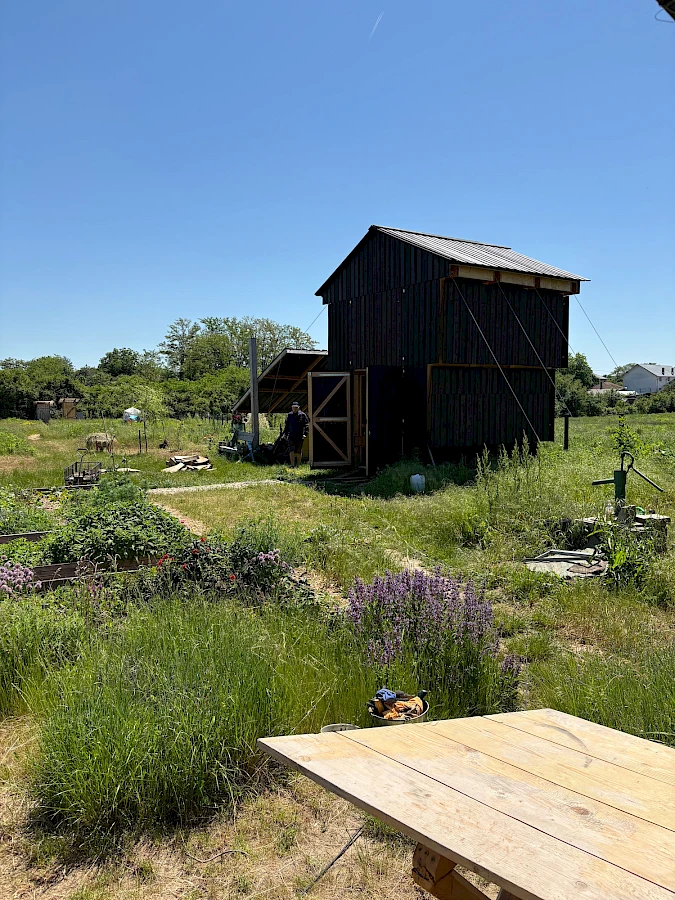
The Station. Photo: Yury Beryozkin
Day One
Arriving in tingling sunshine the groundwork for the day was already underway. Whilst cooking was being finalised, Raluca Voinea and Adelina Luft gathered everyone around and welcome us into the space. Alongside Dimitrie Grigorescu and Martin Piaček, the locality was explained and we were guided through how tranzit fits into it. This iteration of tranzit is an adaptation to the intensification of neoliberal property markets and the increasing impossibility of urban dwelling and making. The strip of land was bought collectively between artist-researchers turned gardeners and constructors and has germinated similar movements by others, including Charles Esche who attended this Climate Assembly and showed us around his neighbouring field. Using the instruments of a weather station, kitchen and greenhouse, the group engage with the varying ecologies, localities and political spheres from a distinctly decolonising position on the edge of Europe.
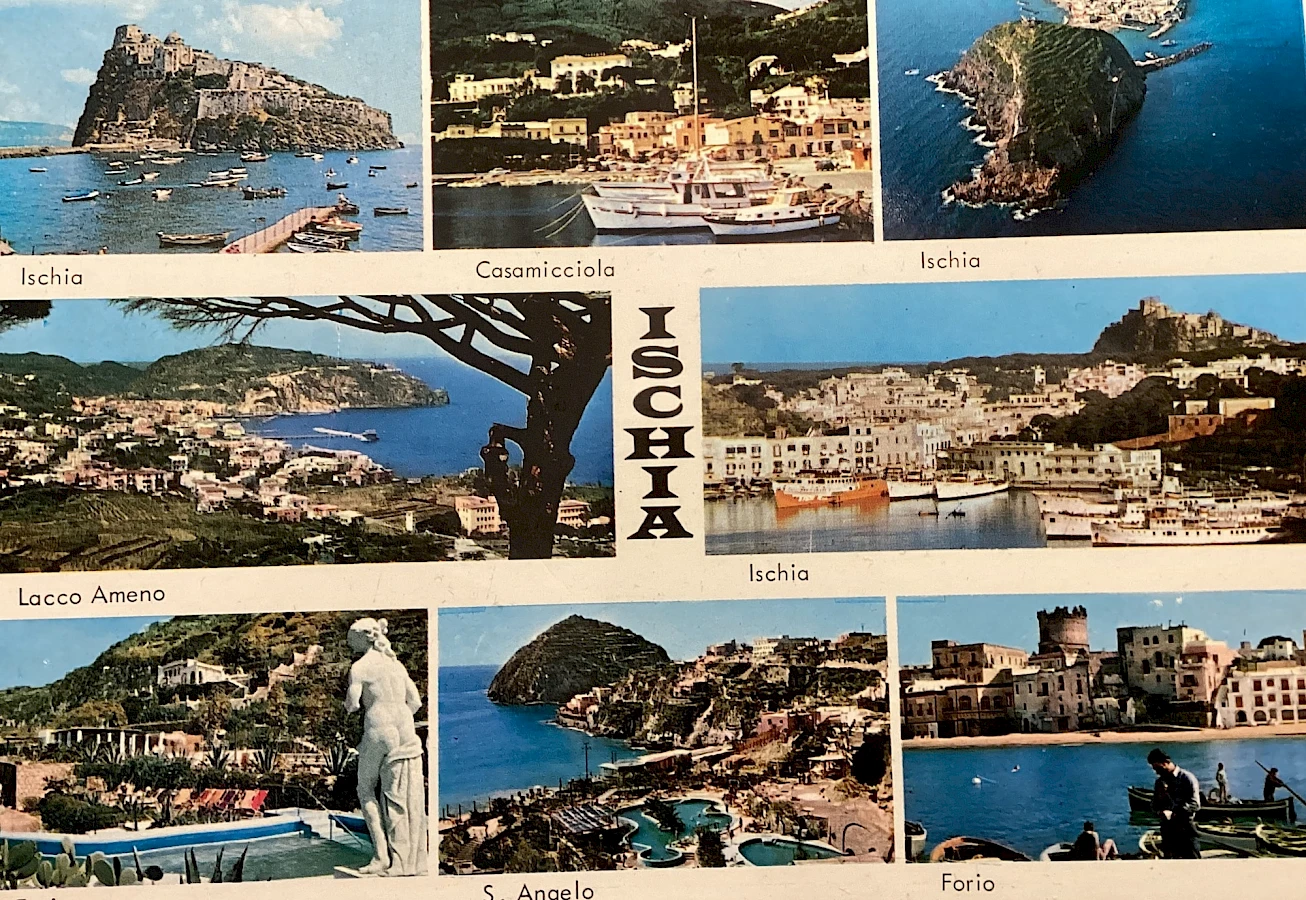
Postcard courtesy Raluca Popa
Following this grounding, Raluca Popa greeted us in the space and introduced us to her practice by distributing handwritten postcards, with quotes from different poets and writers, under the broad theme ‘Conditions of Life’, especially prepared for this occasion. We stood in a loose circle and took turns to read these cards aloud. Mine read:
‘The animals arrived ashore,
not us. A crocodile. A puma.
A rhinocerus. A shark. A horse.
An elephant. Even a long dog.
which did not reach yet the
age of death.
They sailed on our clothes.’
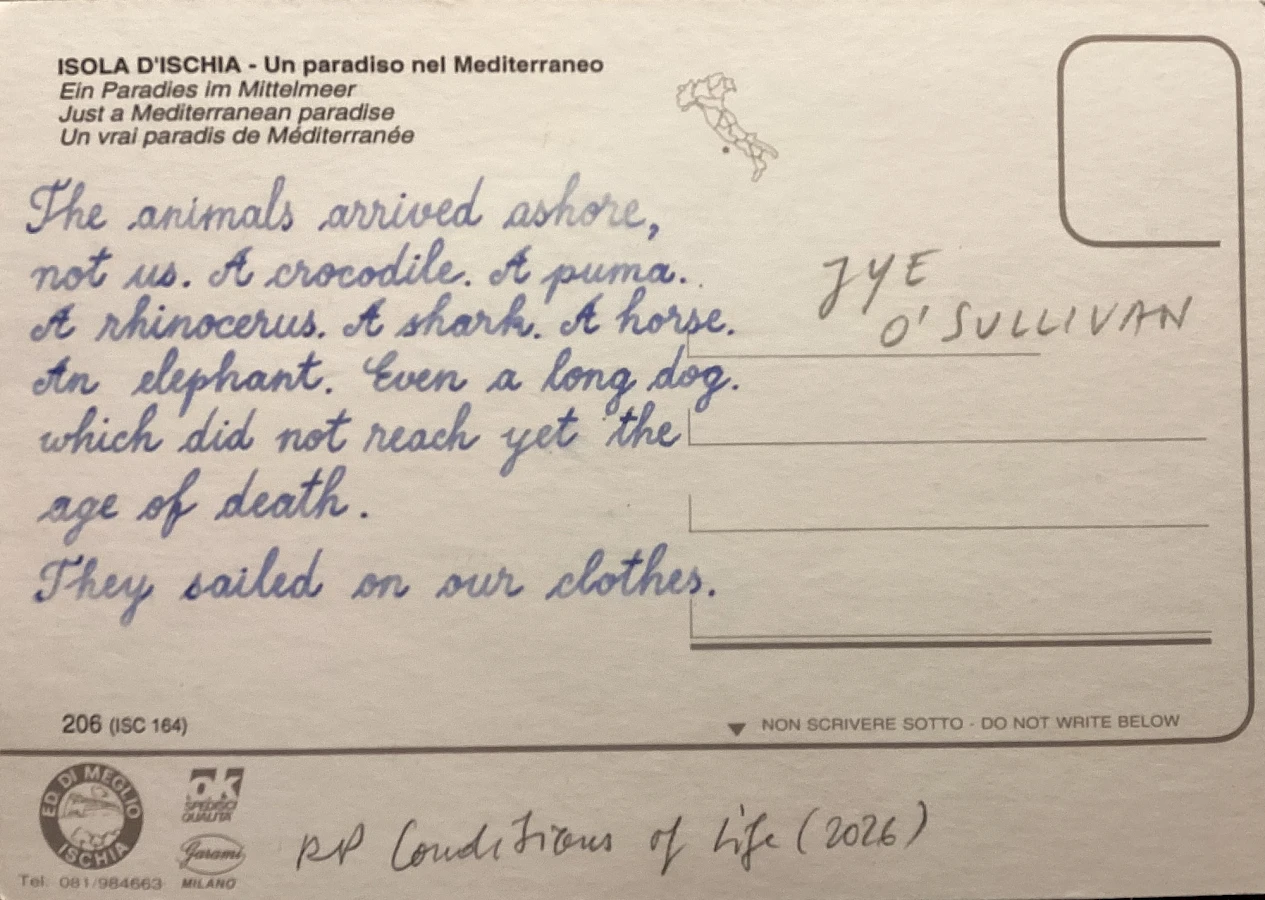
Postcard courtesy Raluca Popa
I could feel the eyes and smile of my comrades from across the field. I had spent the past few weeks working through ideas of how to decolonise natural history museums, talking about tracing the acquisition records of animals, and here I am, listing the animals that sailed to shore in a societal and climate collapse. Through this exceptionally created collective performance, we were not only introduced to each other’s voices, but we planted the themes for the two days. The ways social and climate justice are indistinguishable, the shared decolonial position and a criticality towards Euromodernity combined with a commitment to stand against politics that disregard social and ecological suffering.
Carrying these themes across the field, Charles Esche guided us around his adjacent parcel of land, The Three Ashes, and drawing on his curatorial experience aligned the choices of the land to present discourses. The desperate need for the commons, the failure of governments to ensure meet what Judith Butler would call the ‘conditions of liveability’ and the erasure of biodiversity both from urban and rural spaces.2
With these ideas in mind, we returned to the Station and ate a beautiful lunch. Served on a table made by students from the National College of Art and Design, Dulin (NCAD) and the University of Architecture in Bucharest the previous year, the lunch, cooked by Diana Voicu and collaborators, offered a space to further the conversations begun by the postcards. In the 2013 film Las Maestras de la República, directed by Pilar Pérez Solano, lunch is framed as a learning opportunity. Alongside a FETE (Spanish Federation of Education Workers) pioneered by women teaching, children’s mealtime was both the reception and eating of food and a collective moment involving shared labour and social exchange. In this framing, food offered the vehicle for ideological exchange and a sharing of ethics, even at young ages.
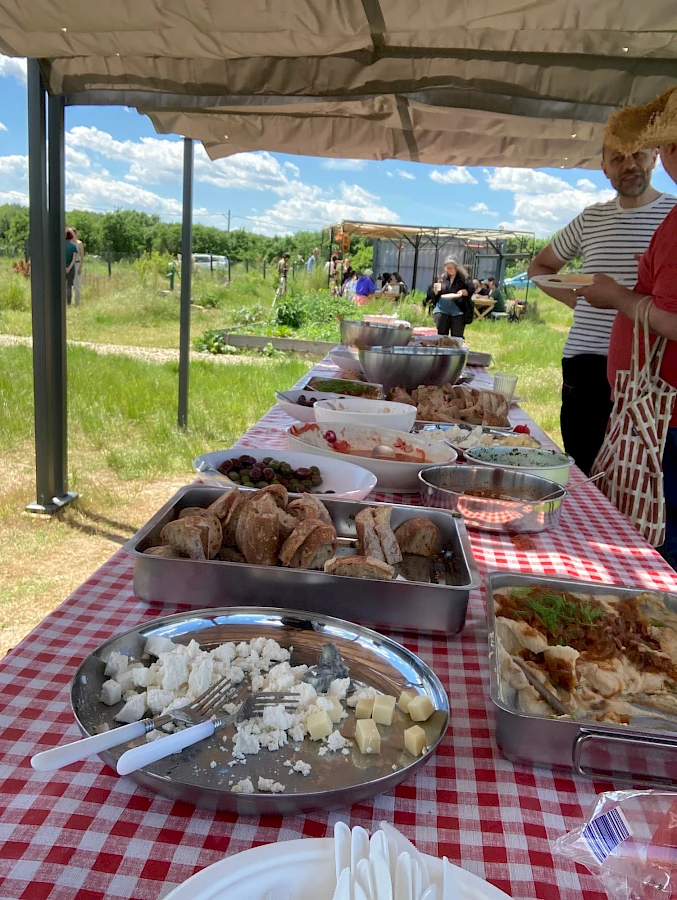
A stunning lunch thanks to Diana Voicu
Throughout the two days with tranzit, food was consistently framed in this manner; as a moment for ideological and ethical exchange that took place through considered meals shaped by locality and those eating. With a global decline in local farming as a result of monoculture and monopoly pressures, as well as a constant battle for affordable healthy food and the time to prepare and eat it as cultural exchange and labour, these moments are precious.3 To host a Climate Assembly without consideration of the food that shapes how we relate to the land would seem foolish, but as anyone who has been to conferences on ecology and climate collapse will know, it is all too common.
With bellies full, we headed to the woods. Here, we heard the poetic interventions of Nora Ugron and Maria Martelli, members of CUTRA collective. Surrounded by trees, we guided each other with closed eyes under the instruction of Zakole, a Warsaw based collective. Touching the moss and listening to the many animals, we explored the site, both placing faith in those who guided us, and trying to cultivate it in those we guided. This exercise offered a space for reflection on the need for mutual aid and interconnectedness, key aspects that are being systemically eroded, undermining the conditions for liveability.
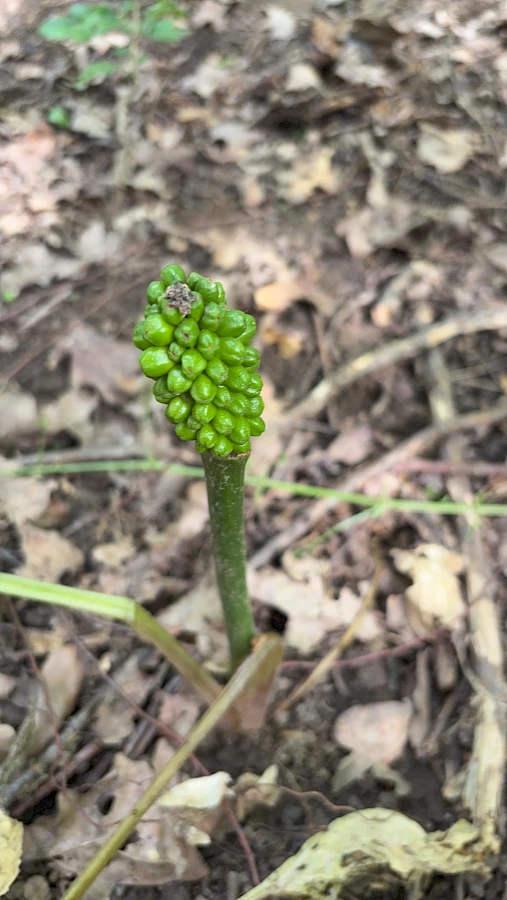
Photo: Yury Beryozkin
It was appropriate then, that on return to the site, artist Harun Morrison drew on an old English folk tradition of burying a single shoe as an apotropaic charm to ward off evil spirits and bad luck at the entrance to the Station. Perhaps configured in relation to the discourses of the day, the shoe, which was collectively buried, might serve to ward against the parasitic epistemologies that we had gathered against. Under the watchful look of a kite flown by Lena Ciobanu and the soundscape of Oto Hudec, reminiscent of Tuareg music and a golden setting sun, it was almost possible to forget the need for such a ward. Yet Raluca and Adelina’s words from the morning still echoed, the Station is not an escape, it is a site to experiment and develop new ways of being in response to urgent crises.
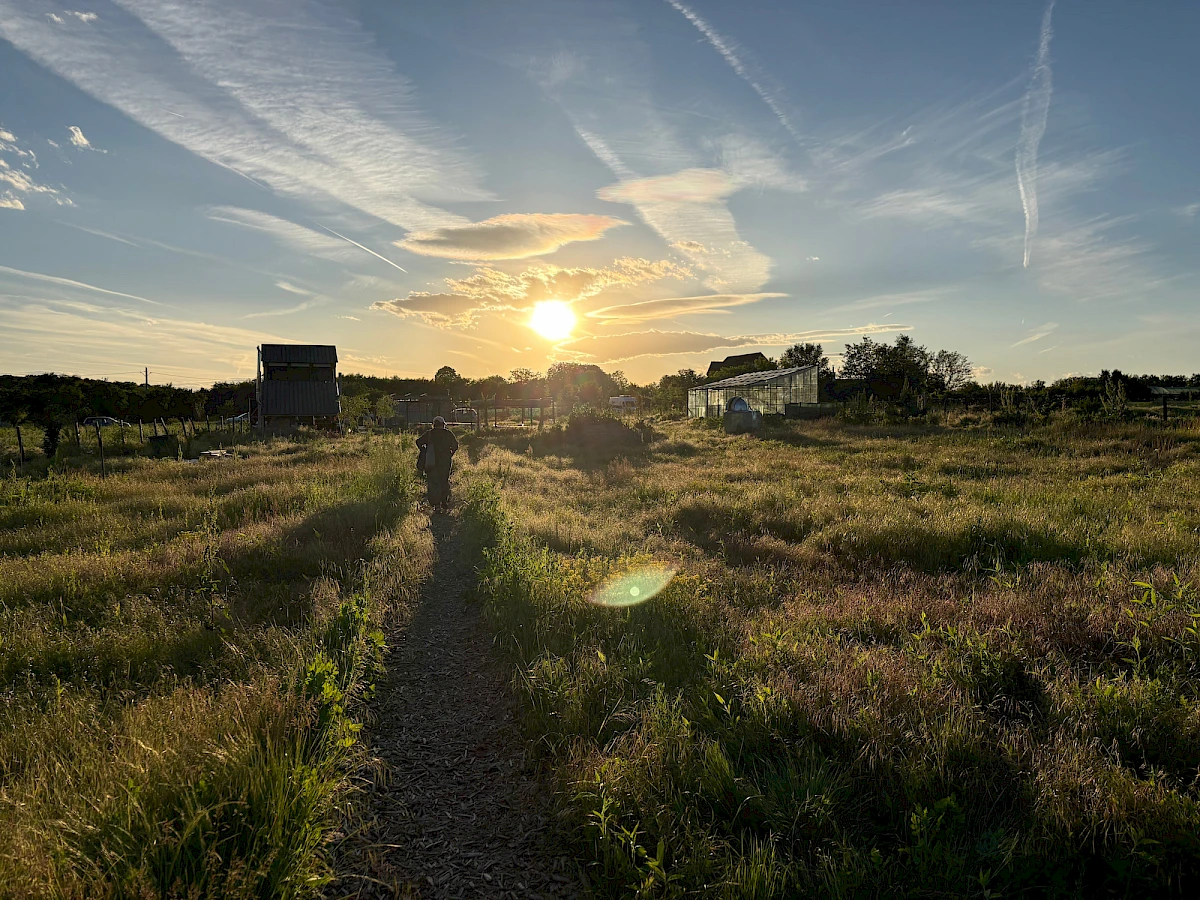
Photo: Yury Beryozkin
Stuck in the quagmires of cost-of-living crises, housing crises, climate crises, the many polycrises that have become the ‘new normal’, the colonial desire to run away and build a different world is, to some extent, understandable. Contrary to what is perhaps Donna Haraway’s most famous line ‘staying with the trouble’, this desire has produced a wide range of projects, from Elon Musk’s Mars-obsession to Ebenezer Howard’s garden-cities. Many, like Howard, held good intentions for urban solutions to environmental and social problems, but they nonetheless fell into a Modern design problem that would be highlighted by cybernetics, they were designing closed systems subject to entropic decay. Whether critiqued for the elitist structures determining participation, the colonial oversight of not recognising what was already in the space prior to ‘development’, or the problematic claim that perfection can be designed, these closed systems, removed from other Nature/Culture ecologies, are a profoundly problematic response to crisis.
Opposed to this, the Station stands a firmly connected space, working with what and those who were there before and in consistent dialogue with the locality, Bucharest and global efforts to develop new creative and critical strategies for survival and liveability. The second day of the Climate Assembly, held at The Legacy House, Bucharest (tranzit’s former space in the city, from 2012 to 2019), saw these connections highlighted.
Day Two
The Legacy House, a site for ethical entrepreneurship, radical hospitality and regenerative culture hosted us in conjunction with Diana Voicu who again provided our considered meals. The day was divided into two sections, the morning held the Internationale Climate Assembly internal discussion and the second half featured a range of presentations from folks engaged in climate struggles in Eastern Europe and beyond. Whilst it would be inappropriate to share the internal discussion in detail here, there were several key insights and dynamics that readers might find heartening. Following that, I summarise the presentations before signing off.
Firstly, during the Climate Assembly it was abundantly clear that all attendees felt the need to maintain the use and concern for ‘climate’. Understandably, in the face of polycrises, there is concern regarding the prioritisation of one aspect over another. Whilst this is understandable and felt by the cultural workers of L’Internationale, it is also important to recognise the entanglements between these issues; the ways in which climate crisis forms, shapes and is shaped by war, genocide and a desperation for hoarded resources. Given the entanglement of these problems, the term ‘climate’ still plays an important role in contemporary discourse and research activity.
Secondly, the Climate Assembly felt that the role of pedagogy was key. Whilst the varying activists and cultural workers believe that research and artistic practice is essential, they also maintain and share the common ground that this has an ethical responsibility to be transformed into a plurality of pedagogical practices. This teaching, co-learning and exchange needs to take place inside and outside of institutions and take varying forms, however it needs to be maintained as central to research and investigative practice.
Finally, and touchingly, there was an overwhelmingly clear desire to continue to work together. Oftentimes the value of solidarity and trust which takes years to build can be pushed to the side in favour of concrete deliverables. What was explicitly clear that morning was that the group assembled were committed to continue to work together irrespective of funding or institutional alliance. This solidarity between cultural workers and desire for mutual-aid and labour is both reaffirming and deeply needed in a moment where individual productivity is placed above collective labour – as slow as this can be.
These three reflections on the Climate Assembly are indicative of a significant number of years of collaborations, developed shared and diverse perspectives with coherent ethical structures and interpersonal solidarity. Furthermore, these ideas are not alone – in the presentations that followed another beautiful lunch, we saw so many more instances of this kind of labour and commitment.
In the first presentation, Valiana Aguilar discussed Suumil Mookta’an, a sister station to tranzit located in Yucatan and ran by a Mayan collective. The station place priority on ecological practices that challenge patriarchal, colonial and extractivist epistemologies. By centring women and viewing daily practices as a political praxes, from dry-toilets to backyard animals, their solidarity and efforts seek to brew a revolution that does not forget food. For Aguilar, the polycrises we are facing is a war on life in the many senses that might be understood. Carefully safeguarding and nurturing life then, is anti-hegemonic resistance. Following this talk, we shared space once again with the Zakole Collective who spoke to the shared themes of weedy ecologies, green spaces and community engagement where the community is not only limited to human actors. Central to this conversation was also the recognition of pedagogical exchange as a politicising force from artistic practice.
Lilia Nenescu and Vitalie Sprînceană took up the prior theme of post-industrial ecologies and discussed their urban gardening practices in the former Republican stadium in Chisinau and set of thematics also shared by Alex Oprita who discussed the ecological restoration of the Vacaresti Delta in Bucharest. These modes of ecological resistance were particularly resonant in the Climate Assembly due to ways their working with postindustrial spaces both destabilases colonial narratives of ‘pure’ nature and offers post-natural ways of ecologically working with these localities. This effort to increase the diverse needs for cross-species liveability in postindustrial ecologies is critical to our moment.
Furthering this conversation Adina Moise shared with us an essential project developing a Community Seed Bank in Bucharest. Echoing the work done by Aguilar and many indigenous collectives around the world, this reconsideration of the necessity of localized seedbanks is critical as they not only offer food-resilience in a time of extraction of forced scarcity, but they also preserve epistemological knowledge and biodiversity. This political stance was shared with Ramona Duminicioiu who discussed the struggle of Romanian peasants and small farmers in marketing organic products as well as the success of the Association Ecoruralis in stopping the illegal government waivers for pesticide permits to multinational corporations.
Both of these projects pull into question multi-scalar resistance and its tensions. During the 20th century, the nation state was often defended as a mechanism for protecting both sovereignty and populations from large external forces, including multinationals and other states. In 2026, conglomerates of nation states, such as the EU, are positioned as a bulwark against increasingly monolithic tech-empires. This being said, as a result of corruption, vested interests or different ethical and ideological positions of rotating parties, the interests of the nation states and their conglomerates do not always align with localities and the people who live with their ecological locales. It is impossible to transmit knowledge across scales without changing the information.
This tension in scale was also explored by Ovidiu Danes, the final presenter, who discussed rethinking human interventions on rivers in Romania. The Dala Foundation, a very small foundation responsible for amazing work, have led investigations into ways to restore waterways that work with the ecosystems of the natural environment to restore the damage done by human interventions as well as prevent flooding from a mixture of naturally occurring and climate-change related alterations to ecosystems. What was particularly striking about this presentation was the refusal for techno-solutionism that stemmed from engagement with locality without erasing human community needs. The identified methods for aquatic repair focused on working with the ecologies, inclusive of local communities, destabilizing Nature/Culture binaries. What’s more, they stood against some dominant voices at governmental and European levels who lean towards technophilic solutions that are inappropriate to localized problems. This commitment to local solutions resonates with the ambitions of our Climate Assembly.
To sign off then, I would like to reflect on this question of scale, and what is next for the climate assembly. Committed to continuing to research and push for the implementation of pedagogical adaptations of this research, our network has retained a strong feeling of ethical solidarity. The challenges that lie ahead however are poly, not only in their thematic and material content, but in their multi-scalar nature. The solutions that work at international scales are not the same as those that work in one specific river, nor do approaches that take a long time address the same problems and urgencies as those that require rapid solutions. As we move forward, our task is to build on the cultivated solidarity we have, that is based in a plurality of perspectives, to develop multi-scalar responses and technē.
Photo: Yury Beryozkin
The polycrises we face are ‘wicked problems’ and the limits to their aspects are unknowable. What’s more, our search for manners to address them directly contributes to them; it was not lost on anyone the number of people who needed to fly to Bucharest for this assembly. Yet, this is the nature of wicked problems and the reason why our continued research, mutual aid and exchange is necessary and why it ought to stem from a place of shared values as opposed to explicit deterministic rules. As these crises change, we need to be adaptable and the only way this is achievable is through a careful solidarity between diverse people. To achieve this, we require the kinds of careful, considerate and generous hosting we received in Bucharest and from the warmth of tranzit and the stimulating interventions of all the comrades and cultural workers who participated. Thank you.
Related contributions and publications
-
Decolonial aesthesis: weaving each other
Charles Esche, Rolando Vázquez, Teresa Cos RebolloLand RelationsClimate -
Climate Forum I – Readings
Nkule MabasoEN esLand RelationsClimateHDK-Valand -
…and the Earth along. Tales about the making, remaking and unmaking of the world.
Martin PogačarLand RelationsClimatePast in the Present -
Art for Radical Ecologies Manifesto
Institute of Radical ImaginationLand RelationsClimateInstitute of Radical Imagination -
Pollution as a Weapon of War
Svitlana MatviyenkoClimate -
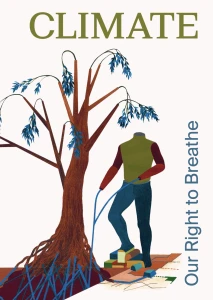
Climate: Our Right to Breathe
Land RelationsClimate
Related activities
-
HDK-Valand
Climate Forum I
The Climate Forum is a space of dialogue and exchange with respect to the concrete operational practices being implemented within the art field in response to climate change and ecological degradation. This is the first in a series of meetings hosted by HDK-Valand within L'Internationale's Museum of the Commons programme.
-
–Van Abbemuseum
The Soils Project
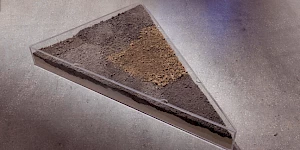
‘The Soils Project’ is part of an eponymous, long-term research initiative involving TarraWarra Museum of Art (Wurundjeri Country, Australia), the Van Abbemuseum (Eindhoven, Netherlands) and Struggles for Sovereignty, a collective based in Yogyakarta, Indonesia. It works through specific and situated practices that consider soil, as both metaphor and matter.
Seeking and facilitating opportunities to listen to diverse voices and perspectives around notions of caring for land, soil and sovereign territories, the project has been in development since 2018. An international collaboration between three organisations, and several artists, curators, writers and activists, it has manifested in various iterations over several years. The group exhibition ‘Soils’ at the Van Abbemuseum is part of Museum of the Commons. -
–Museo Reina Sofia
Sustainable Art Production
The Studies Center of Museo Reina Sofía will publish an open call for four residencies of artistic practice for projects that address the emergencies and challenges derived from the climate crisis such as food sovereignty, architecture and sustainability, communal practices, diasporas and exiles or ecological and political sustainability, among others.
-
–tranzit.ro
Non-Western Technologies for the Good Life

The experimental course ‘Non-Western Technologies for the Good Life’ (November 2023–May 2024) celebrates as its starting point the anniversary of 50 years since the publication of Tools for Conviviality, considering that Ivan Illich’s call is as relevant as ever.
-
–Moderna galerijaZRC SAZU
Open Call – Summer School: Our Many Easts

Our Many Easts summer school takes place in Ljubljana 24–30 August and the application deadline is 15 March. Courses will be held in English and cover topics such as the legacy of the Eastern European avant-gardes, archives as tools of emancipation, the new “non-aligned” networks, art in times of conflict and war, ecology and the environment.
-
–Institute of Radical Imagination
Gathering into the Maelstrom
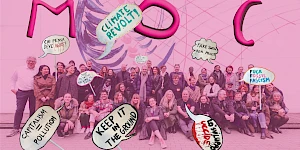
‘Gathering into the Maelstrom’ in Venice at Sale Docks is a four-day programme curated by Institute of Radical Imagination (IRI) and Sale Docks.