Conversation avec Keywa Henri
Artiste Kalin'a Tɨlewuyu originaire de « Guyane française », Keywa Henri explore dans sa pratique la mémoire, la décolonialité et la résistance autochtone à travers des formes vidéo et performatives, à la fois poétiques et politiques. Dans cet entretien mené par Anaïs Roesch, chercheuse et coordinatrice du programme Common Ground de l’association AWARE : Archives of Women Artists, Research and Exhibitions, iel revient sur son parcours, ses études, la construction de son engagement et la manière dont son identité nourrit son œuvre.
Anaïs Roesch : Pour commencer, pourrais-tu nous dire d’où tu viens, dans quel milieu tu as grandi ?
Keywa Henri : Mon héritage et mon identité sont constitués de beaucoup de couches, historiques, culturelles, intimes. Je suis né•e en « Guyane » en 1993 de père Kalin'a Tɨlewuyu et de mère brésilienne. Du côté maternel, mon grand-père autochtone qui a fait face à la répression dictatoriale, a fait vœu de silence. Du côté paternel, nous sommes très fièr•es de revendiquer notre identité ; mais dans les deux cas, nous avons connu la violence, qu’elle soit physique ou symbolique, d’un système qui veut nous effacer. Dans ce contexte, comment ne pas perdre de vue qui on est, d’où on vient et ce qu’on défend quand la Constitution française ne nous reconnait même pas ?
AR : Tu as grandi en « Guyane » mais tu as fait tes études d’art à Lyon. Comment cela s’est-il passé pour toi ?
KH : Oui, comme tous les enfants dits « d’Outre-mer », j’ai fait ma scolarité en « Guyane » mais j’ai dû partir dans l’Hexagone pour poursuivre mes études dans le supérieur car jusque dans les années 2000, il n’y avait pas d’université en « Guyane ».
J’ai intégré l’École des Beaux-Arts de Lyon car je cherchais une formation qui me permette d’avoir un espace de liberté. À l’époque, j’étais la•e seul•e étudiant•e autochtone et l’école n’était pas faite pour des personnes comme moi. Il n’y avait pas un•e seul•e prof noir•e, je ne trouvais aucune référence autochtone dans la bibliothèque… J’ai dû chercher des exemples ailleurs, au Brésil, au Canada.
AR : Aujourd’hui, tu te définis notamment comme artiviste. Comment ton positionnement politique s’est-il affirmé au fil de ton parcours ?
KH : Au début de mes études, je ne voulais pas mettre en avant la question autochtone parce que je ne voulais pas participer de cette folklorisation, exploiter ma singularité juste pour produire quelque chose. Le monde de l’art est comme le reste du monde : il nous infantilise.
Mais aujourd’hui, j’assume pleinement cette position : être une artiste autochtone, c’est porter une parole de résistance. Nous sommes encore trop invisibilisé•es, on s’intéresse à nous pour ce qu’on a mais rarement pour qui on est.
AR : L’écologie est présente dans ton travail, même si tu n’en parles pas frontalement. Est-ce que tu pourrais préciser le lien entre cette dimension et ton engagement ?
KH : L’écologie, pour moi, ce n’est pas un thème, c’est une manière d’exister. Dans la culture Kalin'a, on ne sépare pas l’humain de la terre, ni le corps du territoire. On appartient à un tout. Quand je parle de destruction des forêts, de la disparition des langues ou des fleuves empoisonnés, je ne fais pas de la politique « écologique », je parle de ma famille, de ma maison, de ce qui me constitue. J’observe qu’aujourd’hui on parle beaucoup d’écologie sans jamais vraiment écouter les peuples qui vivent ces réalités. L’Occident veut sauver la planète, mais sans nous, or « nous sommes la réponse » !
AR : Quels changements aimerais-tu voir à l’œuvre dans ce monde ?
KH : Aujourd’hui, d’un point de vue sociétal, nous accélérons notre propre effondrement. Mais, en tant que Kalin'a Tɨlewuyu, plus la menace est forte, plus notre résistance grandit. L’art est pour moi une manière de dire : « Nous sommes encore là ».
Nous devons reprendre le droit d’exister autrement et refuser d’être défini•es par le regard de l’autre. À ce titre, le monde de l’art aussi doit évoluer, il ne peut pas se limiter à exposer des artistes autochtones mais il doit aussi les intégrer dans son fonctionnement même.
Cet entretien a été réalisé dans le cadre du programme de recherche Common Ground d'AWARE : Archives of Women Artists, Research & Exhibitions.
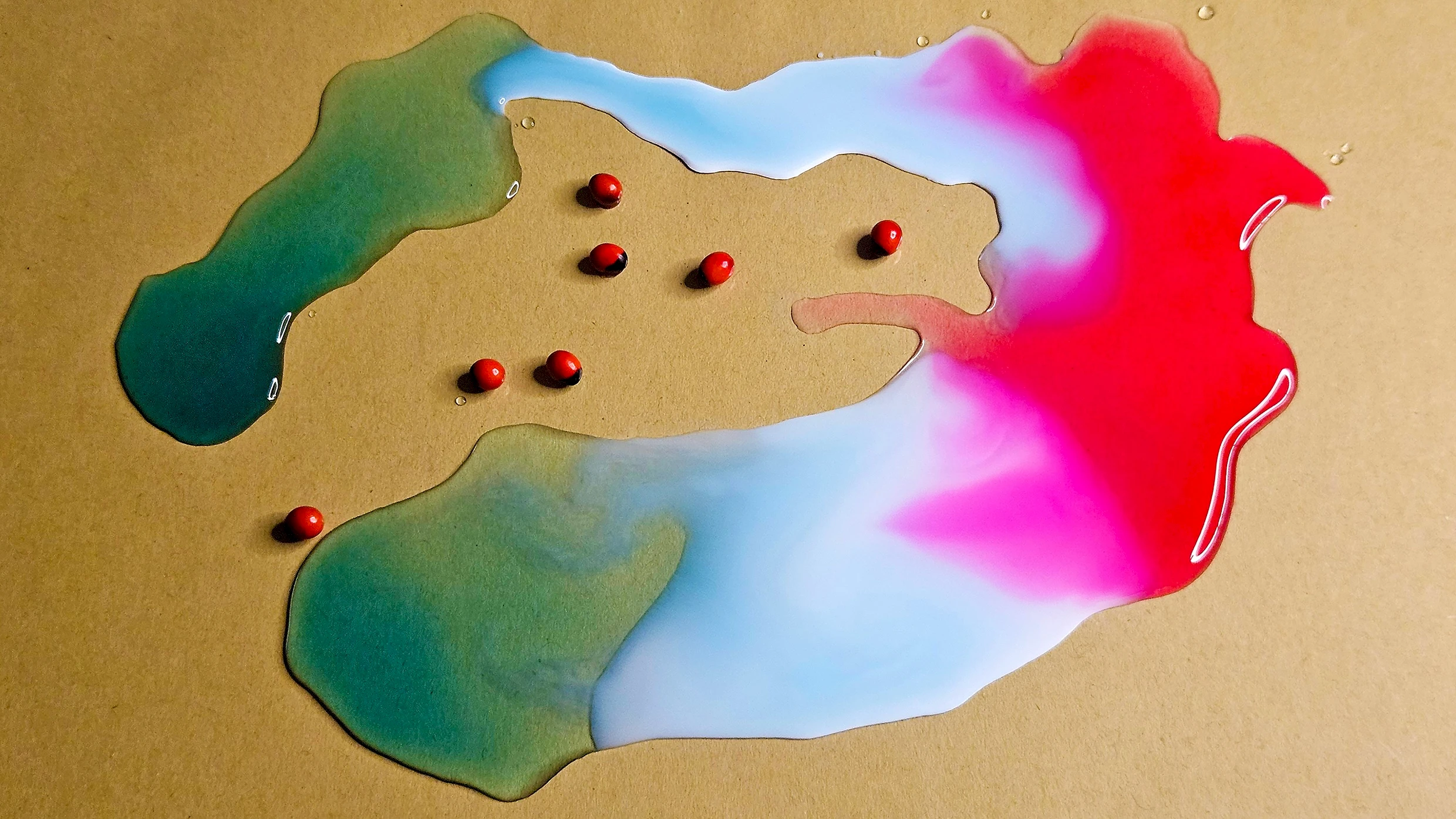
Keywa Henri, « French Guiana », photographie, 2025
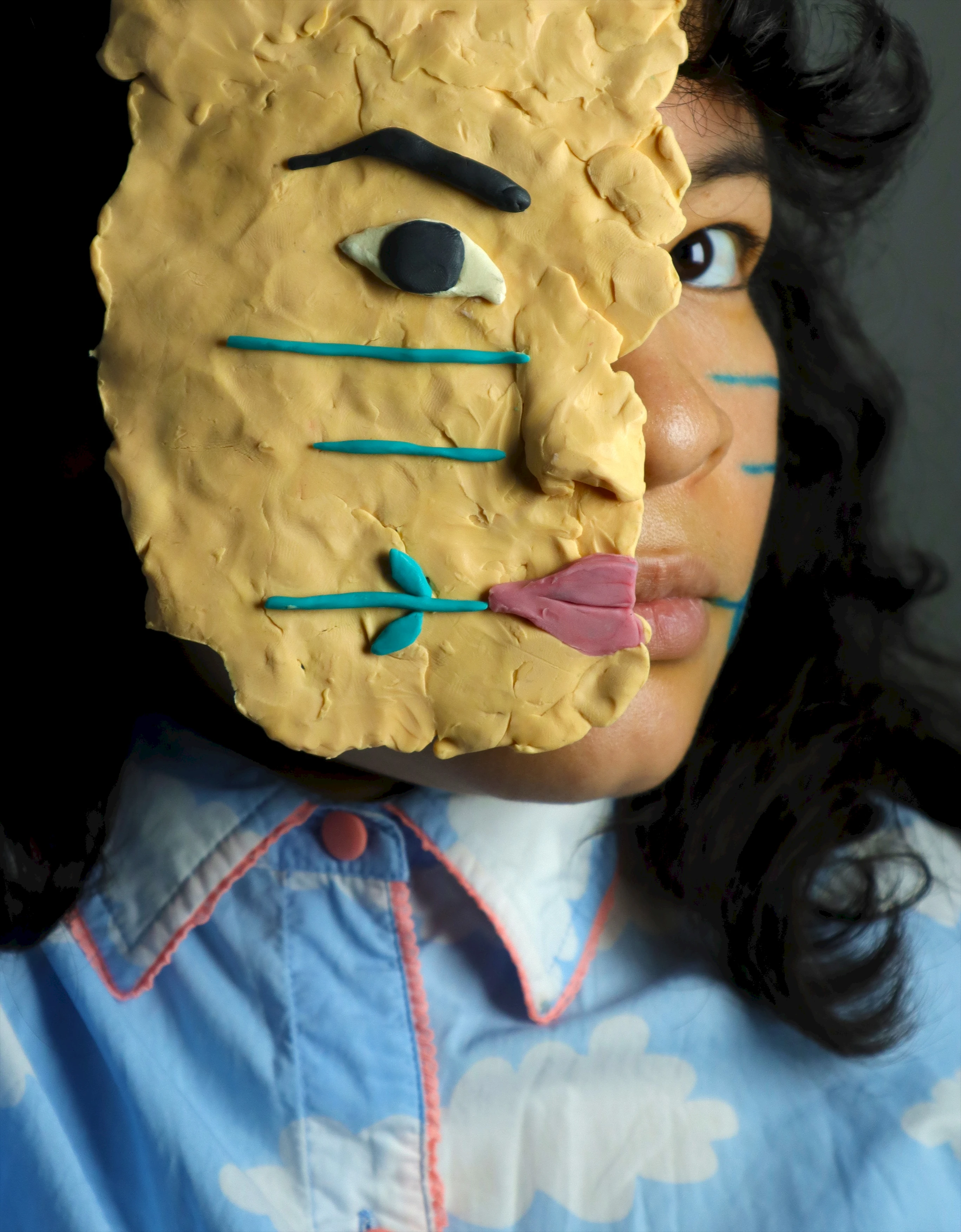
Keywa Henri, Portrait, 2025
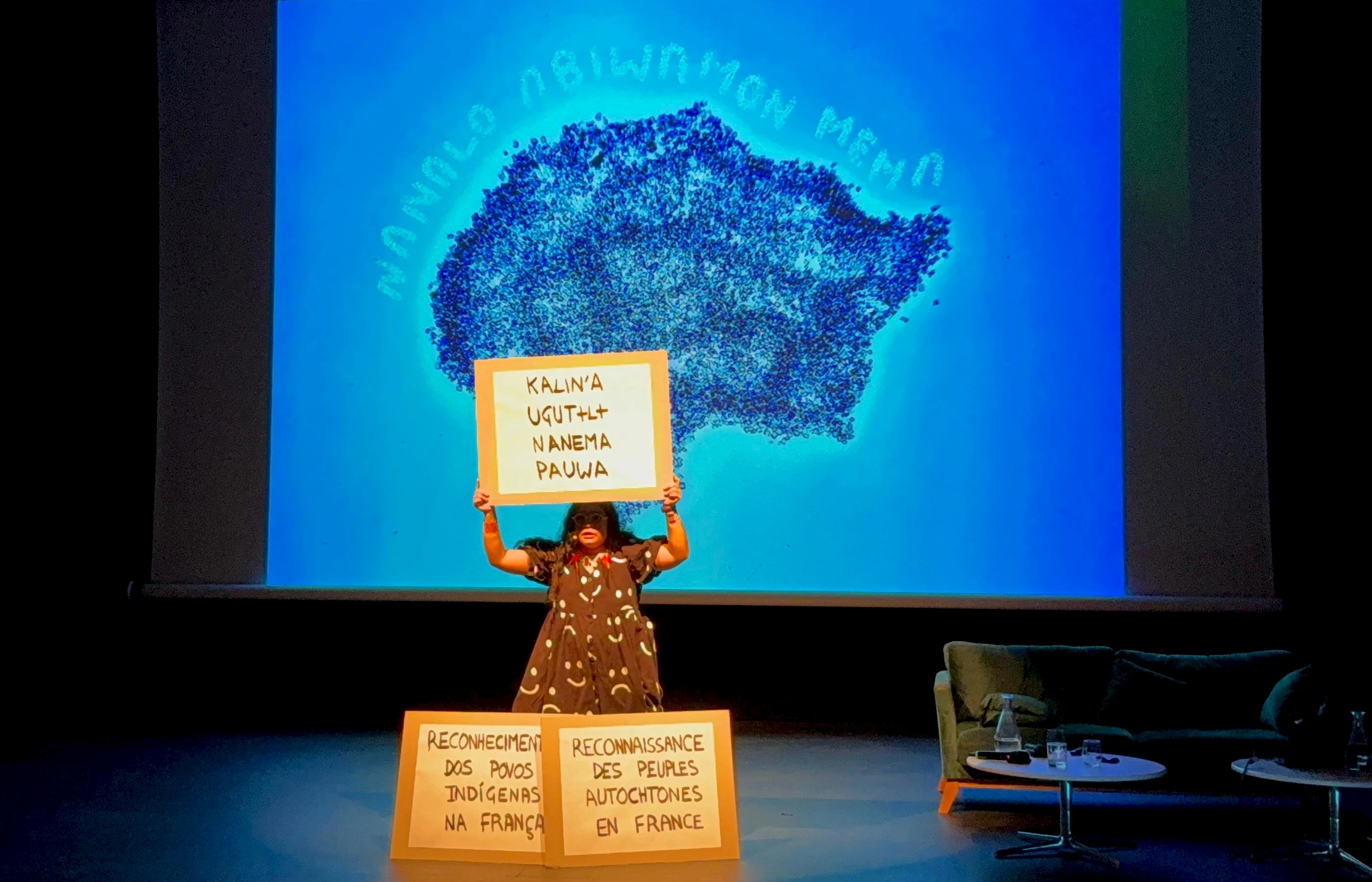
Keywa Henri, Nanalo Abiwanon méma (Nous sommes la réponse), performance, Musée des Confluences de Lyon, 2025
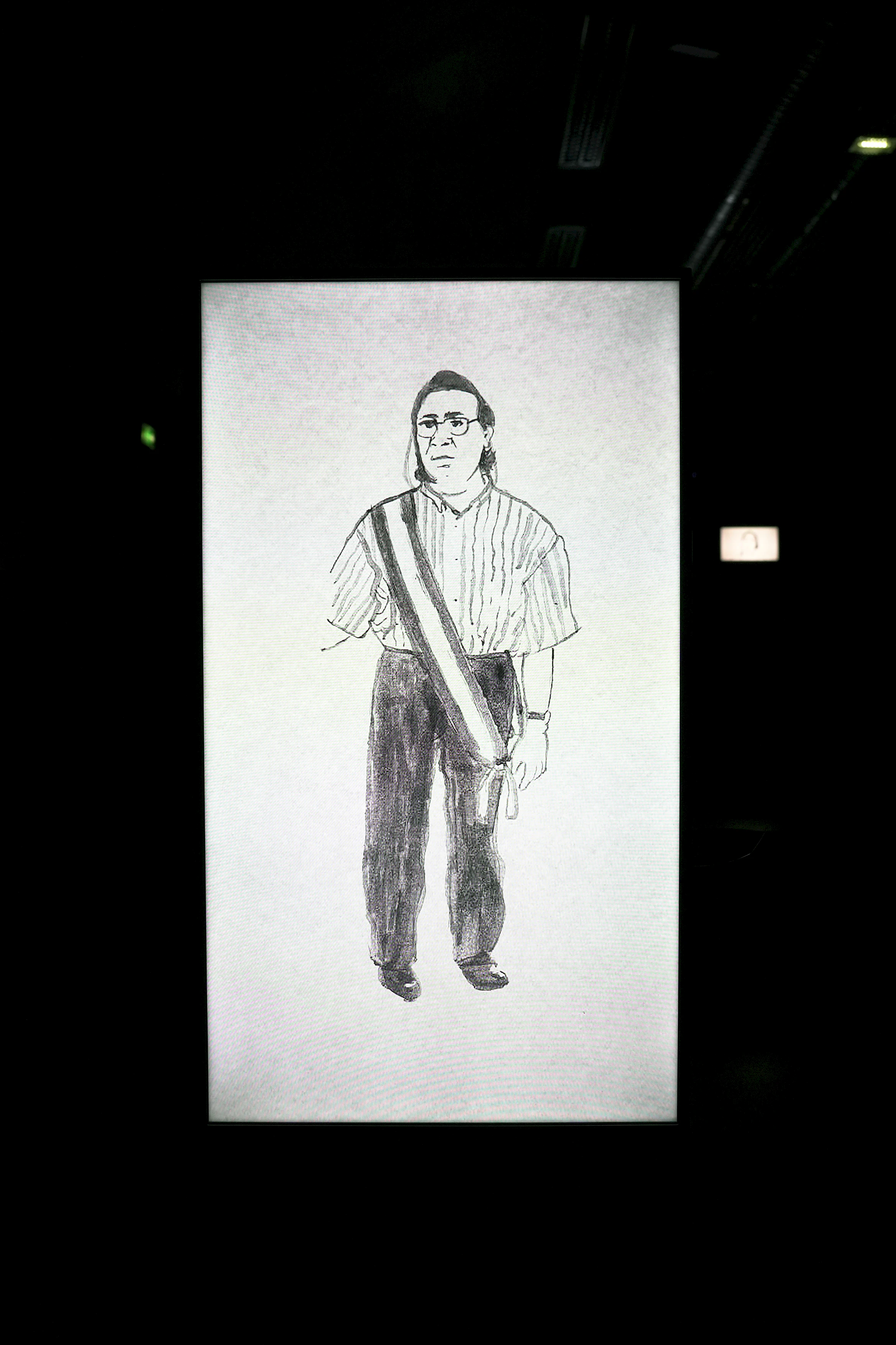
Keywa Henri, Atonin Winion (THROUGH), installation, Vue d'exposition, 2022. Un portrait dessiné à l'encre de genipa, provenant des archives du père de Keywa Henri, Paul Henri, initiateur des mouvements indigènes des années 80 en Guyane française
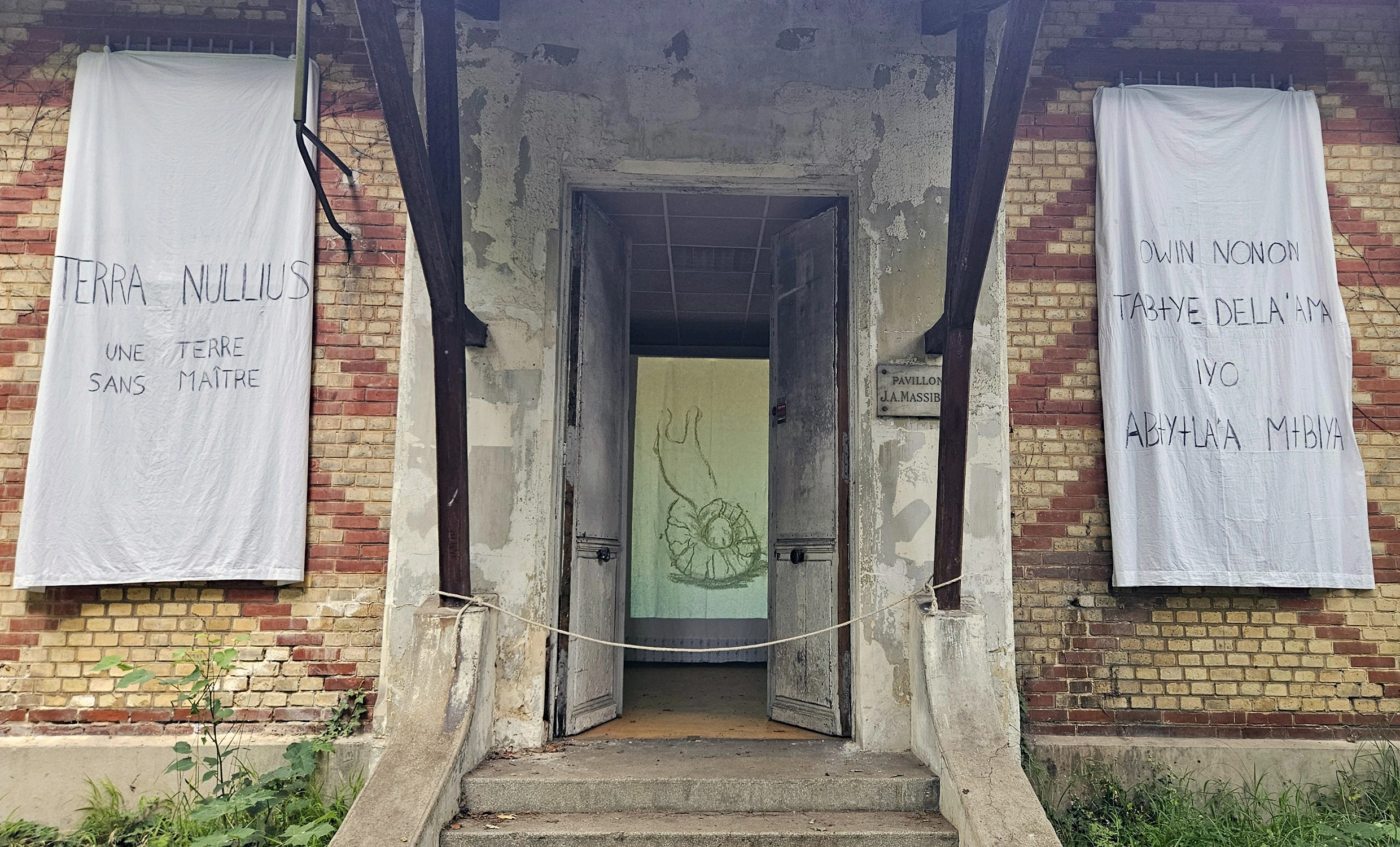
Keywa Henri, Yatɨ ayatɨ enaha moloma (Ma maison est ta maison), installation, vue de l'exposition au Jardin d'Agronomie Tropicale de Vincennes - ancien pavillon colonial de la Guyane française, 2025
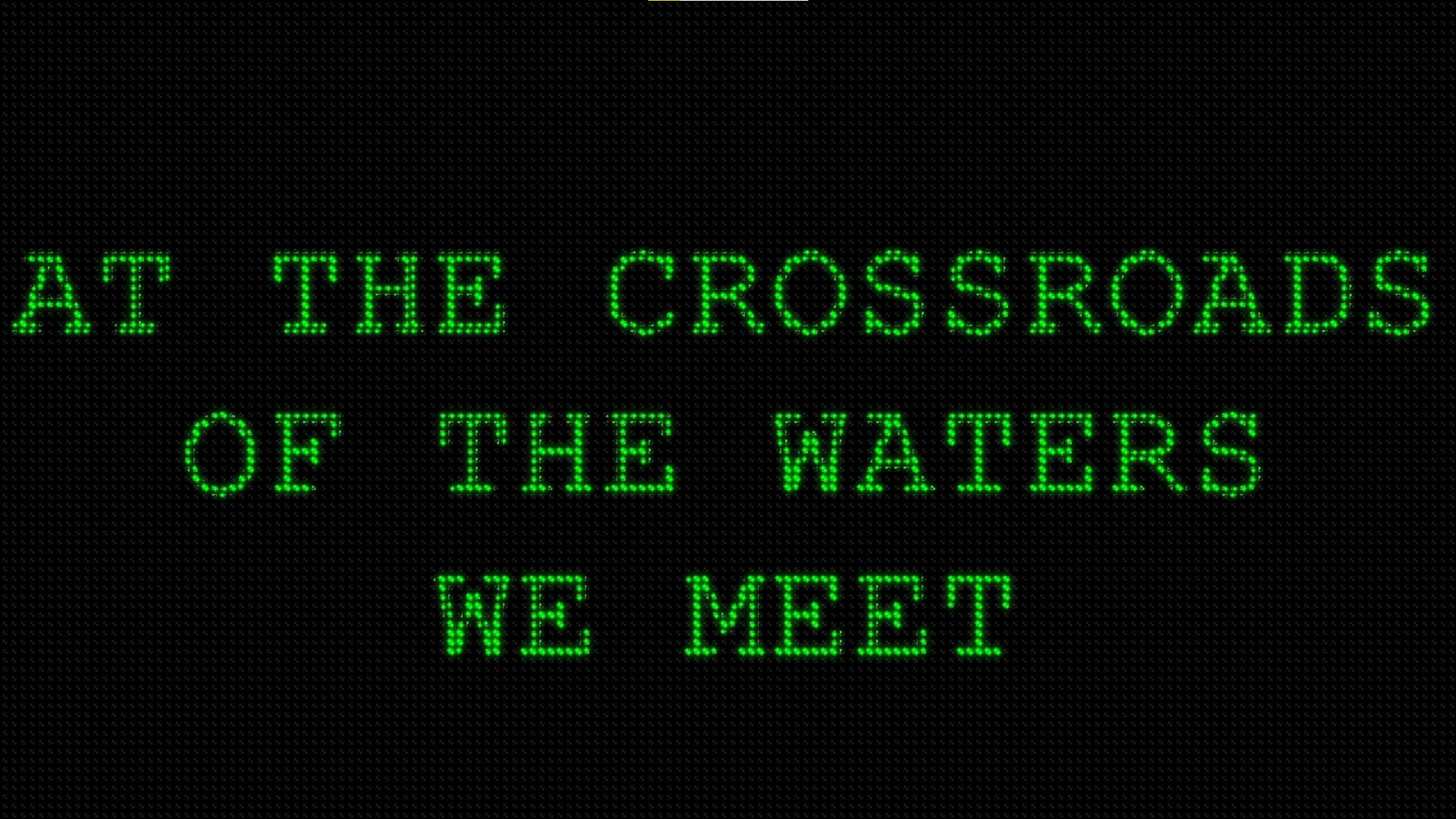
Keywa Henri, EKALITIO AGAIN (Je te le dis encore), installation, 2024
Related contributions and publications
-
Climate Forum IV – Readings
Merve BedirLand RelationsHDK-Valand -
Decolonial aesthesis: weaving each other
Charles Esche, Rolando Vázquez, Teresa Cos RebolloLand RelationsClimate -
Climate Forum I – Readings
Nkule MabasoEN esLand RelationsClimateHDK-Valand -
…and the Earth along. Tales about the making, remaking and unmaking of the world.
Martin PogačarLand RelationsClimatePast in the Present -
Art for Radical Ecologies Manifesto
Institute of Radical ImaginationLand RelationsClimateInstitute of Radical Imagination -
Ecologising Museums
Land Relations -
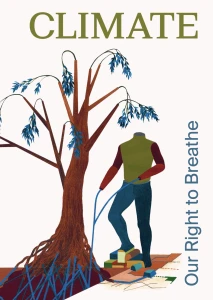
Climate: Our Right to Breathe
Land RelationsClimate
Related activities
-
HDK-Valand
Climate Forum IV
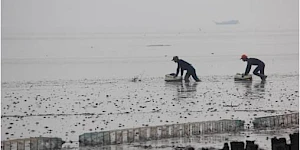
The Climate Forum is a series of online meetings hosted by HDK-Valand within L’Internationale’s Museum of the Commons programme. The series builds upon earlier research resulting in the (2022) book Climate: Our Right to Breathe and reaches toward emerging change practices.
-
HDK-Valand
Climate Forum I
The Climate Forum is a space of dialogue and exchange with respect to the concrete operational practices being implemented within the art field in response to climate change and ecological degradation. This is the first in a series of meetings hosted by HDK-Valand within L'Internationale's Museum of the Commons programme.
-
–Van Abbemuseum
The Soils Project
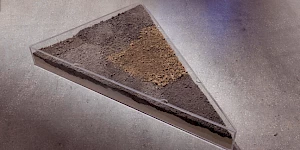
‘The Soils Project’ is part of an eponymous, long-term research initiative involving TarraWarra Museum of Art (Wurundjeri Country, Australia), the Van Abbemuseum (Eindhoven, Netherlands) and Struggles for Sovereignty, a collective based in Yogyakarta, Indonesia. It works through specific and situated practices that consider soil, as both metaphor and matter.
Seeking and facilitating opportunities to listen to diverse voices and perspectives around notions of caring for land, soil and sovereign territories, the project has been in development since 2018. An international collaboration between three organisations, and several artists, curators, writers and activists, it has manifested in various iterations over several years. The group exhibition ‘Soils’ at the Van Abbemuseum is part of Museum of the Commons. -
–tranzit.ro
Non-Western Technologies for the Good Life
The experimental course ‘Non-Western Technologies for the Good Life’ (November 2023–May 2024) celebrates as its starting point the anniversary of 50 years since the publication of Tools for Conviviality, considering that Ivan Illich’s call is as relevant as ever.
-
–Institute of Radical Imagination
Gathering into the Maelstrom
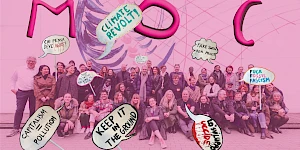
‘Gathering into the Maelstrom’ in Venice at Sale Docks is a four-day programme curated by Institute of Radical Imagination (IRI) and Sale Docks.
-
–Institute of Radical Imagination
Gathering into the Maelstrom (exhibition)
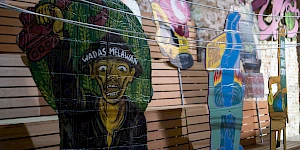
‘Gathering into the Maelstrom’ is curated by Institute of Radical Imagination and Sale Docks within the framework of Museum of the Commons.
-
HDK-Valand
Climate Forum II
The Climate Forum is a series of online meetings hosted by HDK-Valand within L’Internationale’s Museum of the Commons programme. The series builds upon earlier research resulting in the (2022) book Climate: Our Right to Breathe and reaches toward emerging change practices.