Re-worlding Comradeship: Summoning the Anti-Anti-Communist Interpellation
Within the context of the first iteration of the School of Common Knowledge (2024) Ovidiu Țichindeleanu explores the construct and history of Comradeship. Țichindeleanu traces Romania–Yugoslav relations in the 1960s and 70s, empahsising inspiring examples of peer to peer practices during the time as a countermove to 'Anti-Communist Interpellation'.
From 1989 to this moment in 2026, every single day of the new public sphere and newly produced culture industry of postsocialism has been subject to the anti-communist interpellation. Far from enacting some form of social justice after totalitarian abuses, the anti-communist interpellation has imposed, during this rare historical experience of a general change of paradigm, a new dominant background for thoughts, a ramp for getting onto stages and a turnstile into institutions. The power of the anti-communist interpellation has been such that by now there is no need for conceptual definitions and regular phrases with subjects and predicates in order to convey its meaning. One answers spontaneously to the interpellation: Who, me? Yes: grey, totalitarianism, oppressive, the East, failure, bankruptcy, grey, the past, poverty, inefficient, socialism, backward, evil, repressive, Gulag, irrelevant, unlike the West. The anti-communist interpellation has been essential for the aesthesis of postsocialist thought, both in the former Socialist bloc of Eastern Europe, and for the Western and Westernized understanding of the West.
Every now and then, the interpellation also elicits spontaneous retorts in the East. Usually, they take the overcompensating form of overreaching attempts to impose old symbols, without the support of either critical thought or critical mass. In spite of what they may think of themselves, such attempts remain under the sign of the anti-communist interpellation. To the slow and systematic violence of the latter, they can only respond with rash and random violence. A different critical way is needed in order to avoid both oblivion and infatuation.
Only the movement of another aesthesis of thought would be able to break this binding spell. Such a movement would have to be fostered first in the international space of the former Socialist bloc of Eastern Europe. Rekindling comradeship and regional internationalism, unmediated by centres, is key. But first, one has to articulate and rearticulate the anti-anti-communist interpellation:
Hey you,
gardener of dreams,
assorted radical leftist,visionary cultural worker,
centrist opponent of fascismor proficient navigator of the corridors of big buildings who has realized things have to change,
hey all of you,
when we’ll decide to rebuild from what we have
after all the theft and wars,
after seeing we are left with more and more devaluation and destruction after so much capital injection,
when we’ll have to scour through our own historical experience for seeds and resources,
well then, you there,what were the undercurrent visions and ideologies of the socialism of the future,
the emergent, tentative, critical, burgeoning, experimental fields and tendencies that could still be?In economics, politics, and other domains shaping values?
The internal differentiations, the moments of immanent causation, the conscious living contradictions that still are?The groups of affinity in solidarity across peripheries that are still felt and found,
the allied layers of the emergent social formation that are still producing and becoming?
And when we will have relearned all these and more,
the plentiful concrete that has been ignored and discarded,
the grey Archimedean matter,
in whose companionship will we find ourselves?
What comradeship will we be able to affect, support, engage?
Ceaușescu and Tito: Re-learning comradeship from an unlikely source
One of the most obvious de- and re-significations of postsocialism is that of the word ‘comrade’ and its local versions and derivates. Since 1989, not only has the common form of address ‘comrade’ (in Romanian: tovarăş; masc. tovarăşul, fem. tovarăşa) stopped being used seriously in the public sphere, but so have the related verbs. The postsocialist journalists, intellectuals and politicians who redefined the Romanian public space and culture industry after 1989 have pointedly returned to the more hierarchical ‘sir’ as a form of address (domn, domnule, doamnă), while relegating the use of ‘comrade’ to exclusively derogatory or ironic expressions. The work of re-signification went as far as explicitly revaluing ‘the elite’, the high society of domni and doamne, as the real carriers of the true values of society (as opposed to the uncivilized plebes), and even super-valuing the diasporic descendants of boyars who returned after 1989. Such is the prominent case of Neagu Djuvara, who became an authoritative voice re-narrating the history of Romania.1 The single serious exception to the new rule has been the use with caps of Tovarăşul and Tovarăşa to refer seriously, without naming them, to Nicolae Ceaușescu and Elena Ceaușescu, respectively. Outside the public sphere, in the vernacular of informal groups, the words tovarăşul and tovarăşa have remained in sporadic use, in a non-ironic and earnest sense. However, an important verb such as întovărăşire, meaning the process of comradeship, or the process of becoming comrades in a social way, before any Party-related connotation, has practically disappeared from common use. This disappearance from speech acts is contemporary with the growing divide between the newly rich and the newly poor of postsocialism, and with the social fragmentation produced by the postsocialist mass migration of the East European labour force towards the West.
The verb întovărăşire points to a fundamental sense of comradeship: the forming of social bonds outside the nuclear family, which in turn gives both meaning and immanent forms of agency to society. In order to heal and to transform the postsocialist transition, which has been objectively defined by social fragmentation, by the decomposition of popular agency, one has to commit to the practical and emotional work of becoming comrades (întovărăşirea), of regaining a common sense of comradeship.
In the historical experience of real socialism, the process of establishing comradeship was undoubtedly dominated and re-signified by the Communist Party. Party members were the first comrades. More generally, at the level of the societies ruled by the communist parties, comradeship took the particular sense of the collective politicization of the lower classes of workers and peasants who became members of the Party. A comrade was not only an isolated individual with acute political awareness of the man-made nature of their social and material condition, but a person associated with companions in the struggle to overcome these material conditions, social hierarchies and divides. Through class struggle, the newly emerging socialist society was to be emancipated from historical forms of exploitation and oppression in the local process of transition from capitalism to socialism. The new society was supposed to be a society composed of comrades, rather than one ruled by kings or boyars, or by the elites of the bourgeois middle class. Likewise, externally, the socialist countries were supposed to be united in comradeship with other socialist countries, as well as with all the peoples who were emerging from the self-emancipatory movements of national liberation, overcoming historical forms of colonial, capitalist and imperialist oppression and exploitation, even if they were choosing to follow paths of development and social orders other than socialism.
In other words, comradeship was both the basis and end-point of class consciousness, solidarity and internationalism. However, in real life, the process of comradeship took hard work and had to overcome conflicts and to deal with external and internal pressures. The intentional character of diplomatic statements of friendship and cooperation (‘we want to become friends’) was not enough, and in order to become real comradeship it had to be confirmed by spontaneous affinity. Such is the case of the long-term comradeship developed and maintained between Yugoslavia and Socialist Romania, seeping all the way to the individual figureheads Iosip Broz Tito and Nicolae Ceaușescu.
To begin with, after the end of World War II, Romania had joined the public denunciations of Yugoslavia’s ‘deviationism’ made by the leadership of the USSR. Tito refused to come to the Bucharest Cominform meeting of the East European communists in the summer of 1948. The relations between neighbours were at an all-time low. Bucharest accused Tito not only of being a tool of the Western imperialists, but also of fomenting ethno-nationalist trouble in the south-western Romanian region of Banat. The aggressive language of reciprocal accusations intensified, particularly after Tito decided to get economic assistance from the United States. The split became so grave that the Romania–Yugoslavia and Hungary–Yugoslavia borders were consolidated with military fortifications. Tito’s suspicions were all but confirmed when a coup d’état led by the Montenegrin general Arso Jovanović, with the support of the Soviets and the complicity of Romanians, was foiled. The opposing Radio Free Yugoslavia continued to air from Bucharest. However, things radically changed after Stalin’s death in 1953, after the Belgrade Declaration of 1955, signed by Tito and Khrushchev, and in the context of the definitive retreat of Soviet troops from Romania, which was to be completed in July 1958.
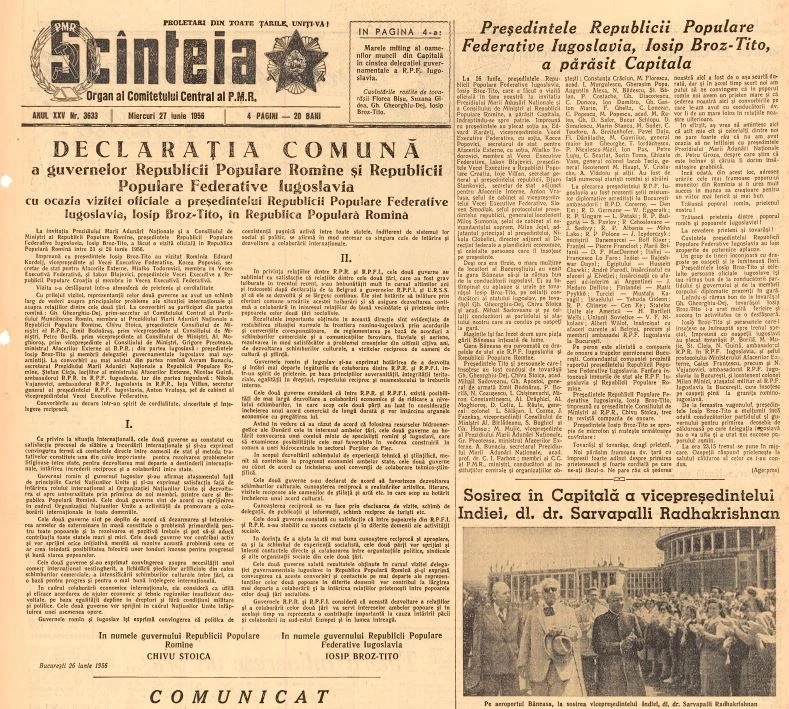
Tito's visit to Bucharest, Scinteia, 27 June 1956, personal archive
Thus, in the summer of 1956, Tito returned by train from Moscow and stopped in Bucharest for his first post-war visit to Romania. He was welcomed with official pomp by the leadership of the Romanian Workers Party and by an enormous mass of enthusiastic people. The visit was concluded with a ‘Common Declaration’ of the governments of the two countries.2 In the Declaration, the members of the two governments already announced the beginning of common works on the massive hydroelectric power plants at the Iron Gates on the Danube, as well as a vast programme of joint diplomatic work and economic and cultural exchanges.
By the end of the same year, the rapprochement was in full swing. Orizonturi,3 the Romanian Internationalist monthly literary magazine, published an issue on Yugoslavia in November. Literary and theory translations from Ivo Andrić and Zoran Markus were accompanied by a comprehensive collective report, written by Romanian and Yugoslav authors, on the self-managed communal leadership of the Yugoslav city of Smederovo. The public presentation of the latter would have been unthinkable just a few years earlier, but now the self-management of the factories of Smederovo and the self-managed administration of the city, integrated with its connected villages through a locally chosen popular council, were explicitly presented as a direct and innovating continuation of the principles of the Commune of Paris regarding the autonomy of workers. The vice-president of the Yugoslav government, Eduard Kardelj, was quoted saying that the system of communal self-management, ‘albeit controversial in the Socialist bloc, is the best mechanism to ensure the direct participation of citizens to social leadership’.4 Remarkably, none of this direct participation required membership of the Communist Party. The collective of Romanian and Yugoslav authors of the report (major poet Nina Cassian among them) conducted in-depth interviews with the locals and emphasized in conclusion the distinct nature of the Yugoslav path of ‘transition to socialism’. The distinct characteristic of the latter was that the self-management of factory workers and of cooperatives guaranteed the democratic nature of the political process of the transition.
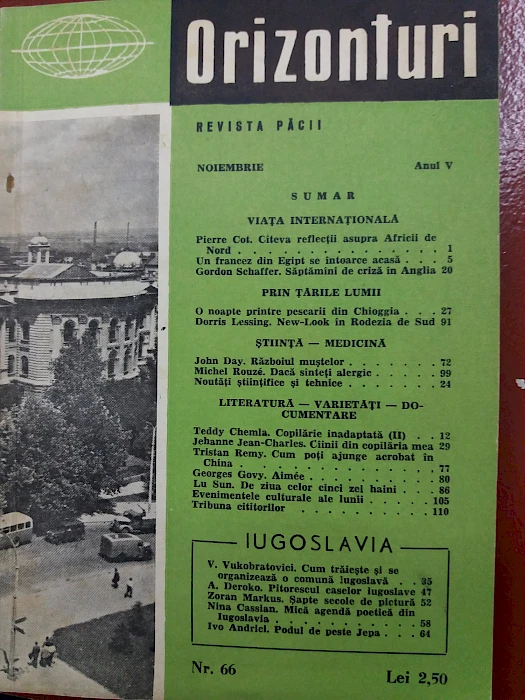
Orizonturi, nr. 66, November 1956, personal archive
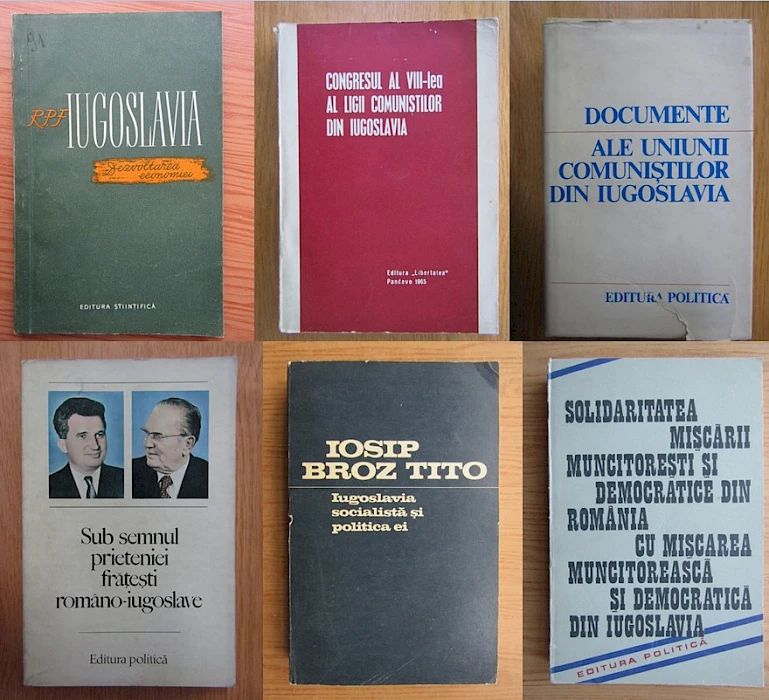
Publications in Romanian of Yugoslav Political Theory 1956-1982, personal archive
Thus, what these authors were able to say and to make visible through their collective voice and comradeship was already beyond the possibilities that each had in their internal public sphere, as well as in their respective international relations to the USSR. To give an idea of the flight of radical imagination that was fuelled by this ongoing process of creating peer-to-peer comradeship, the same issue of Orizonturi was publishing translations into Romanian from contemporary Chinese literature, as well as anti-colonial and anti-racist political reports about Southern Rhodesia – the future Zimbabwe, whose movement for national liberation was to be later supported militarily and diplomatically by Socialist Romania. However, only in the peer-to-peer collaboration between the Romanian and Yugoslav comrades was it possible to have such a discussion about autonomy and the different paths taken in the spirit of the Paris Commune, which could even implicitly bypass the Bolshevik Revolution.
Tito’s visit to Bucharest (24 – 27 June 1956) had followed the massive success of Kim Ir Sen’s visit (13 – 17 June) and was to be followed by the secret but highly consequential visit of Nikita Khrushchev to Bucharest in November the same year, to coordinate the repressive response to the social movements of the Hungarian Revolution and to the associated protests of the Romanian students. However, the reciprocal reliance and comradeship between Yugoslavia and Socialist Romania continued to be sowed in autonomous terms, outside the influence of the Soviet Union, until the 1980s.
From the late 1950s, the orientation of Socialist Romania’s foreign policy clearly aligned with the anti-colonial struggles of the ‘decade of decolonization’, particularly after the Bandung Conference (1955) and the consequent founding of the Non-Aligned Movement in Belgrade (1961). This was a time of relentless struggles for national liberation, countered by the military aggression of the Western colonial powers: the Netherlands in Indonesia (1945–49); France in ‘Indochine’ (1946–54) and Algeria (1954–62); the UK in Kenya (1952–60); Belgium in Congo (1960–65); Portugal in Angola, Guinea-Bissau and Mozambique (1961–74); the USA in Vietnam (1955–73), Laos (1955–75) and the Dominican Republic (until 1966). During this time, Romania started to take a distinct position within the Socialist bloc, inspired by the movements of decolonization and national liberation, as well as by the comradeship with non-aligned Yugoslavia and with communist China. After Chairman Liu Shaoqi’s open criticism of the grave mistakes committed in the ‘Great Leap Forward’ in 1961 and the consequent 1962 ‘Conference of the Seven Thousand Cadres’ in Beijing, which announced the reforms led by Deng Xiaoping, thus preparing the path for the formulation of a ‘Socialism with Chinese Characteristics’ two decades later, Romania’s leadership looked with interest to the changes and then supported China’s position in the Sino-Soviet split, even if it could not undersign Beijing’s harsh denunciation of the USSR’s policies in the Global South as ‘social imperialism’.
As the split heated up with the exchange of open letters between Moscow and Beijing during 1963–64, the collective leadership of the Romanian Workers Party organized a spontaneous visit to China, North Korea and the USSR in spring 1964, and upon returning to Bucharest they published in all the relevant languages the Declaration of April 1964 by the Romanian Workers Party. This remarkable collectively authored document defined the orientation of Romania’s foreign policy and international political economy to also be pursued by Nicolae Ceaușescu after his coming to power one year later.5 While supporting the just right to defence of the anti-colonial and national liberation struggles, and the ‘common anti-imperialist front of the socialist countries and the peoples fighting for national liberation’, the overarching principle of the foreign policy was defined as the ‘peaceful coexistence between different social orders’.6 Peaceful coexistence referred not only to the absence of war, but to the pursuit of cultural and economic exchanges, as well as the development of internationalism in the spirit of solidarity and friendship among peoples. The key expression ‘different social orders’ applied not only to the main contradiction between the socialist and the imperialist-capitalist blocs, but also to the differences between the socialist countries and the non-aligned states that did not choose socialism, as well as to the differences within the Socialist bloc itself. Thus, the collective voice of the Romanian leadership argued explicitly against the Soviet-led project to re-organize COMECON, the common market of the Socialist bloc, into one single organism of centralized planning. Underlining that, in practice, COMECON did not even include all the existing socialist countries (Yugoslavia and China were not part of it), the Romanians argued that Lenin’s theoretical vision of the inevitable tendency towards the creation of one ‘general plan’ and one ‘unified economy’ of world socialism would only become relevant after the future global victory of socialism, and thus it was not applicable to the political situation of the present. They repeatedly referred to the ‘diversity of the characteristics’ of each state and cunningly invoked Lenin’s own reflections about the ‘enormous abundance and diversity of the forms, methods and paths of application of the general laws of socialism, which will inevitably grow as more peoples and countries will enter the revolutionary process.’7
The diversity could only be appreciated through the process of comradeship, of becoming comrades, practised in peer-to-peer relations at the periphery, outside the decision centres of the superpowers.

Tito's visit to Bucharest 1969, TV Newsreel capture, Romanian National Television, personal archive
This was the context of Ceaușescu’s coming to power in 1965 and of the first official meeting of his team with Tito and his delegation in April 1966 in Bucharest. Ceaușescu started the discussions by expressing the desire of the Romanian leadership to ‘develop the relationships with Yugoslavia across all the domains of activity.’8 He then presented the internal economic situation of Romania, including some problems with the work of industrial planning and with the intellectual class, and gave concrete details (numbers) of the ongoing economic plan, both good and bad. Tito then presented a generous synthesis of the economic history of Yugoslavia after World War II, including mistakes made under his leadership, such as the excessive loans taken from the Western world, grandiose monuments, the excessive construction of factories in each of the six republics, and insufficient development of transportation infrastructure. Tito then detailed the principles of the economic reforms of ‘market socialism’ adopted in 1965, and likewise gave concrete details about agricultural and industrial production. The second day was dedicated to international politics. This time, Tito began, offering his personal evaluation, after visits and meetings, of the state of Yugoslav relations with Ghana, Algeria, Guinea, Egypt and Syria (the United Arab Republic), Yemen, Morocco, Congo, Uganda, Ethiopia, Sudan, Indonesia, and Vietnam. After a break, Tito continued, presenting the state of Yugoslavia’s relations with the European countries: Italy, France, England, Belgium, Switzerland and the Federal Republic of Germany, as well as the Eastern bloc of Czechoslovakia, Hungary, the German Democratic Republic and Poland. He then presented Yugoslavia’s relations with the Soviet Union and the United States, before moving on to his personal experiences as well as official relations with Brazil, Bolivia, Chile, Peru and Mexico. Tito ended by sharing the personal conversation he had had with US president John F. Kennedy in October 1963, a month before his assassination. In turn, Ceaușescu presented Romania’s state of relations with the United Arab Republic and Algeria, moving then to Burma, Pakistan and Indonesia. He shortly turned to the state of Romania’s relations with France, England, Belgium, Netherlands and the Federal Republic of Germany, as well as Brazil and Argentina. From the Socialist bloc, he underlined that Romania’s relations with the Soviet Union were in a process of mending, while its relations with everywhere else were good – particularly China, despite their strong disagreements. He then followed up with a presentation of the internal discussions of COMECON, of which Yugoslavia was not a part, and of the special relations and support given to Vietnam. The only disagreements they noted were in relation to their analyses of the situation in China and in Indonesia.
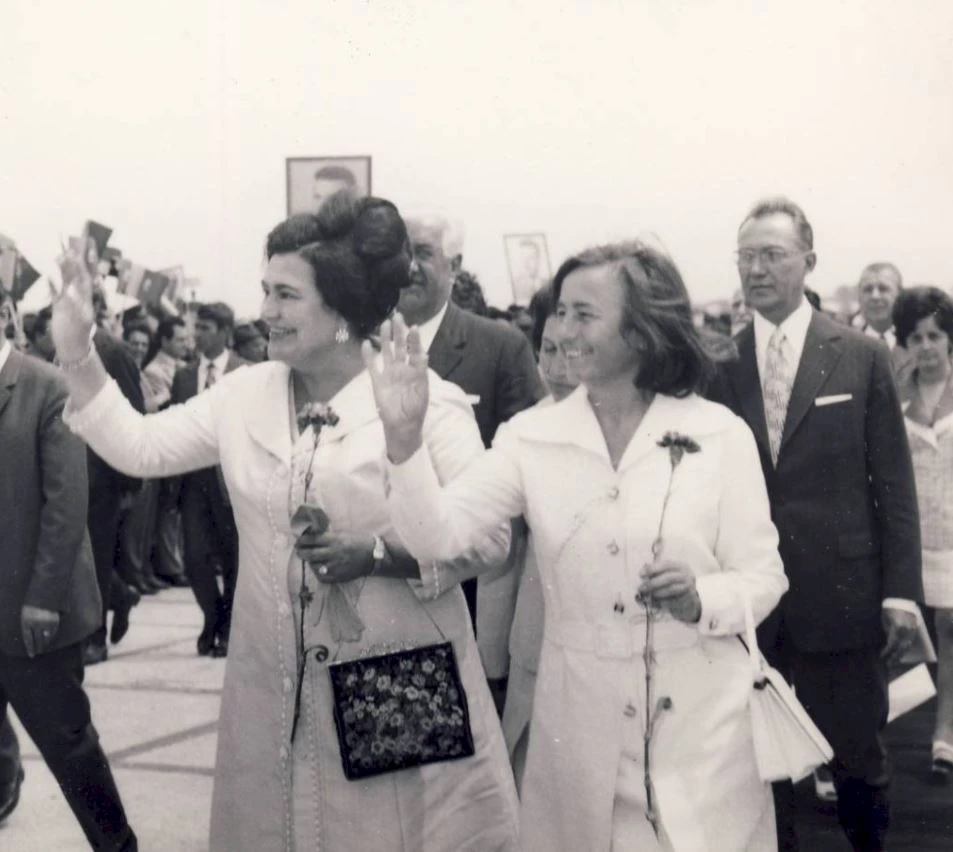
Jovanka Broz and Elena Ceaușescu, Neptun, 1974, personal archive
This summary of this first encounter is important in order to understand the level of sharing that took place during these meetings. The practice of providing honest accounts, sharing information to which only one part was privy, and sharing personal experiences of visits and meetings was to be continued throughout the next fourteen years, until Tito’s passing in 1980. The Romanian and Yugoslav parties quickly realized that through comradeship they could both develop new potential. Both Yugoslavia and Romania had about twenty million people, relatively similar levels of economic development (though Yugoslavia was ahead in industry) and a common energy base on the Danube; they had access to different constituencies and could support and complement each other. Unlike Romania, Yugoslavia was not part of COMECON and the Warsaw Treaty, but it did not have to be. Romania was not a member of the Non-Aligned Movement, but it did not have to be in order to pursue its own non-aligned policies. As becomes increasingly clear from the recorded stenograms of their meetings, both Tito and Ceaușescu realized they needed each other, and they came to rely on each other, developing a close relationship over the years. From April 1966 to November 1979, they organized no fewer than fifteen such close meetings in Romania and Yugoslavia. They met in Bucharest, Belgrade and various other cities, but also in resorts in the mountains and at the seaside, sharing successes and disappointments. Together, they developed a consistent international politics based on the new-found agency of ‘small and mid-size states’, as Romania and Yugoslavia both were, together with most of the more than fifty states that emerged from the struggles of anti-colonial national liberation. The process of comradeship was extended in the public sphere, where, besides the innumerable translations of literary works, Romania constantly published the political writings of the communist leadership of Yugoslavia, including original documents and studies on cases of self-management.9
These two toxic hardmen, undisputed patriarchs of authoritarian regimes at the top of modern state-formations, undoubtedly realized that they needed each other and that formal comradeship needed warmth. They had to foment a process of comradeship, of collective political becoming (întovărăşire) that was also personal. The process of comradeship started before their proper encounter, with social and political conditions set in place by the international and regional developments of the 1950s and early 1960s, but it did become personal. As opposed to liberal democracy, which has provided no model for conducting international politics based on genuine relationships, the East European Socialist bloc in this case provides a model of international politics based on real long-term friendship.
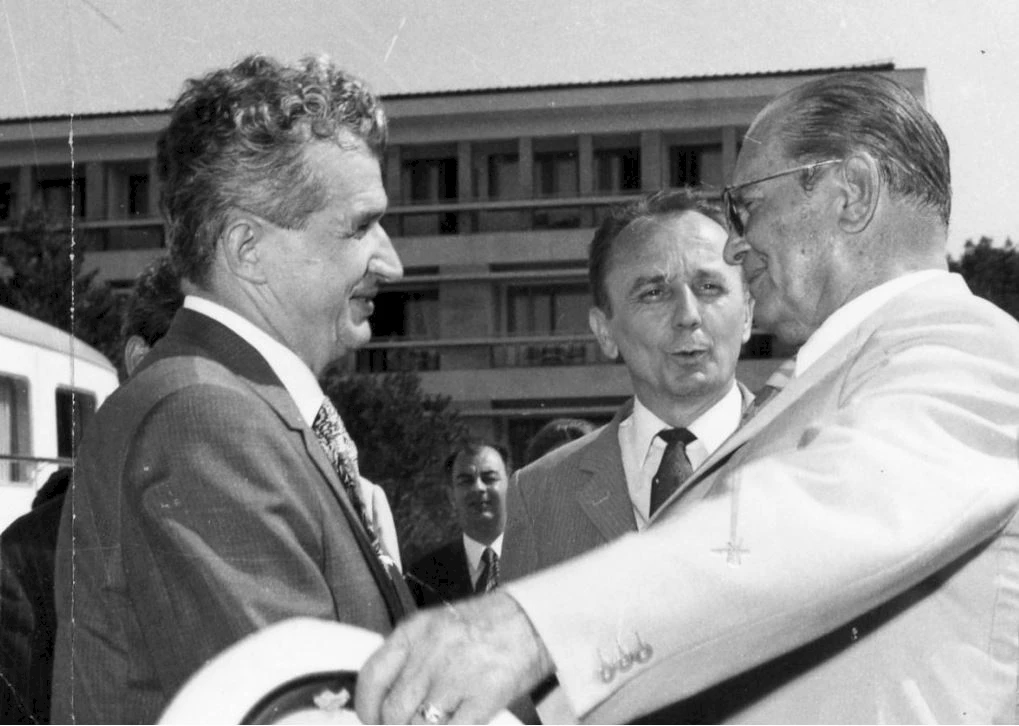
Ceaușescu meets Tito, 1973, personal archive
In their final meeting in 1979, a few months before Tito’s death, both agreed that the level of political and cultural companionship between Romania and Yugoslavia had been impressive and much deeper than the level of economic cooperation, and that ‘much more could and should have been done’. Their purportedly heroic and vertical masculinity proved to be a complex scaffolding supported by reciprocal props. With Tito’s death in 1980, their personal relationship also disappeared, in spite of renewed efforts to forge comradeship between the two countries.10 For both constituencies, the 1980s brought the opposite of comradeship: irreversible divides, social fragmentation and isolating austerity.
The fall of the Berlin Wall did break down the famous socialist kiss. After the paradigm shift of 1989, Eastern eyes, minds and bodies reoriented and even physically moved West, forgetting that regional and trans-peripheral comradeship once bestowed collective power and was able to pronounce the distinct difference of this semi-periphery of the world.
Related contributions and publications
-

…and the Earth along. Tales about the making, remaking and unmaking of the world.
Martin PogačarLand RelationsClimatePast in the Present -
The Kitchen, an Introduction to Subversive Film with Nick Aikens, Reem Shilleh and Mohanad Yaqubi
Nick Aikens, Subversive FilmSonic and Cinema CommonslumbungPast in the PresentVan Abbemuseum -

The Repressive Tendency within the European Public Sphere
Ovidiu ŢichindeleanuInternationalismsPast in the Present -
Rewinding Internationalism
InternationalismsVan Abbemuseum -

Glossary of Common Knowledge, Vol. 2
Schools -

Glossary of Common Knowledge
Schools
Related activities
-
–Van Abbemuseum
The Soils Project

‘The Soils Project’ is part of an eponymous, long-term research initiative involving TarraWarra Museum of Art (Wurundjeri Country, Australia), the Van Abbemuseum (Eindhoven, Netherlands) and Struggles for Sovereignty, a collective based in Yogyakarta, Indonesia. It works through specific and situated practices that consider soil, as both metaphor and matter.
Seeking and facilitating opportunities to listen to diverse voices and perspectives around notions of caring for land, soil and sovereign territories, the project has been in development since 2018. An international collaboration between three organisations, and several artists, curators, writers and activists, it has manifested in various iterations over several years. The group exhibition ‘Soils’ at the Van Abbemuseum is part of Museum of the Commons. -
–VCRC
Kyiv Biennial 2023
L’Internationale Confederation is a proud partner of this year’s edition of Kyiv Biennial.
-
–MACBA
Where are the Oases?

PEI OBERT seminar
with Kader Attia, Elvira Dyangani Ose, Max Jorge Hinderer Cruz, Emily Jacir, Achille Mbembe, Sarah Nuttall and Françoise VergèsAn oasis is the potential for life in an adverse environment.
-
MACBA
Anti-imperialism in the 20th century and anti-imperialism today: similarities and differences

PEI OBERT seminar
Lecture by Ramón GrosfoguelIn 1956, countries that were fighting colonialism by freeing themselves from both capitalism and communism dreamed of a third path, one that did not align with or bend to the politics dictated by Washington or Moscow. They held their first conference in Bandung, Indonesia.
-
–Museo Reina Sofia
Team of Teams
This project researches citizen participation as a fundamental pillar in the creation of community.
-
–Van Abbemuseum
Maria Lugones Decolonial Summer School
Recalling Earth: Decoloniality and Demodernity
Course Directors: Prof. Walter Mignolo & Dr. Rolando VázquezRecalling Earth and learning worlds and worlds-making will be the topic of chapter 14th of the María Lugones Summer School that will take place at the Van Abbemuseum in Eindhoven.