Common Knowledges: Thinking about rootedness through food
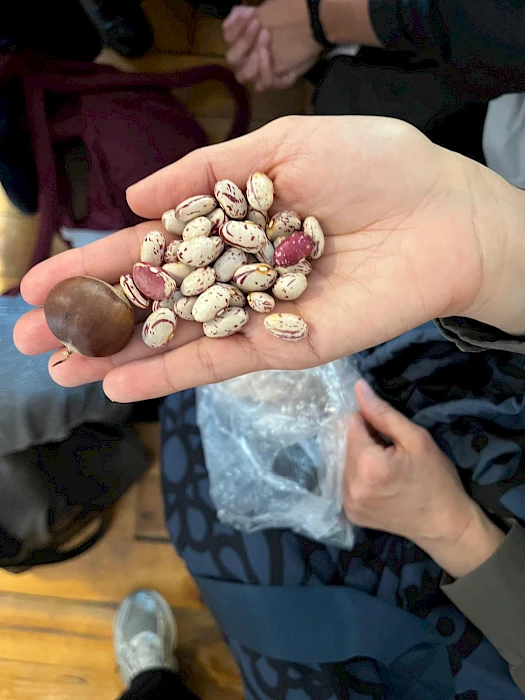
On 12 November 2025, the School of Common Knowledge took place at the Paisanaje headquarters in Madrid. Prior to the workshop, participants were asked to bring a food item from their places of origin that would shape emotional and physical landscapes – territories of memory and rootedness. With these materials, an affective and gastropolitical cartography was designed on a piece of fabric that served as a large tablecloth for the meal that day. All the images included here are of that tablecloth. The following texts reflects on that assembly and the wider project of Paisanaje.
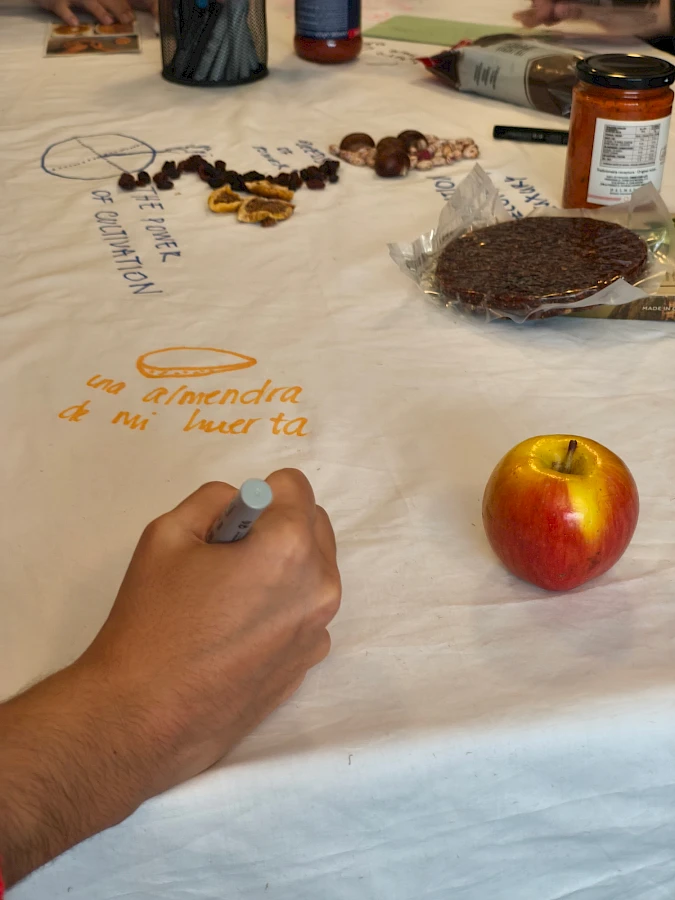
Photo: Paisanaje
El cilantro es un alimento que me vincula con el territorio. En mi pueblo, en el pacífico colombiano, suelen llamarlo cimarrón. Para mí el cilantro no es solo una planta, me conecta un poco más con mi casa, con mi hogar. Cada hojita me lleva a cada sabor de cada preparación de mis ancestros. Es como algo muy conectado al territorio ya que en el pacífico colombiano se usa mucho en el marisco. Se usa para dar sabor al alimento de una manera significativa. Eso hace que se vuelva algo muy importante en las comidas de mi pueblo. El cilantro es caracterizado también como una planta de lucha, una hoja de resistencia, que siempre ha estado ahí a pesar de todas las dificultades. La usamos para la medicina ancestral, la usamos para un té… Conectamos mucho con esa planta y para mí eso es espectacular.
Morgan Ortiz
The sociologist Philip McMichael had been long developing his ideas around the corporate food regime, shaped by the large agrifood corporations and supermarkets that dominate the global production and commercialization of food. As a consequence of the industrialized food system, McMichael started to use the term ‘food from nowhere’1, a concept that evokes a powerful image, one that condenses some of our concerns about food, regimes of visibility, and the production of territory. Food from nowhere arrives at our table thanks to the invisible hand of the market. Food from nowhere appears on the supermarket shelf in a similar way to how the commodity fetish appeared to Marx at the Great Exhibition in London in 1851. Food from nowhere is like modern paintings hung in a white cube. Because the ‘nowhere’ does not only refer to our ignorance about the true geographical origin of what we eat, see and buy; it also alludes to the complex process of deliberate concealment of the terrible consequences of the unlimited availability of all kinds of food, at any time of year, on our tables in the global North.
The point is that it is not only food that appears uprooted in supermarkets. Before they reach our eyes, the goods displayed on counters, in glass cases and on shelves have produced other forms of uprooting in their places of origin. The corporate food regime deploys chains of exploitation and ecological disaster across different territories of the world, especially in the global South, but also in many other souths. Reversing the food-industrial processes of extraction and exploitation would not be as simple as countering food from nowhere with food from somewhere, because rootedness is not a property that can be labelled. Rather, like Morgan’s village cilantro, it articulates a complex web of relations among materials, territory, forms of production, property regimes, food cultures, myths, rituals and spiritualities. It transcends any notion of consumer responsibility and is instead a complex process of cultural mutation – a transformation that begins by recognizing that we, too, are subjects rooted in the land and in our bodies, and that food, the production of nourishment, is what truly sustains us.
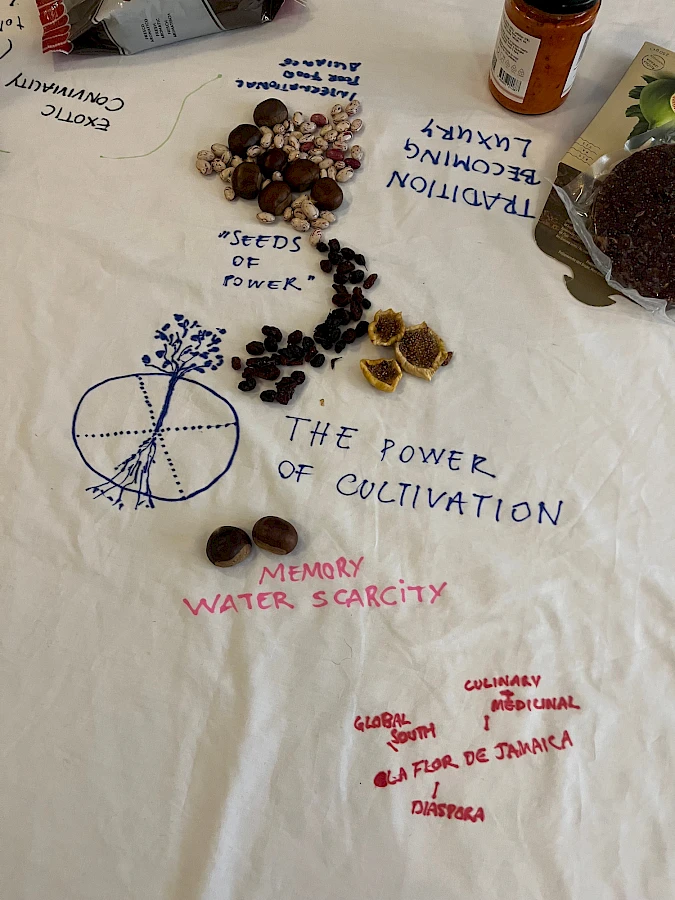
Photo: Paisanaje
When we received the invitation to participate in the autumn 2025 School of Common Knowledge, whose central theme is rootedness, we decided to organize a workshop at our headquarters in Madrid where we have built a space of hospitality for migrant people that coexists with our cultural programme, artist residencies and communal meals. Our proposal was to open our home so that, in times of permanent dispossession and planetary genocide, we could have a conversation about memory and territory through food. Far from any abstract thinking, we wanted our proposal to gather-in common knowledges that have historically been marginalized; situated knowledges that for a long time have been dismissed by academia and have only recently begun to be recognized by some artistic institutions, but which are nonetheless fundamental for sustaining life: care, cooking, food, cultivation.
I brought a small chestnut from the north of Greece, from mountainous landscapes where trees have been growing for centuries. Compared to the large, glossy chestnuts more commonly seen across Europe, this one is modest in size, almost discreet, but dense, sweet, and intensely fragrant. Chestnuts here are not just food. They are seasonal markers, gathered in autumn when the spiny shells split open to reveal the fruit inside. They are eaten roasted on street corners, boiled at home, or slowly folded into sweets. The chestnut carries a texture that is both nutty and soft, almost like a memory you can taste: earthy, slightly smoky, and nourishing. It is a food tied to terrain and endurance, to colder climates and slower rhythms, where cultivation and care stretch back generations.
Marianna Tsionki
Through Marianna’s personal story, the chains of knowledge and memory broken by the corporate food system begin to reconnect, evoking the warmth of a chestnut on a cold winter street. Like Marianna, the other participants in the session brought food to our gathering on common knowledges, to share a part of their own story, irremediably tied to certain bodies and territories. We asked ourselves about the consequences of imperial modes of eating that programme forgetfulness, make worlds invisible, and reconfigure landscapes. And we reflected on rootedness in two directions: in the sense of those who put down roots in a specific geographical place, and also in the sense of those who have been displaced but whose memory returns them to an origin. Knowledges and memories of cultivation, traditional recipes. That combination of memory and affect contained in a bowl of soup or a roasted chestnut.
Foods that produce rootedness differ substantially from those that the food industry promotes as ‘superfoods’, which are healthy and improve the neoliberal version of the ‘self’ that is also self-produced through what it eats, while remaining deeply indifferent to the origins of its sustenance.
Mientras la quinua es promovida en Europa como símbolo de alimentación saludable e incluso de consumo ético y hasta como un gesto ‘político’, en Perú su consumo, debido a los altos precios, es reemplazado por arroz importado de baja calidad, mientras aumentan los precios de los alimentos más nutritivos producidos y consumidos históricamente localmente.
La industria alimentaria, frente a las denuncias contra la agroindustria, los agroquímicos y los transgénicos durante la última década, ha tenido la astucia propia del capitalismo voraz de construir un nuevo mercado basado en la venta de productos ‘sanos’ y ‘superalimentos’ como supuesta solución. Mientras tanto ha acaparado agua, tomado tierras, elevado precios y así aumentado el vacío en el estómago de aquellos pueblos históricamente saqueados para sostener la gula del capital hoy también, a través del mercado de lo saludable.
El éxito macroeconómico del sector agrícola, celebrado mediante cifras siempre crecientes gracias a la nueva industria de los ‘superalimentos’ en el norte global, convive con más del 40 por ciento de anemia infantil en el país. El saqueo agroindustrial no solo implica la toma de tierras y el uso monopolizado del agua para la macroproducción de paltas, arándanos o espárragos por grandes empresas para la exportación, limitando la agricultura familiar y cooperativa, sino que también implica el aumento en los precios del mercado local, afectando el acceso a alimentos básicos de la dieta peruana de las familias campesinas y de la clase trabajadora.
Daniela Ortiz
Daniela has spent years drawing attention to the consequences of the planetary food factory upon the territories of the global South and its working classes. ‘Superfoods’ and ethnic foods form something akin to a ‘cultural food colonialism’2 in which the place of origin is precisely foregrounded (exotic, distant, pristine, wild), feeding the distinctive appetites of gourmets interested in foods brought from elsewhere. In this sense, and beyond liberal concepts such as ‘sustainable’ food or an interpretation of food sovereignty built on the power to decide or choose what to eat, our collective has been interested in thinking about food as a cultural process. Not so much as something that ‘produces us’ as subjects, in the manner of healthy and balanced eating or gourmet options, but rather the production of food as a generator of memories, of territories, of wage relations and of relations of production and land ownership. A way of thinking about food that stems from a deep commitment to autonomy and that connects us genealogically with our comrades of the Spanish Revolution who fought for ‘land and freedom’ and that is renewed in the present by the contemporary ecological question. Our project seeks to produce, from within art, models of healthier and more just relations with more-than-human environments. That is why we think of food and cultivation as tools for rootedness and as a powerful driver of climate change. Faced with the vast expanses of monocultures such as cereal, the maize and rice paddies that have transformed and shaped our landscapes for centuries, we ask ourselves whether it is possible to configure new ecosystems through the introduction of regenerative agricultural methods (agri-‘culture’ – from the Latin root word ‘cultus’, meaning ‘cultivating’, ‘honouring’, ‘caring for’) – a care of the land that does not treat the soil as an entity to be injected with fossil fuel-dependent agrochemical inputs, but as a complex living organism that can be cared for in its complexity, beyond extractive practice. According to the planetary boundaries framework, agriculture is the main direct cause of several limits already exceeded, including genetic diversity loss, unbalanced phosphorus and nitrogen cycles, land-use change, and climate change. Food production contributes between 25 and nearly 50 percent of global greenhouse gas emissions, depending on whether the entire food chain is included.
The past year has been crucial for our collective work. We have been able to advance on questions we had been investigating in different forms and contexts over the previous decade. Thanks to Infinito Delicias, a new institution in Madrid that invited us to be the collective-in-residence of its art and food programme, we have been able to deploy a cultural programme that, inspired by Raymond Williams’s notion of culture as a way of life, has committed to returning to the original sense of culture as cultivation: the tending of natural growth. In this sense, our programming has abandoned the rhythms of cultural marketing in order to adapt to a new calendar sequenced by the care of the land: from the green pruning of the vineyard to the winter pruning of the olive grove, the grape harvest and wine production, and the transhumance with the flock. Our cultural action has left the centre of Madrid to unfold among the olive trees of the Madrid Alcarria, the vineyards of the Alberche riverbank, and the highland pastures of the Sierra de Madrid. We have explored collective labour as celebration, and the gathering of food and its subsequent preparation and handling as cultural practices of rootedness that strengthen social bonds and, at the same time, intervene in the territory. What we have found is that they transform leisure habits and open the possibility of creating new traditions and rituals. In these movements, which have followed a pre-industrial calendar, we have left behind the climate-controlled environment of the cultural centre to embrace the harshness of the weather. Activities have had to be rescheduled because of rain; we have felt the ravages of heat and the rigours of cold. We have asked ourselves whether Madrid, that great drain on the energy, water and other resources of its surroundings, might become a place of production – not only of surplus value but of sustenance; whether, beyond a finance- and service-based economy, a new way of living in Madrid might be proposed, one that draws nourishment from its context and that does not only extract, but also contributes, through regenerative agriculture, to changing forms of land use.
Many questions arise from this investigation unfolding at the margins of art and food: To what extent is self-sufficiency possible, not only in food but also in cultural practices? Is it still possible to disconnect not only from the large food industry but also from cultural industries as we have known them until now? These hard-to-answer questions challenge the common ground from which institutionalized critical art is produced, and, through their radical defence of the local, they are profoundly internationalist. Because in the claim for cultural and food autonomy we weave networks of solidarity with other peoples, like the Lebanese who for decades have been fighting for their food autonomy in the face of the expansion of monocultures such as avocado, which is exported primarily for the healthy diets of the global North.
Lebanese agro-ecologists no longer fight only against the invasion of avocados. They must also defend themselves against the ecocidal programme of the Israeli army. Ecocide rhymes with genocide, and the pouring of white phosphorus over Lebanese territory, the destruction of olive groves, the fumigation of large stretches of land with concentrations of glyphosate far exceeding recommended levels are some of the practices that Israeli forces have set in motion – not only to exterminate their enemies in their colonization strategy, but for the annihilation of any form of life in the colonized territories. According to the Lebanese Ministry of Agriculture, by April 2026, 23 percent of arable land, 40 percent of fishing boats, and half of all beehives had been destroyed. This is the colonizers’ strategy of uprooting: not content with the systematic destruction of homes and villages, they must also raze gardens, livestock enclosures, hydraulic and energy infrastructure. A deliberate destruction of ecosystems to undermine human survival, killing every form of life in the land in the process of being colonized. The same logic of destruction is deployed against Palestine, where it was previously implemented. There, food remains an act of resistance:
في فلسطين، ثمة أطباق لا تنضج نارها إلى بـ "اللّمة"، وكأنها ترفض الوحدة. في مقدمتها يأتي "المفتول"، ذلك الطبق الذي لا يبدأ من المطبخ، إنما من تكاثف الأيادي وهي تفتل حبات القمح الدائرية ليمتزج لاحقاً بمرق اللحم الطازج والبصل والبهارات، في رحلة طهي تستغرق ساعات من الحب المنسكب.
المفتول ليس مجرد طعام، بل هو عهد سنوي. ففي ثاني أيام عيد الأضحى من كل عام، يتسع بيت جدي لأمي "محمد" لقلوب أحفاده الخمسة والتسعين، أبناء سبعة عشر خالاً وخالة. نجتمع سوياً حول صواني المفتول نتقاسم المذاق وأنفاس الحياة، تدور بيننا حوارات دافئة ونعيد تشكيل هويتنا الجماعية في مساحة ممتدة لإنعاش الروح وحصن حماية ألوذ إليه لأستمد منه القوة والتعافي والبقاء على قيد الأمل.
Mahmoud M. Alshaer
The circular grains of wheat that Mahmoud evokes carry the ancestral knowledge of those who have cultivated Palestinian lands and experimented with different seeds to adapt them to the territory and its climate. In July 2025, Israeli forces destroyed the facilities of Palestinian seed repositories in the West Bank that served for seed multiplication. In doing so, they not only destroyed an essential natural heritage for survival, but also agricultural knowledge accumulated over decades. These varieties, cultivated and refined by generations of Palestinian farmers from Gaza and the West Bank, included tomatoes, cucumbers, eggplants, zucchini and other singular crops native to the region. They were living archives of Palestinian agricultural knowledge, carrying unique genetic traits: drought tolerance, soil adaptation and high nutritional value. To destroy those seeds is also to erase the memory of generations who have cared for and cultivated the land. It is a way of preventing the sowing of futures. It is to cultivate death and hatred within the framework of a genocidal culture.
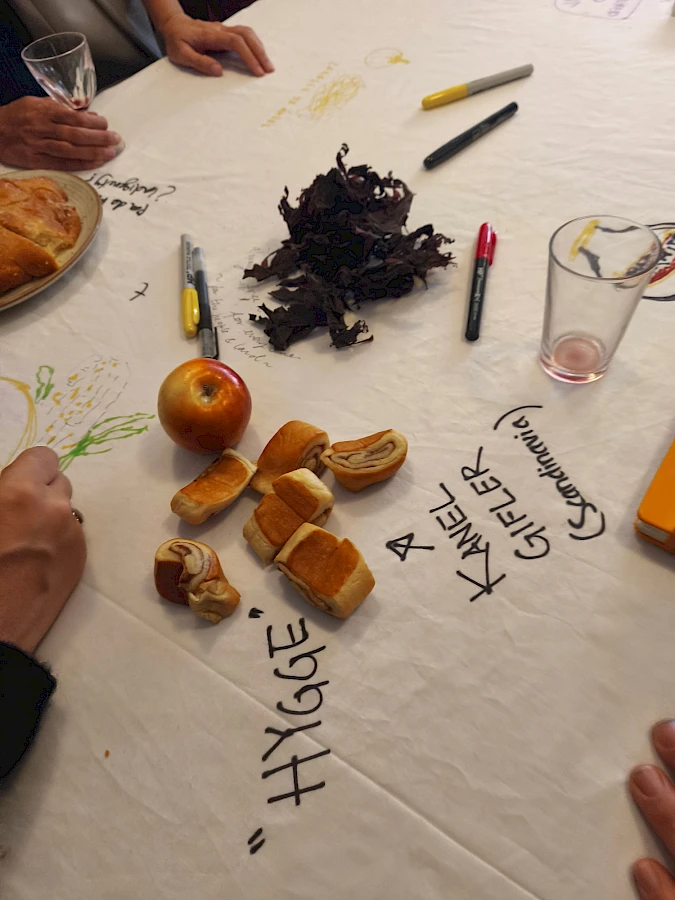
Photo: Paisanaje
To eliminate a seed bank is an attempt to erase any possibility of surviving autonomously. And yet, as Mahmoud affirms, they have still not managed to extinguish hope. Knowledges, like foods, come from somewhere, and they are tied to bodies. And like the seeds of cilantro, chestnut, wheat, quinoa, grape and olive in this text, they are not simply commodities or ingredients for healthy dishes. They harbour and contain cultural forms that, just as they can be forms of exploitation, can also be powerful tools for building bonds, ending hunger and producing territory.
Our work is modest (it could not be otherwise) but it is also committed and ambitious. We work by attempting to push beyond the disciplinary boundaries established by modernity. We challenge the pressure towards continuous mobility derived by the internationalization of the arts, the economy of visibility as well as the privatization of the imagination in the professionalization of artistic practice. Experimenting with food, rehearsing new ways of inhabiting the city and constructing territory compels us to continuously rethink our practices, to question our desires and to divert some of our primary intuitions.
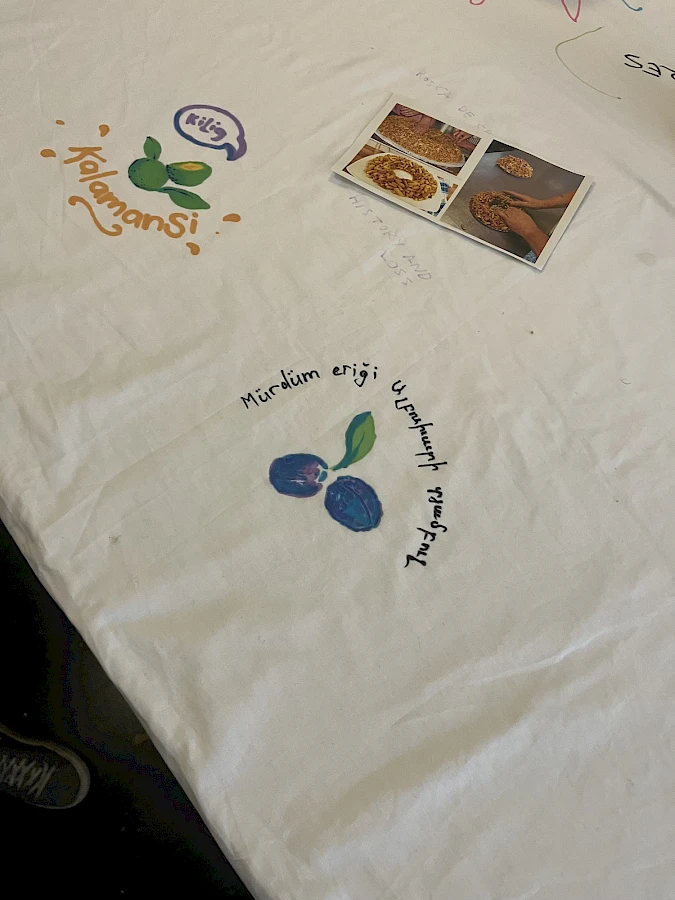
Photo: Paisanaje
In preparing this text, after the School of Common Knowledge we asked those who participated in the gathering to send us a short text, like Marina’s paragraph about chestnuts, or the one Amanda sent us, in which she said:
Participating in the School of Common Knowledge was a deeply meaningful experience for me. Paisanaje invited us to bring an ingredient that reminded us of home, and I brought maize, reflecting on its profound importance for Mesoamerica – not only as food, but as memory, territory, and ancestral technology. Maize carries within it centuries of collective knowledge, cultivation practices, cosmologies, and forms of communal life. I spoke about the ongoing struggle against transgenic seeds and the importance of defending the extraordinary biodiversity of native maize varieties in Mexico, which are deeply tied to cultural and ecological sovereignty. To defend maize is also to defend territory, autonomy, and ways of life that resist extraction and homogenization. What stayed with me most from our gathering was the intimacy created through simple gestures – walking, preparing olives, eating, and listening to each other’s stories. Food became a language for memory and belonging, allowing us to share histories of migration, affection, care, and resistance through collective presence and conversation.
Amanda Macedo
The invitation to keep on conversing, just as Amanda describes, through food, rootedness and displacement, inspired others to join this conversation. Morgan cooked for us on the day of the gathering; he used some cilantro. Daniela presented her film about genocide, Una gota de leche (A Drop of Milk) a few weeks later at a meeting of our communal meal programme. Mahmoud arrived in Madrid in January as a result of the Israeli genocide against the Palestinian people. So, rootedness is not related to origin but to the capacity to converse, to build worlds, and to inhabit solidarity.
Rootedness, we have learned, is not a destination. It is a conversation, one that happens around a table, over a shared dish, in the simple act of listening to someone else’s story of displacement and memory. A conversation with those who are present, but as well with some that already left… A conversation with our dead, but as well with new friends yet to come.
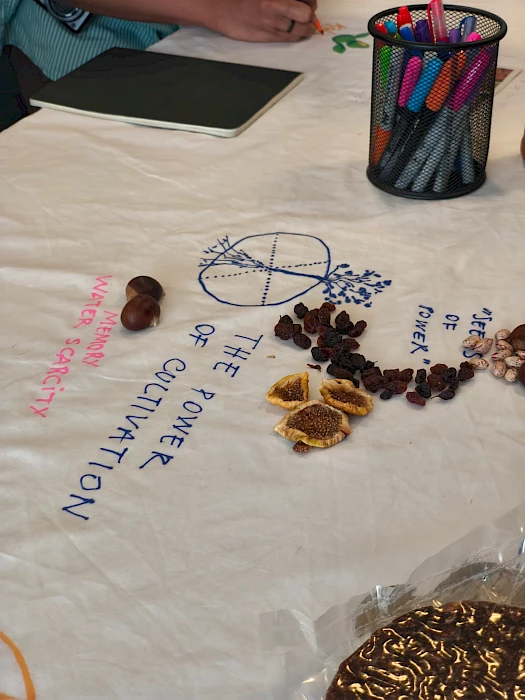
Photo: Paisanaje
Related contributions and publications
-
Decolonial aesthesis: weaving each other
Charles Esche, Rolando Vázquez, Teresa Cos RebolloLand RelationsClimate -
Climate Forum I – Readings
Nkule MabasoEN esLand RelationsClimateHDK-Valand -
…and the Earth along. Tales about the making, remaking and unmaking of the world.
Martin PogačarLand RelationsClimatePast in the Present -
Art for Radical Ecologies Manifesto
Institute of Radical ImaginationLand RelationsClimateInstitute of Radical Imagination -
Pollution as a Weapon of War
Svitlana MatviyenkoClimate -
Ecologising Museums
Land Relations
Related activities
-
MACBA
The Open Kitchen. Food networks in an emergency situation
with Marina Monsonís, the Cabanyal cooking, Resistencia Migrante Disidente and Assemblea Catalana per la Transició Ecosocial
The MACBA Kitchen is a working group situated against the backdrop of ecosocial crisis. Participants in the group aim to highlight the importance of intuitively imagining an ecofeminist kitchen, and take a particular interest in the wisdom of individuals, projects and experiences that work with dislocated knowledge in relation to food sovereignty. -
MACBA
The Open Kitchen. Map of edible tensions
with Marina Monsonís, Paisanaje and Ruralitzem
The MACBA Kitchen is a working group situated against the backdrop of ecosocial crisis. Participants in the group aim to highlight the importance of intuitively imagining an ecofeminist kitchen, and take a particular interest in the wisdom of individuals, projects and experiences that work with dislocated knowledge in relation to food sovereignty. -
–MACBA
The Open Kitchen. The fermented seed, colonialism and extractivism
The MACBA Kitchen is a working group situated against the backdrop of ecosocial crisis. Participants in the group aim to highlight the importance of intuitively imagining an ecofeminist kitchen, and take a particular interest in the wisdom of individuals, projects and experiences that work with dislocated knowledge in relation to food sovereignty.
-
HDK-Valand
Climate Forum I
The Climate Forum is a space of dialogue and exchange with respect to the concrete operational practices being implemented within the art field in response to climate change and ecological degradation. This is the first in a series of meetings hosted by HDK-Valand within L'Internationale's Museum of the Commons programme.
-
–Van Abbemuseum
The Soils Project
‘The Soils Project’ is part of an eponymous, long-term research initiative involving TarraWarra Museum of Art (Wurundjeri Country, Australia), the Van Abbemuseum (Eindhoven, Netherlands) and Struggles for Sovereignty, a collective based in Yogyakarta, Indonesia. It works through specific and situated practices that consider soil, as both metaphor and matter.
Seeking and facilitating opportunities to listen to diverse voices and perspectives around notions of caring for land, soil and sovereign territories, the project has been in development since 2018. An international collaboration between three organisations, and several artists, curators, writers and activists, it has manifested in various iterations over several years. The group exhibition ‘Soils’ at the Van Abbemuseum is part of Museum of the Commons. -
MACBA
The Kitchen: Workshop by Marina Monsonís
The Kitchen is a meeting place open to the participation of all, especially people and organizations that want to share their knowledge and experiences around the kitchen.
-
–MSN Warsaw
Multicultural Youth Center
The Museum of Modern Art in Warsaw, together with the confederation of museums L'Internationale, is establishing a Multicultural Youth Center. This is a unique space for 16-24 year olds to explore and develop their creativity, make new friends and hang out in a friendly and supportive environment.
-
–MACBA
Where are the Oases?
PEI OBERT seminar
with Kader Attia, Elvira Dyangani Ose, Max Jorge Hinderer Cruz, Emily Jacir, Achille Mbembe, Sarah Nuttall and Françoise VergèsAn oasis is the potential for life in an adverse environment.