MA Forum in collaboration with LIO: Rana Issa
In this MA Forum we welcome Rana Issa who will focus on the role of essay writing in her practice, including excerpts from a current essay reflecting on the relationship with her native Gaza. The essay is the final chapter in her forthcoming publication Ummiyat.
Rana Issa is a Palestinian writer, translator and cultural producer whose work centers on literary and contemporary artistic practices intertwined with Arabic cultural history. In this seminar, she will discuss the role of essay writing in her practice, including excerpts from her forthcoming book Ummiyat, an autobiographical history that constructs feminist legacies of motherhood and language through modes of exposure, confession and exhibitionism. By working to display, uncover, and reveal sites of trauma, the text attempts to come to terms with how we speak about the unspeakable and why it matters.
Rana says of the forthcoming book:
‘Ummiyat is an autobiographical history that constructs feminist legacies of motherhood and language through modes of exposure, confession and exhibitionism. In my family, concealing trauma has been practised across the generations as a way to recuperate the dignity of family members in the wake of extremely traumatic political and personal events. By labouring to put on display, unconceal and reveal the sites of trauma, this text attempts to come to terms with how we speak about the unspeakable and why it matters.
Ummiyat is a neologism that captures how Arabic semantically entangles motherhood, slavery, illiteracy and nation into one trilateral lexical root. Through thinking between those concepts, my talk unfolds the story of my grandmother, Izdihar, a bitter woman if ever there was one. Izdihar has a name that signifies the flowering, blossoming, blooming and opening up towards prosperity and progress. Nothing could have been further from the life of this miserable woman. By committing to divulge her tale, I broach the silence of what has happened in my family, and come to learn about the source of Izdihar’s consuming misery. The text plays with exposure and concealment as nuances of colour that enliven a portrait, and produce a text that thinks about desire by continuously deflecting it on the shores of its character’s life.’
More info here.
Rana Issa is a writer, translator and cultural producer focusing on literary and contemporary artistic practices entangled with Arabic cultural history. She is the artistic director of Masahat: Spaces for Arab Culture in Exile. She works at the intersection between public humanities, activist engagements and academic curiosity. Rana’s work has appeared in leading journals, platforms and presses, and it encompasses theoretical, literary, translational and historical genres and modes of writing. Rana has collaborated with international artists from the region in the fields of film, performance arts, visual arts and sculpture. Her book The Modern Arabic Bible was published in 2023 by Edinburgh University Press. Issa is the co-founding board member of Masahat. She is Assistant Professor at the American University of Beirut and Research Fellow at University of Oslo.
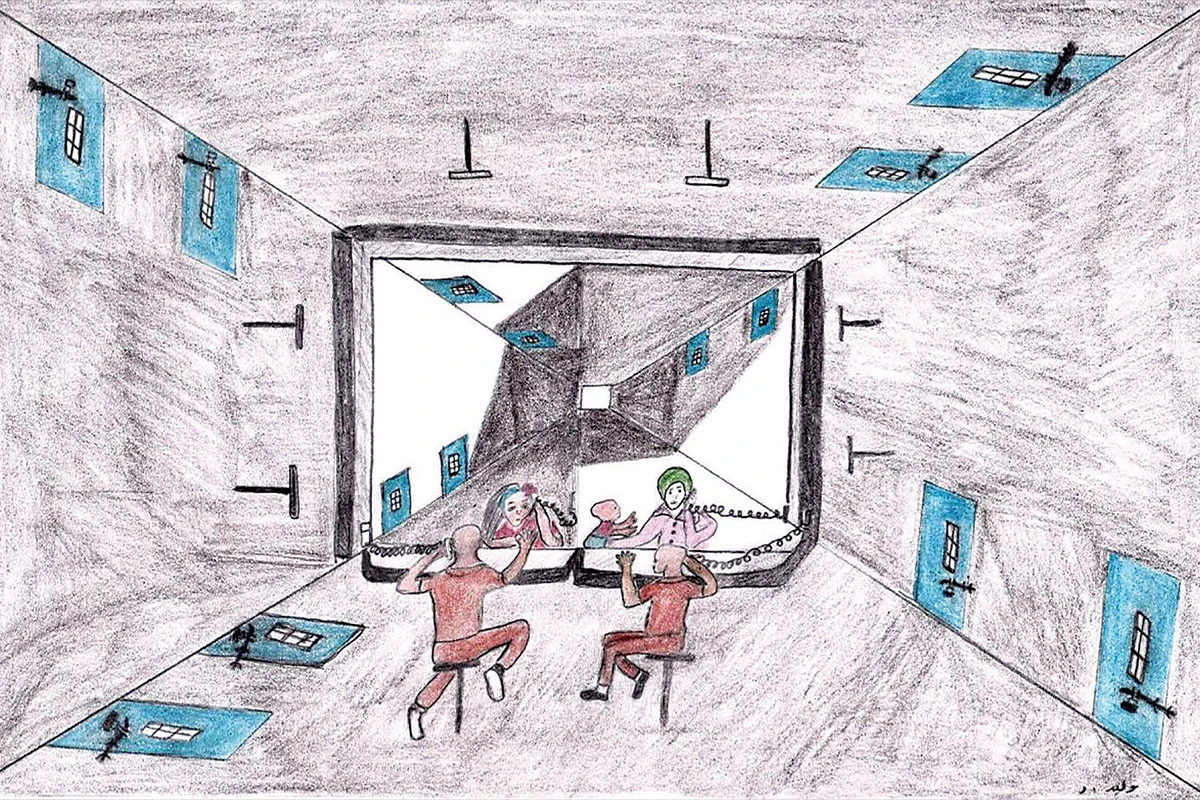
Walid Daqqa, On Parallel Time, drawing, undated
MA Forum is a seminar series on artistic research, hosted by HDK-Valand in collaboration with L’Internationale Online. Through invited guests, the series explores different dimensions of artistic research. The lectures are free and open to all.
Related contributions and publications
-
Broadcast: Towards Collective Study in Times of Emergency (for 24 hrs/Palestine)
L’Internationale Online Editorial Board, Rana Issa, L’Internationale Confederation, Vijay PrashadInternationalismsSonic and Cinema Commons -
Siempre hemos estado aquí. Les poetas palestines contestan
Rana IssaEN es tr arInternationalismsPast in the Present -
Poetry Against Language Dioxide
Rana IssaInternationalisms -
Climate Forum I – Readings
Nkule MabasoEN esLand RelationsClimateHDK-Valand -
…and the Earth along. Tales about the making, remaking and unmaking of the world.
Martin PogačarLand RelationsClimatePast in the Present -
The Kitchen, an Introduction to Subversive Film with Nick Aikens, Reem Shilleh and Mohanad Yaqubi
Nick Aikens, Subversive FilmSonic and Cinema CommonslumbungPast in the PresentVan Abbemuseum -
The Repressive Tendency within the European Public Sphere
Ovidiu ŢichindeleanuInternationalismsPast in the Present -
Glossary of Common Knowledge, Vol. 2
Schools -
Glossary of Common Knowledge
Schools
Related activities
-
HDK-Valand
Climate Forum I
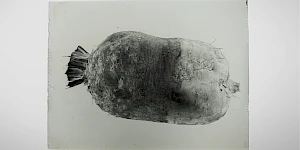
The Climate Forum is a space of dialogue and exchange with respect to the concrete operational practices being implemented within the art field in response to climate change and ecological degradation. This is the first in a series of meetings hosted by HDK-Valand within L'Internationale's Museum of the Commons programme.
-
–Van Abbemuseum
The Soils Project
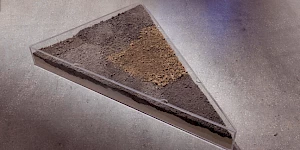
‘The Soils Project’ is part of an eponymous, long-term research initiative involving TarraWarra Museum of Art (Wurundjeri Country, Australia), the Van Abbemuseum (Eindhoven, Netherlands) and Struggles for Sovereignty, a collective based in Yogyakarta, Indonesia. It works through specific and situated practices that consider soil, as both metaphor and matter.
Seeking and facilitating opportunities to listen to diverse voices and perspectives around notions of caring for land, soil and sovereign territories, the project has been in development since 2018. An international collaboration between three organisations, and several artists, curators, writers and activists, it has manifested in various iterations over several years. The group exhibition ‘Soils’ at the Van Abbemuseum is part of Museum of the Commons. -
–VCRC
Kyiv Biennial 2023
L’Internationale Confederation is a proud partner of this year’s edition of Kyiv Biennial.
-
–MACBA
Where are the Oases?
PEI OBERT seminar
with Kader Attia, Elvira Dyangani Ose, Max Jorge Hinderer Cruz, Emily Jacir, Achille Mbembe, Sarah Nuttall and Françoise VergèsAn oasis is the potential for life in an adverse environment.
-
MACBA
Anti-imperialism in the 20th century and anti-imperialism today: similarities and differences
PEI OBERT seminar
Lecture by Ramón GrosfoguelIn 1956, countries that were fighting colonialism by freeing themselves from both capitalism and communism dreamed of a third path, one that did not align with or bend to the politics dictated by Washington or Moscow. They held their first conference in Bandung, Indonesia.
-
–Museo Reina Sofia
Team of Teams
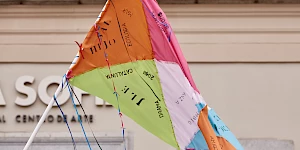
This project researches citizen participation as a fundamental pillar in the creation of community.