Housing Music
Onkar Singh Kular compiles a track list, assembling and sampling from his long term research into sound system culture and Black musical genres of reggae, dub, jungle and bhangra – as sonic, aesthetic and spatial practice.
Introduction
During my design education in the early 2000s, I came to believe that the history of diasporic designing in the UK began with the prominent figures of David Adjaye and Zaha Hadid. These were the two individuals that I could search up in my library and read about in magazines and cultural journals, and who featured in design and architecture exhibitions of the time. It is only recently, looking back at my history of living in the north of England, growing up in a majority Punjabi, Muslim and Jamaican community, that I have begun to recognize that profound acts of designing and worldmaking were taking place all the time and at varying scales at home and on my doorstep.
One example of how I arrived here has been through researching the history of the sound system cultures and Black musical genres of reggae and dub, and subsequently those of bhangra, jungle and grime. These musical genres were responding to social, cultural and political exclusions that required diasporic communities to design and make their own spaces, objects and broadcasting infrastructures for sociality and living. These exclusions continue in the historiography of design and architecture today: there are still very few journal articles, books, academic research projects, documentaries or exhibitions that foreground how, within these cultures, diasporic communities designed and spatialized worlds. However, these designing cultures have left media and memory traces that require alternative methods of researching, archiving and mediating.
Over the last few years, I have been developing research methods and public outputs that think ‘into’ and ‘through’ these histories as a way of building counter-archives. These acts of counter-archiving are not just acts of setting records straight: more importantly, located in these histories of designing and worldmaking are valuable lessons and models for how we might live and act more equitably and sustainably today. Featuring a series of texts, tracks and video collages, the following mixtape is one sample of this counter-archive being made public.
1. Housing Music
[King] Tubby had a way of squelching the sound of the music, so at one end you would hear the bass escaping through the floorboards and at the other end the treble dancing on the ceiling.
– Dennis Bovell1
On a warm summer day, when we play our music with our windows open, we begin to broadcast, with our homes becoming hyperlocal radio stations. When we close our windows, we close off this form of public service broadcast. At the same time, through everyday sounds – singing birds, the sound of the wind, people speaking and traffic moving – the outside world broadcasts into our private space, creating a two-way sonic exchange.
Between the ages of seven and eleven, three young brothers would fall asleep to the gentle vibration of their bedroom windows by the bass coming from Deighton Youth Club, located directly opposite their Victorian house in Huddersfield. A feature of many Victorian houses, the sash window has two glazed wooden frames that allow the window to open vertically. A common occurrence with older sash windows is that they expand and contract, depending on temperature and moisture. This may produce a vacuum between the two parts of the window, somehow creating the conditions to amplify low frequencies which, in turn, become vibrational sounds. Here, the windows became a hybrid instrument of relational activity and ad hoc materiality – not house music but, in this case, housing music.
Recently, I have been researching how the home has historically been modified, hacked, utilized and reclaimed towards a form of diasporic and relational broadcasting. As one example: from the 1950s on, through racist door policies, Black and Asian people in the UK were excluded from bars and clubs where they might listen and dance to music. This led to the creation of the blues party, continuing a tradition that began in the West Indies, sometimes referred to as a ‘blues’, ‘shubs’ or ‘shebeen’, where Black people could meet, eat and dance together. To run a blues party, organizers would clear out furniture from a domestic house, set up a reggae sound system made up of large speakers, turntable, mic and amps, and offer Caribbean food to guests. Blues parties would be regularly closed down by the police, but this didn’t stop sound systems being moved quickly to back-up houses where the same sequence would be repeated.
There is something captivating in this repetition: in the thought of countless people, over countless weekends, moving large pieces of furniture (tables, rugs, couches and wardrobes) in and out of homes to make way for sound systems. I can’t help but speculate whether this pre-dance ritual created a form of spatial intelligence, embodied knowledge and resistance choreography that we have played little attention to in sonic-spatial history so far.
To all those who have ‘architected’,2 Track 1 is ‘One Step Forward / Ital Corner (12” Mix)’ by Max Romeo & Prince Jazzbo
2. Black Street Technology
Militant historian Sónia Vaz Borges points towards a different type of archival architecture, stating:
The errant archive is made of people, their stories, memories, experiences, and reflections. It is not fixed in space, place, and the information that these errant archives provide are not frozen in time. The memories that the errant archive shares are expressed in diverse forms, according to the context in which it is consulted and the conversation that develops.3
Throughout my childhood, I would see my father filling the boot of his car with musical instruments, his prized Technics keyboard and amplifiers. As the lead singer of a Punjabi bhangra group he would travel around England, performing songs and Hindi cover versions at wedding receptions. Two- to three-hundred guests, including children, adults and the older generation, would be invited to the average Punjabi wedding to share food and dance. The receptions were mostly held in affordable community halls, youth clubs and school gyms that would accept large numbers of South Asian guests. Out of sheer probability, from time to time we would also see my father perform live at one of these weddings.
I now recognize these municipal spaces as a key component in a self-organized broadcasting infrastructure for diasporic ritual and sociality through music. In addition to these municipal spaces, this infrastructure was an assemblage of the car, the motorway network, modified music equipment, cottage industry dubplate production and pop-up music shops in grocery stores – an assemblage, that is, of what Houston Baker effectively describes as ‘deformations of mastery’: the use of objects, products, technologies in ways not sanctioned or anticipated by the institutional forces that produced them. 4
Over the last few years, I have been archiving oral history accounts of designing and space-making within bass cultures, from reggae to dub, from bhangra to grime. These accounts can be found through ‘digging in the crates’ of recorded interviews and podcasts hosted on social media platforms such as YouTube and Spotify. Once edited (sampled), compiled and organized (mixtaped into categories), they begin to form an archive of experience and knowledge of designing and community space-making, one with a particular emphasis on women, who have been somewhat marginalized in a predominantly technical and male historization of this culture.
One category I refer to as ‘Black street technology’ captures some of this designing. The following is a small section of this oral mixtape:
Sometimes there were no venues for us to play. We would go and make a venue. Meaning we would go find a derelict house, lick down the door and create the place where we could invite the public … we loaded up [the car] with records, and we drove from London to Leeds and all these towns in the Midlands. We stopped off at seventy-five shops, leaving records and collecting cash … some of them weren’t even record shops, they were grocery stores or barbers or travel agents, anywhere Black people came … . As black and brown we weren’t allowed into spaces. We had to make our own, find them, build them … particularly back in the day, you know, the sound system would be using electricity from the outside street lighting system. So, it took a certain person with that technical knowledge to not only build the speakers but the knowledge to wire them up to the street … and when we are talking about the speaker boxes, they were the size of domestic wardrobes.
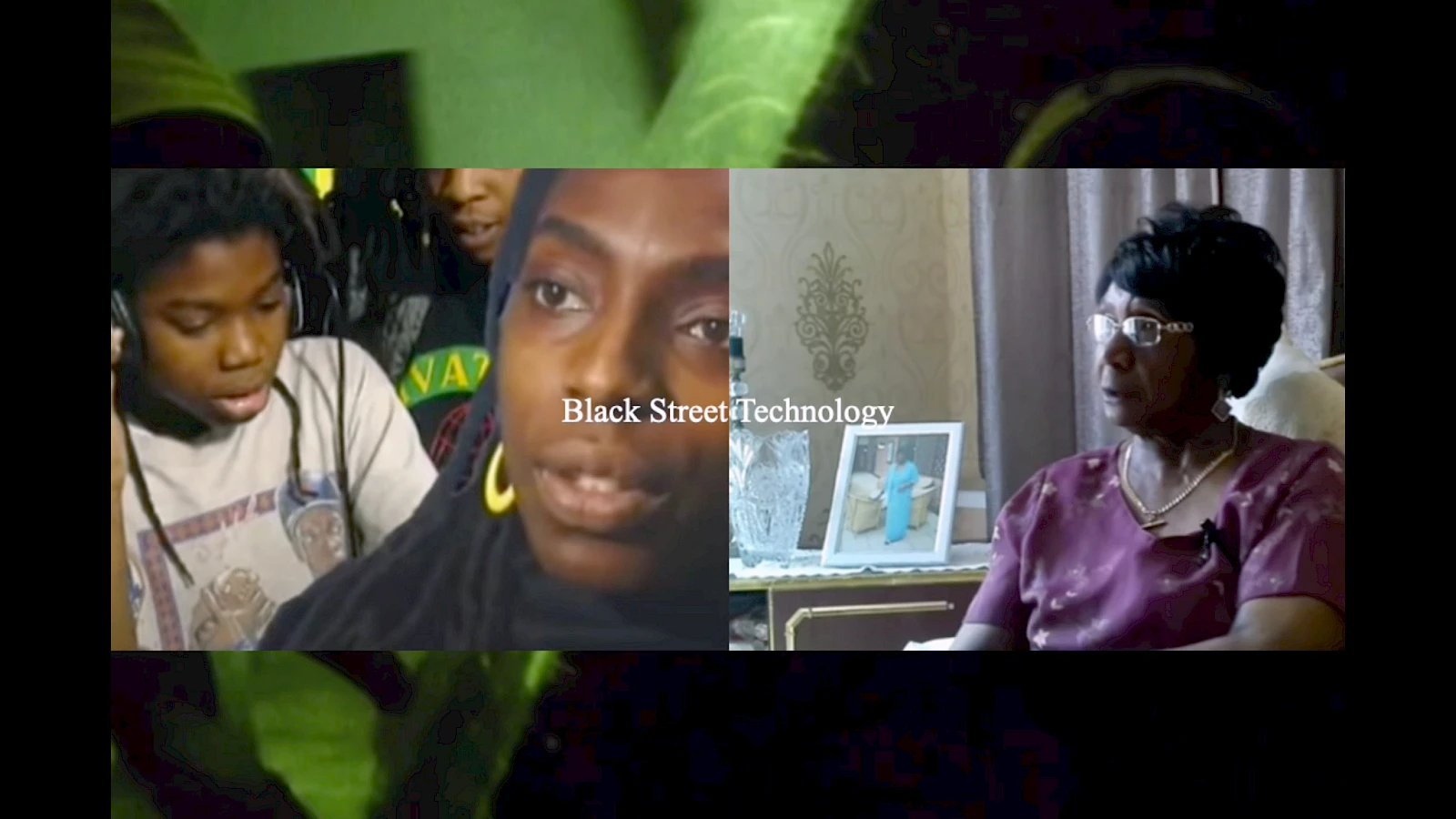
A shout-out to the Black Audio Film Collective and my two Brummie aunties, Track 2 is ‘Handsworth Revolution’ by Steel Pulse.
3. Serious Business: A sonic ecology from gaps
During a podcast interview, the late dub poet Benjamin Zephaniah told this remarkable story of how (probably around the late eighties) the UK soul singer Janet Kay had a blank VHS tape labelled with the handwritten letters B, L, A, C, K on standby next to her video player. Anytime Janet would see a Black person on TV she would quickly insert the tape into the VHS player and press record.
In ‘Mutualism, Massive and the City to come: Jungle Pirate Radio in 1990s London’, Malcolm James and Tom Cordell state that ‘anyone flicking across their FM dial could hear it in the gaps between the BBC and commercial stations – the Friday-to-Sunday broadcasts of a new kind of music, illegally beamed across the city … . A unique sound – breakbeats, live spoken vocals, and bass lines. Jungle!’5
Sitting somewhere between a curated and an open-source platform, The Pirate Archive is a website that documents the social history of UK pirate radio from below. As well as listing pirate radio stations by region, it allows citizens to fill in the sonic gaps of pirate radio history by uploading photographs, artworks, newspaper articles, tape recordings and personal stories.6 There is also a comprehensive set of documentaries that provide a revealing media history of the movement. The material highlights the significance of pirate radio in the circulation of UK Black music and how it drew from the creative practices and pedagogies of reggae sound systems. Viewed as a whole, The Pirate Archive provides a counter-cartography of what was excluded from British broadcasting (with a capital C). In one of the Pirate Archive videos, a reporter is being shown by a council official how pirate operators install antennas and home-made equipment on tower blocks.7 As they walk up the tower, the council official points to how the operators find sophisticated ways to wire equipment through the floors and walls. At the top, slightly aghast, he goes on to show how operators ‘even’ set up and secure their broadcasting studios through the service gaps (plumbing, toilets and air ducts) of the building. Watch enough of the videos and you begin to notice that jungle pirate radio not only operated within the service gaps of the tower block, but also in the scheduling gaps and slack-spaces of the private home and the public city.8 These included improvised studios in abandoned flats, in squats, living rooms, kitchens and teenagers’ bedrooms – spaces that were generally occupied in-between police raids, landlords reclaiming properties and parents returning home.9
In jungle pirate-radio history, a common statement is that it was ‘a game of cat and mouse’. Here, the ‘game’ refers to the attempts made by authorities (the cats) to shut down the pirate radio stations set up by operators (the mice). The novelist J.G. Ballard once said that viewing episodes of Starsky and Hutch with the sound off was like watching training videos on driving, parking and the three-point turn. View episodes of the cartoon series Tom and Jerry with the sound off and you notice that Jerry (the mouse) has constructed a space for living within-and-beyond the architect’s plan of the house that he and Tom (the cat pursuing him) occupy. Through creatively hacking the building, Jerry has made a life in-between the gaps inside the walls. In a number of episodes, you notice that Jerry has not only built a safe space away from Tom but constructed a network of doorways, corridors and rooms, furnished with a bed, paintings and even a record player. The more Jerry is hunted by Tom, the more elaborately and creatively he designs his space and makes his world. But if you search for plan drawings of Tom and Jerry’s house online, you will notice that the drawings do not include this wonderful in-between architecture.
Rewind to The Pirate Archive, when the pirate operators are interviewed in the videos, they not only mention pirate infrastructure – the aerials, transistors and equipment – but also intimately discuss their own lived environment. It becomes apparent that their know-how of tower-block architecture relates to an embodied spatial knowledge of the place: an ability to not only see beyond the architect’s plan, but to construct counterplans for making meaningful spaces and lives. Here, we might consider the bass continuum as an epistemological frequency that also carries knowledge and ways of being.
Track 3 could be considered a socio-spatial record of UK Pirate Radio. ‘Highrise FM’ by DRS & Dynamite.
4. Jugaadist Massive
Everyone designs who devises courses of action aimed at changing existing situations into preferred ones.
– Herbert A. Simon10
Jugaad is a South Asian practice of making do, adapting and navigating everyday problems with what is available. Search the internet and you will find ad-hoc solutions to fixing everyday goods and adapting Western technologies to localized contexts and needs. In the West, somewhat simplistically, it has been related to DIY and the bricoleur. Borrowing from jazz improvisation, I prefer to think of Jugaad together with AbdouMaliq Simone’s formulation of ‘improvised lives’ – an endurance strategy whereby poor urban dwellers ‘write themselves into a milieu that otherwise might seem to marginalize them’.11 From jua kali in Kenya to Système D in the Caribbean, adapting and improvising practices are also shared across colonial geographies. Much has been written about these situated practices while mostly ignoring how they travel and also transform through migration and diasporic communities.
You can trace improvisational tendencies within the collective ecologies of sound system cultures. Out of hardship, a lack of resources and exclusion, sustainable practices were hardwired into the production and performance practices of reggae, dub, UK bhangra, jungle, techno, grime and other Black subgenres.
In the UK, blues spot gramophones were bought with the first week’s wages working at the hospital. Placed at the centre of living rooms, parties were made. Blues parties were the original raves. Neighbours were invited. Word of mouth became social media. Furniture was cleared, repurposed for selling homemade food, Red Stripe, Rum and Coke. Reggae, dub, lovers rock were played. Blues got raided. Wait for the police to leave. Go to the back-up house prepared on the next road. Electricity pinched from the street. Scale up. Amplifiers made by the Jamaican radio operator at Heathrow airport. Building sites were raided. Wooden doors were taken off. Boarded-up windows were stripped of their timber. From this bounty, speakers were built the size of wardrobes. Youth Training Schemes became night schools to learn electronics. Posters were designed, screen-printed between commercial clients. Caretakers of youth clubs, church halls and community centres were sweet talked, keys were exchanged. Sound systems were wired up and down, sometimes three to four times per night. Stringing up became an artform – all while dropping dubs. Vans were refitted into mobile record shops, dub vendoring from town-to-town. Rewinds extended the happiness of the single object. Riddims were reused over countless tracks. ‘Bam Bam’ – just ask Sister Nancy. Versioning became a frugal pleasure machine. Speakers were stacked high to become houses of commons, street media for our people. Radio stations were dread broadcasted from living rooms. Bedrooms became the factories of a generation of pirates. Record crates were dug, samples were clipped, prolonging the lives of forgotten drums. Soldering irons made multi-track machines. YouTube was hacked. Nokia phones distributed grime performances from buses, playgrounds and jammed basements. Mobile universities were made from the ground, box boys were educated, each-one-teaching-one. All while Mad Professors taught Black history.
I now recognize that my parents spent much of their time making do, adapting and navigating. From my father modifying his newly purchased electronic instruments and producing bhangra music videos with his state pension, to my mother who made curries out of tins of baked beans and constructed her clothes from local fabrics and, without ever speaking English, created hospitality for those that she loved and did not know. Like so many post–Partition and Windrush migrants, they not only improvised but lived sustainably within their means – located within these histories are not only ways of designing counter-obsolescence but valuable lessons in anti-extractive living. They are what I refer to as the Jugaadist Massive.
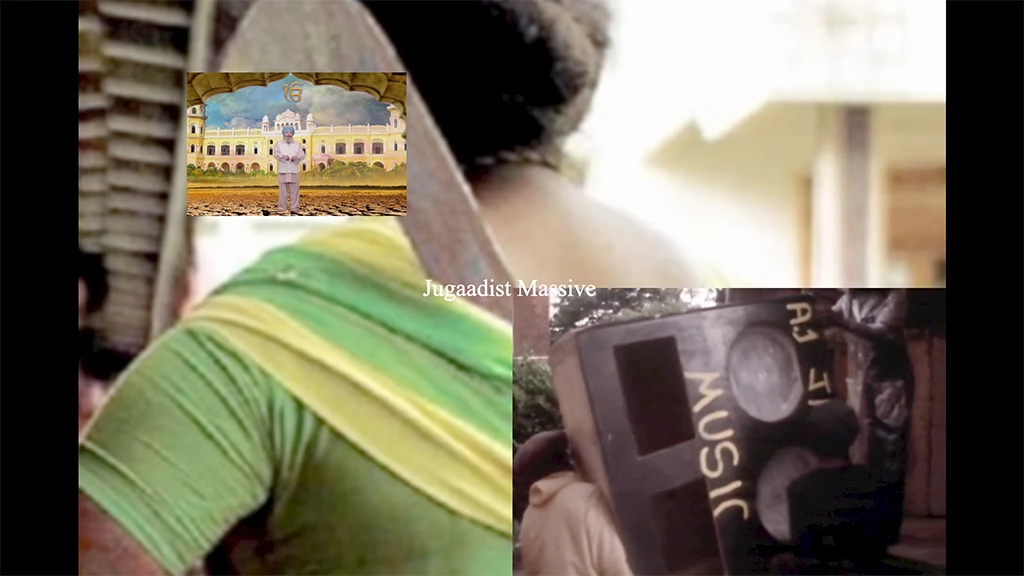
Track 412 is ‘Bhabo ni wilayat mangde’ by Indian Stars (Shinda Group) – as far as I am aware it only exists as a 7-inch record. Good luck trying to find it online.
5. Madchester
Opened in 1982, The Hacienda was initially co-owned by the band New Order and their label Factory Records. As a consistent loss-making adventure, it became famous in the early nineties as a northern centre for acid house and for the Madchester indie scene. Designed by the interior architect Ben Kelly, The Hacienda represented a paradigm shift in the design of nighttime venues, from ones that were focused on excessive drinking and ‘finding romance’ to ones geared towards long-play dancing. Housed in a former yacht showroom, design historian Catherine Rossi states that the club ‘was an exercise in postmodernism: an industrial theatre set, in which everyone was on stage and performing amid industrial ready-mades that included (traffic) bollards, road lights and black and yellow striped columns’13 – one where the outside was turned inside, in a series of postmodern jokes…
Rossi goes on to say that ‘The “industrial” aesthetic so commonplace today in UK dance music venues and luxury housing began at the Hacienda.’14 In a move that reflects the rhythms of gentrification, The Hacienda was closed in 1997 and stripped of its interior. By 2007, the venue had been purchased, demolished and rebuilt as luxury flats. Notably, the developers used both the club’s name and its iconic black and yellow stripes as part of its branding. Also as part of its branding the developers used the following strapline in their sales literature: ‘Now the party’s over… you can come home.’15
It was only recently, when I played the Factory-produced Happy Mondays record ‘Tart Tart’, I noticed something a little eerie. The label of the record has a photograph of the Irish Manchester United football player George Best. During the seventies, he was like the white Pelé and a national icon. In the middle of a family dinner, my father mentioned that he was friends with George Best… Slightly gobsmacked, I asked him to elaborate. He mentioned that when he first arrived in the UK, he worked on a building site with Irish labourers. Apparently, they took a liking to my father and invited him to join them in watching Manchester United matches. At his first match, not knowing the rules of football, he instead just watched the most graceful player, George Best, on the pitch for the entirety of the game. During games that followed, my father continued to do this, and after one of the matches, they visited a very different type of Manchester nightclub frequented by George Best… At the nightclub, somebody had informed George of this young handsome Indian man who came to matches and only watched him. He requested a meeting, and there apparently began a friendship.
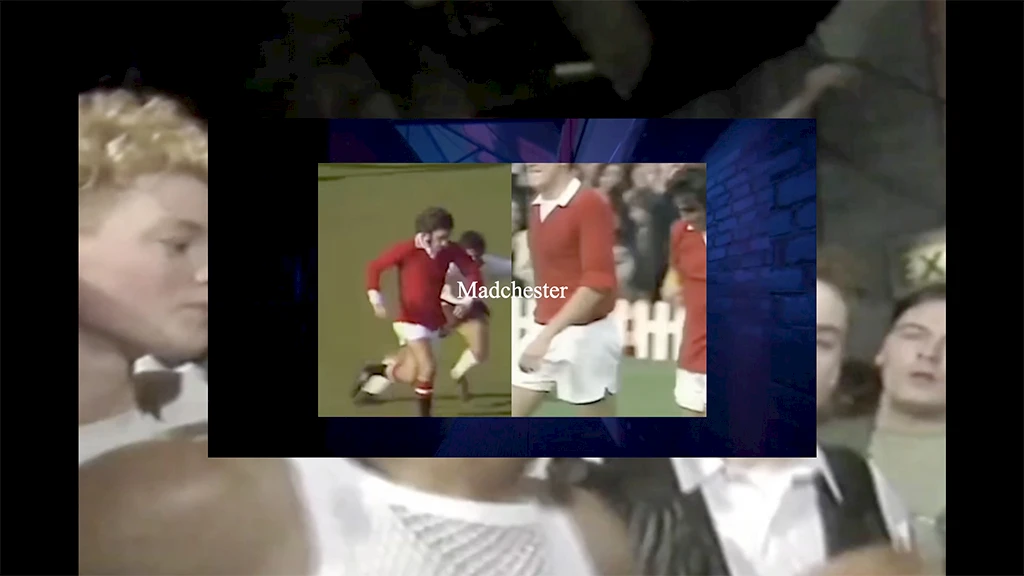
Featuring George Best in the middle, Track 5 is ‘Tart Tart’ by Happy Mondays.
6. Dek Bass
As I scroll through my social media content, mixing football, reggae sound systems and rap battles in Calcutta, my feed occasionally slips in clips of young men soldering circuit boards, constructing and stacking speakers, using fans to cool down blinking amplifiers, transporting speakers with makeshift trucks and dancing to music so bass heavy and bleepy that the wobbly filmed footage and my headphones struggle with the distortion.
At times, these three-metre-high speaker stacks form temporary architectural arrangements of sound walls – they look big enough for a large music festival, but this is not Glastonbury or Coachella. These are clips from sound clashes in the rural areas of West Bengal where, traditionally, powerful mobile sound systems were used for political rallies, religious gatherings and wedding celebrations – in a place where sonic overload is the signature of urban life, with officials reporting that at one traffic crossing alone there were 19,000 car honks per day.
By competing with other local sound systems known as ‘box competitions’, these portable walls of sound were originally conceived for sound operators to advertise and showcase their systems. The winning formula of these sound clashes is to sonically dominate your competitor with extreme use of bass and noise. As audiences grew, these trade-related displays provided fertile conditions for dek bass, a rural electronic dance music situated on the edge of listening.
Developed by carpenters-sound-engineers-come-producers, here ‘dek’ refers to the use of cassette decks and tapes in the production ecology and audio performance of this subculture. And although the tracks are predominantly bass driven, with the mixing in of everyday environmental sounds, Bollywood music references and sirens, dek bass has somehow developed into a sonic report of life in this part of India. As locals gather for a form of rural raving, this could be considered an example of ontological designing, whereby when things are designed for a particular purpose, they, in return, ‘design back’ into something new and magical. Here, what the designing-back returns is the sonic and vernacular form of dek bass and its subsequent worldmaking practices.
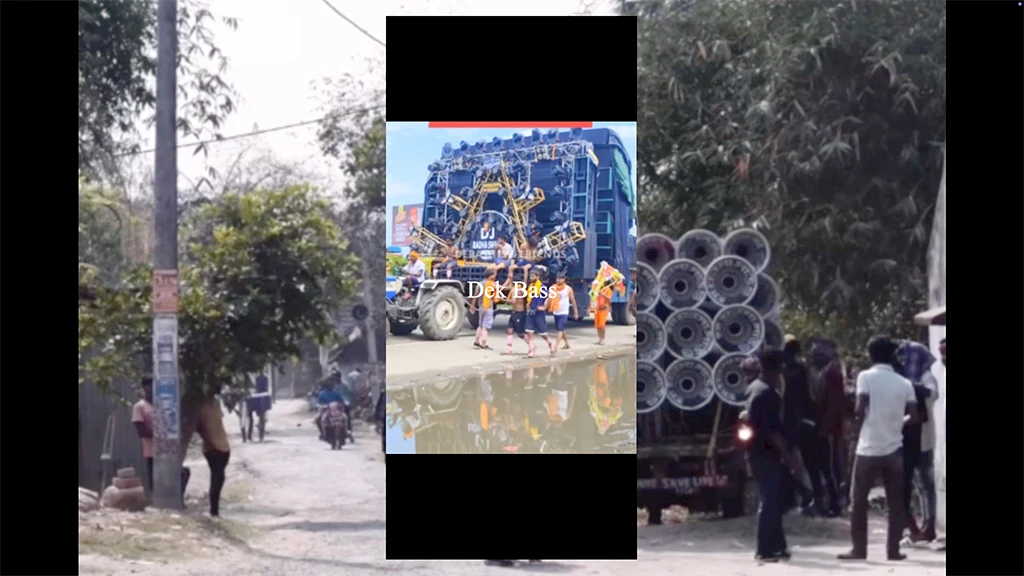
Track 6 is ‘Bharo Mang Mari Bharo (2 Step Crow Blaster Long Piano Humming Competition 2024)’ by DJ Susovan.
7. Diagnostic Listening
‘Don’t Drake and Drive’: internet meme warning of the dangers of listening to emo rap while driving as you might inadvertently end up at your ex-partner’s place asking for forgiveness.
As early twentieth-century cars were notoriously unreliable, drivers were on constant alert, tuning their ears to detect any strange sounds emerging from the engine. As a companion for lonely drivers, the emergence of the car radio shifted the locus of their diagnostic listening to broadcasts from the outside world. With this changing earscape, the car radio has played a pivotal role in shaping Black music history. Berry Gordy, founder of Motown Records, inspired by Detroit’s car industry, famously claimed that Motown recordings were mixed to sound good on car radios – ultimately to attract a white listening ear. Following the Gordy trajectory, hip-hop polymath Dr. Dre stated that the development of heavy bass sound systems combined with the amount of driving time required by living in Los Angeles was influential on his slow, hypnotic G-Funk sound. The demise of the car industry also provides a diagnostic backdrop to the birth, sound and practices of Detroit techno.
Across the Atlantic, tuning into techno’s analytical frequency, jungle pirate radio also found its audience in and through tower blocks, bedrooms and cars. In Sonic Intimacy (2020), Malcolm James states:
In the car stereo, the surround acoustical properties of the reggae sound system found affinity with a mobile micro-environment … young men desiring power and potency fitted powerful but affordable Japanese-produced stereo systems into their otherwise inexpensive vehicles; these were secondary sites of jungle broadcast as high streets were filled with distorted bass lines and rattling car exteriors.16
Through its sonic, social and spatial organization, jungle pirate radio cut through synthetic mid-nineties optimism by providing a diagnostic reading of capitalist urbanization processes in the UK.
During the late eighties driving with my father was always a process of diagnostic listening; not to the car or the world outside, but to his mood. A good mood would equal playing music and not necessarily conversation.17
This process would begin with being asked to reach inside the glove compartment and grab a brightly coloured bhangra cassette tape. Bhangra, a musical genre with its roots in Punjabi agriculture, aided by electronic keyboards, affordable cassette-tape recording and piracy, had found a socio-media translation through the Punjabi community in the UK.
Like reggae and dub, it too was a marginalized music requiring a DIY infrastructure of production, broadcasting and distribution. The cassette tape and shop were the medium for bhangra distribution. At one point, it was estimated that some bhangra artists sold over 30,000 cassette tapes a week that did not register within the UK chart system. Often located on street corners, it was hard to miss these hybrid South Asian grocery and cassette shops – with posters displayed in their windows transforming them into scaled-up versions of the tapes themselves. Here, I like the dual meaning of ‘broadcast’, as both ‘to transmit media’ and, as an agricultural term, ‘to scatter seeds’ – to cast broadly by hand.
From Southall to Solihull, Handsworth to Huddersfield, it could also be said that these media shops were cast and cultivated along the songlines of where the post-Partition diaspora found work in the National Health Service, public transport and UK factories. As such, these shops were not only a broadcasting infrastructure for bhangra music but also as a form of spatial broadcasting – stating that we are here.
And once the cassette had been inserted, I recall how the atmosphere of the car would further change, this time with the addition of my father’s humming.
Occasionally heard leaking out of cars, Track 7 is ‘Chura Liya, 7” Radio Mix’ by Bally Sagoo.
8. The Door, the Floor and the Ceiling: The Africa Centre, the Sikh Gurdwara and the Blue Note, London
The Door
In music venue and club culture history, doors are political objects, used as a means of separating who can get in and who cannot. Instead of utilizing the door as a threshold towards a generous form of hospitality, clubs have exercised exclusion through the smoke screen of security.
Speaking about the Africa Centre, a nonprofit space for the African diaspora in Covent Garden, London, Jazzy-B recalls the following Soul II Soul Sound System night and their innovative door policy:
There was such a sense of community and purpose in there that one night we were rammed with a queue of about four hundred people outside the door who couldn’t get in, I went on the mic and said … ‘Look, you’ve been in here for four hours now and there’s as many people outside want the same experience, how about you do them a favour?’ … . And they actually fucking left! No complaints, just ‘Fair enough, see you next week.’ We swept the floor and let the late shift in.18
The Floor
One of my first experiences listening to live music was in a Sikh temple known as a gurdwara. During service the congregation listen to hymns sung from the Guru Granth Sahib. As you enter the gurdwara you are required to take off your shoes and cover your hair. Once inside you sit on the floor signifying an equality within the rest of the congregation. The floors of gurdwaras are carpeted and then covered with large cotton sheets. To extend the lives of objects, in Black and Asian houses you would often see carpets and sofas covered with sheets or even plastic. To be honest, my experience of sitting cross-legged on a carpeted floor, listening to spiritual music for a few hours at a time eventually made me agitated and uncomfortable. In my late teenage years, I had the chance to see the electronic music group The Orb at a student union concert at the Octagon, Sheffield. As I entered the concert, to my disappointment, I noticed that everybody was sitting on the dirty wooden floor. I joined them, hoping that once the warm-up band had finished everybody would get up and begin to dance. An hour into the concert, everybody remained on the floor, and I was too much of a coward to break up this collective seating arrangement.
The Ceiling
As opposed to the dance ceiling, much has been written about the dance floor. It might be down to a gravity bias as the floor is literally what holds us in place. In It’s a London Thing (2019), Caspar Melville describes the Metalheadz night at the Blue Note in London:
June 1997. Sunday. The club is just one room, a low-ceiling rectangular box, decks at one end, the same level as the dancefloor, and the big Eskimo sound system dominating. It’s like being inside a big bass bin – dark-blue walls, stripped down, dank. You can smell the Caribbean food they serve upstairs. It’s packed and the walls are sweating – someone has rigged up a makeshift canopy above the turntables to stop condensation dripping on the records as they play.19
Riffing off McKenzie Wark and her writing around raving – here, the collective labour of the dance makes its presence known through the sweating ceiling.
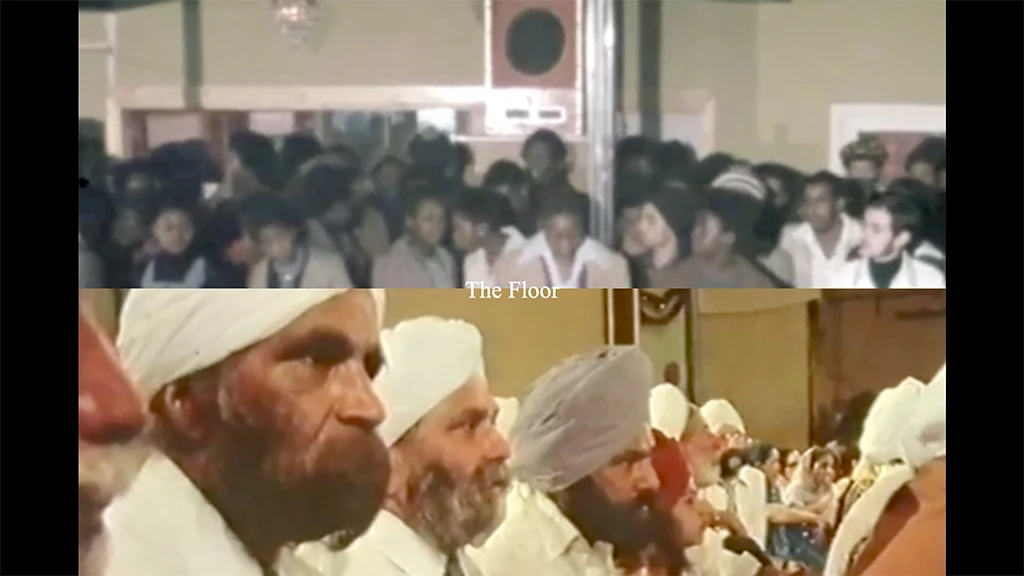
Track 8 is dedicated to The Orb, one of the spiritual and sonic architects of the rave chill-out Room. ‘Little Fluffy Clouds: Cumulo Nimbus Mix’ by The Orb.
9. Slabspace
The ship remained perhaps the most important conduit of Pan-African communication before the appearance of the long-playing record’.20
Emerging out of mid-nineties Houston, Texas, screw music is a geographically distinct remixing technique and production style associated with the late DJ Screw and known as ‘chopped and screwed’ – terms also associated with carpentry and DIY. Here, ‘screwed’ refers to a distorted slowing of a song, combined with the ‘chopped’ technique which is the playing of two copies of the same record, with the second copy being played a beat behind the first. Screw is closely associated with ‘lean’, a codeine-based cough syrup mixer that slows and distorts the senses. Here ‘slow’ and ‘slowness’ also relate to the environmental conditions of Houston where it is regularly hot, dancing is less energetic, and driving is time-consuming in a traffic dense city.
Whereas lean could be described as the sound-drink of screw music, the sound-object is Houston’s distinctive car culture SLAB (sometimes translated as an acronym for ‘slow, loud, and bangin’). In Welcome 2 Houston (2023), Langston Collin Wilkins writes:
Slab cars are large-bodied American sedans that feature multi-layered paint jobs (to achieve a candy effect), dynamic exterior alterations, three-dimensional trunk displays, and explosive sound systems. Slab owners purchase their cars when they are nearing their end and slowly convert them into something more elaborate. During this process, the vehicle becomes inscribed with individual experience and identity and broadcasts this to the outside world … while driving or stationary drivers ‘pop’ their trunks to reveal the elaborate, neon LED displays positioned inside.21
Once parked in sequence and with trunks popped, they form temporary exhibition spaces that at times reference ‘neighbourhoods, social groups, and fallen friends’.22
In Sweden, the subgenre of epadunk blends bass heavy eurodance and könsrock – a ‘post-woke’ anti-establishment Nordic rock music. This purposefully low-brow mash-up shares its sonic ecology with the Swedish DIY car cultures of EPA tractors and A-Traktors. Following World War II, Swedish farmers transformed robust American cars into makeshift EPA tractors. By the 1960s, with skills and knowledge passed down from elders, isolated rural youth began to modify, craft and personalize new types of EPA tractor known as A-Traktors, specifically designed for cruising and socializing while complying with a speed limit of 30 km/h for under-fifteens.
Drive through rural areas of Sweden, and you will regularly see and hear A-Traktors making their own transitory architectures through cruising and parking. As the low speed limit of the A-Traktors requires regular overtaking, you get the chance to peek into a tightly packed pleasure zone of bopping heads listening to epadunk. Usually at service stations, fast-food restaurants or out-of-town shopping centres, the act of parking also takes on a spatial and sonic performativity – with A-Traktors acting as sequenced youth bedrooms on wheels that take turns to sound their impressive systems on asphalt slabs.
Slabspace could be described as a performance assemblage of lean, screw, slab, A-Traktors and epadunk. As our technologies (including new cars) are increasingly designed by major corporations to become closed objects (just look at your phone as one example), purposefully refusing the right of access, it makes it harder for users to repair, modify and extend the lives of these objects – silently capturing and foreclosing futures yet to be made and sounded.
Track 9 is ‘No Ordinary Love’ by Sade, on DJ Screw Chapter 349 – Funky Ride.
The still images, tracks and videos act as background mixes to the text. They contain brief excerpts of copyrighted film, TV, music and related material sourced from YouTube and Instagram, included solely for non-commercial, educational purposes in accordance with fair use / fair dealing principles.
Related activities
-
–MACBA
Song for Many Movements: Scenes of Collective Creation
An ephemeral experiment in which the ground floor of MACBA becomes a stage for encounters, conversations and shared listening.
-
–MACBA
Visions of Panafrica. Film programme
Visions of Panafrica is a film series that builds on the themes explored in the exhibition Project a Black Planet: The Art and Culture of Panafrica, bringing them to life through the medium of film. A cinema without a geographical centre that reaffirms the cultural and political relevance of Pan-Africanism.
-
Museo Reina Sofia
Cinema Commons #1: On the Art of Occupying Spaces and Curating Film Programmes
On the Art of Occupying Spaces and Curating Film Programmes is a Museo Reina Sofía film programme overseen by Miriam Martín and Ana Useros, and the first within the project The Cinema and Sound Commons. The activity includes a lecture and two films screened twice in two different sessions: John Ford’s Fort Apache (1948) and John Gianvito’s The Mad Songs of Fernanda Hussein (2001).
-
Museo Reina Sofia
Sonic and Cinema Commons
Sonic and Cinema Commons is a research, programming and publishing project that explores how cinema and sonic experiences generate spaces for the formation of interpretive communities, foster collective debate and prefigure proposals for the commons. Co-organised with L’Internationale Online, 2025 and 2026.
Related contributions and publications
-
Opening Performance: Song for Many Movements, live on Radio Alhara
Jokkoo with/con Miramizu, Rasheed Jalloul & Sabine SalaméEN esInternationalismsSonic and Cinema CommonsPast in the PresentMACBA -
Live set: Una carta de amor a la intifada global
PrecolumbianEN esInternationalismsSonic and Cinema CommonsPast in the PresentMACBA -
Mix tape: Let's funk up all genders!
Materia Hache / Others to the FrontEN esSonic and Cinema CommonsSituated OrganizationsMuseo Reina Sofia -

Mix tape: International
Roberta Miss aka Nur/SeSonic and Cinema CommonsM HKA -
The Kitchen, an Introduction to Subversive Film with Nick Aikens, Reem Shilleh and Mohanad Yaqubi
Nick Aikens, Subversive FilmSonic and Cinema CommonslumbungPast in the PresentVan Abbemuseum -
Live set: Apotome
Khyam AllamiSonic and Cinema Commons -

Broadcast: Towards Collective Study in Times of Emergency (for 24 hrs/Palestine)
L’Internationale Online Editorial Board, Rana Issa, L’Internationale Confederation, Vijay PrashadInternationalismsSonic and Cinema Commons -

Present Present Present. On grounding the Mediateca and Sonotera spaces in Malafo, Guinea-Bissau
Filipa CésarSonic and Cinema CommonsPast in the Present -
Sonic and Cinema Commons: Editorial
L'Internationale Online Editorial BoardSonic and Cinema Commons -
Housing Music
Onkar Singh KularSonic and Cinema Commons -
Cine zapatista y estética obedencial: poéticas insurgentes desde la comunidad
Natalia Arcos Salvo, Louis HendersonEN esSonic and Cinema Commons