Re-installing (Academic) Institutions: The Kabakovs’ Indirectness and Adjacency
In this article, Christa-Maria Lerm Hayes discusses the relevance of Ilya and Emilia Kabakov’s work in times of rising authoritarianism and the defunding of art, culture and the university in the West. It is based on the author’s contribution to the ‘Ilya Kabakov In Memoriam’ event held at the Van Abbemuseum in the Netherlands on 16 March 2024.
I would like to use this opportunity to reflect on Ilya and Emilia Kabakov’s works, particularly their installations, in order to glean from their thinking and methods of working their relevance for the West today. I do this from the vantage point of someone who spent their formative years in the Soviet sphere of influence, East Germany in my case. While the Kabakovs have engaged in the mediation of the East in the West for quite some time,1 I would like to suggest that there is greater awareness of comparable experiences in the West now than many of us might have anticipated years or even months ago – certainly, since the landslide victory of the extreme right in the last elections in the Netherlands, and the placing of restrictions on what can and cannot be said in Western cultural and even academic institutions since the Hamas/Israel war in Gaza began in October 2023.
A more widespread increase in affective understanding of the Kabakovs’ work and the strategies they employed is not something to cheer about. As an academic today, I find myself in a position where the things I have to name as what the Kabakovs’ work shows are things that maybe shouldn’t be named so directly. Have the humanities reached a point where it is advisable for academics to resort to the indirectness with which art itself can engage with issues, and to do so also in order that our own interventions in the world are most directly effective?
Art institutions engaging with research practices, such as the Van Abbemuseum, are in a similar position. Here, they have contextualized the present exhibition of work by Ilya and Emilia Kabakov through reference to decolonizing and demodernizing, directly naming the ‘Russian imperialist urge’ manifest in the war on the Ukraine.2 Such a comparatively anti-authoritarian perspective coincides with Piotr Piotrowski’s call for a horizontal art history, which I will build on broadly in what follows. I would like to begin with an illustrative quote from Piotrowski, who relates a parable told to Igor Zabel by Ilya Kabakov, in which the latter noted a
permanent tendency to criticize, provoke and even destroy within [Western] culture. He compared his experience of this tendency to the experience of an orphan living in a children’s home who is visiting the family of his friend. This friend is sick of his home and his behaviour is aggressive and insulting, while the visitor himself sees a totally different picture: a nice home, kind and intelligent parents. But … the friend’s family is strong enough that it is not in danger because of the boy’s outburst. The same is true of Western culture, says Kabakov, and continues: Western culture is so vital, its roots are so deep and so alive, it is so productive that it, speaking in the language of the parable, absorbs, recasts and dissolves in itself all destructive actions by its own ‘children’, and as many believe, it sees in these actions its very own development – what is elegantly referred to here as ‘permanent criticism’. But I [Kabakov] would like to add a footnote: this criticism, like the destruction itself, is permitted … only from its own children. That same mom described above would have behaved quite differently if I had started to act up at the table the same way as her son. Most likely she would have called the police.3
Piotrowski interprets the meaning of this parable to be that: ‘the West continues to play the role of a master, and any dialogue with a master cannot be a dialogue of equals.’4
The themes that arise in the Kabakovs’ analytical (research-based) art practice (not to say art(istic) research), installations (most often in public or semi-public space) and uses of the archive map rather well (possibly too well?) onto the research themes of the EU-funded project in which I and the Van Abbemuseum are partners. This project recently allowed me to spend time in Dublin, London and Prague, cities in which I encountered some of the works and exhibitions I will discuss here. Its title is ‘SPACEX: Spatial Practices in Art and Architecture for Empathetic Exchange’.5 I’m cheerfully flagging my Western institutional identity here as a way to delve into the Kabakovs’ work through personal associations and experiences that the SPACEX project has gifted to me in these cities.
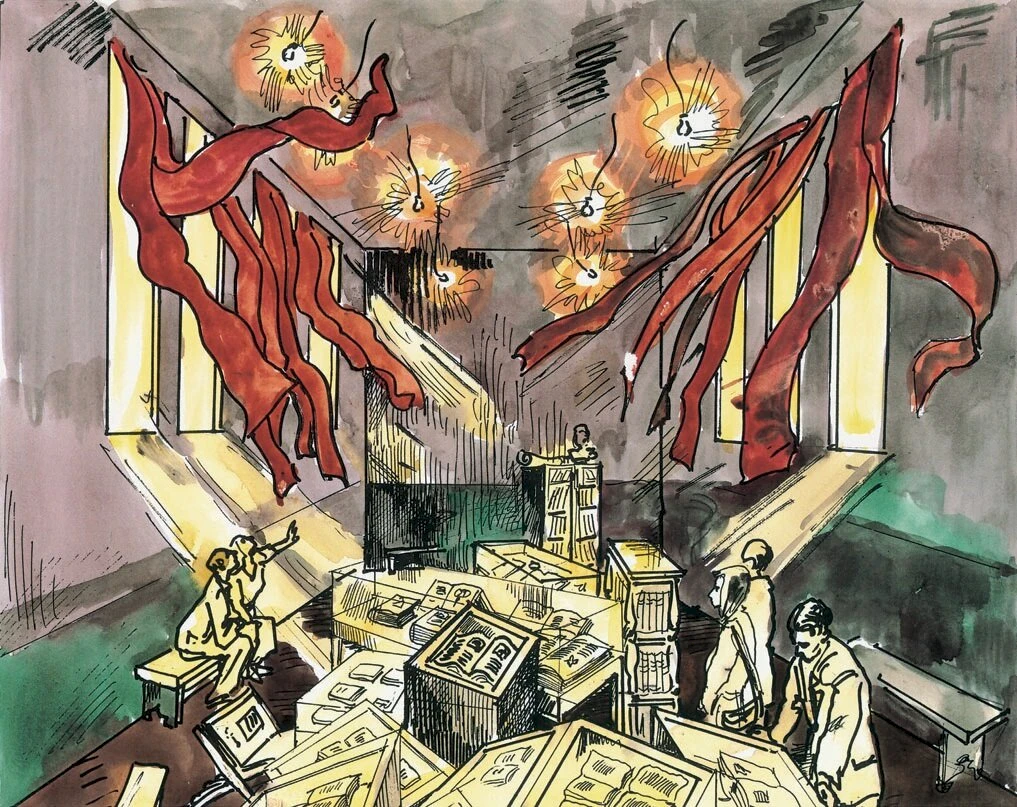
Ilya and Emilia Kabakov, The Old Reading Room, Doelenzaal, University of Amsterdam Library, 1999.
To begin close to home: while in Prague, I learnt that, in 1999, the University of Amsterdam (UvA), where I work, showed an installation by the Kabakovs, The Old Reading Room, in the Doelenzaal of the university’s library. For nearly ten years, I’ve been trying to attend to how my own university shows the art that it owns and commissions. Along with some colleagues, I became somewhat frustrated with for example the Doelenzaal’s appearance: together, we formed an ‘art committee’. For many years, this representative room of the university was adorned with posters from the 1950s referencing ‘het Oosten’ (the East) without further comment. The art committee directly challenged various instances of colonial framing, but to little effect, and now the Kabakovs’ work leads me to believe that we, or I, approached things too directly. Perhaps I was misled by the initial atmosphere when I arrived in the Netherlands in 2014. Then, there was a positive sense of change. It felt nearly 1968 or Prague Spring–like: internationally visible demonstrations took place, and the Senate House (Maagdenhuis) was occupied.6 My students and I added an exhibition to the visual culture of the occupation, looking at the history of a dozen previous occupations at the university, many of which were successful.7 Museums and partner universities we admired showed this self-perpetuating ‘Strijd ∞’ (‘Struggle ∞’) exhibition. Then came the reactions to the occupation, where the Humanities Faculty wanted at least to show itself to be diverse. For instance, it commissioned a group portrait of some excellent female scholars to add to the many individual portraits of male professors that hang in important rooms. But even this showed the limits of progressive change: the painting is isolated, it includes five women in one frame, and was painted by a man. In an essay that I felt compelled to write, I likened the painting’s colour scheme to works by the Kabakovs.8 The frame itself hangs just outside the ‘VOC zaal’, a single image to counter all past and present exclusions.9 To me, it seemed that the women, with their eternally smiling demeanour, were trapped in a Kabakov-coloured corridor, where West overtly meets East. The institution’s intention was (all too clearly, in my analysis) to draw attention to itself, its power and rituals (the mirror à la Velazquez, the composition à la Rembrandt), rather than to the work of the women, or to demonstrate real inclusivity by appointing at least one professor who is a woman of colour.
Under current conditions, to re-engage with the history of the university, and to do so by honouring the Kabakovs’ 1999 installation, became an inspiring task. Realized with the participation of some allies at UvA, documentation of The Old Reading Room occupies, at the time of writing, the space in which the work was installed in 1999 and will do so until the university has sold the building after the completion of a new city centre library in 2025.10
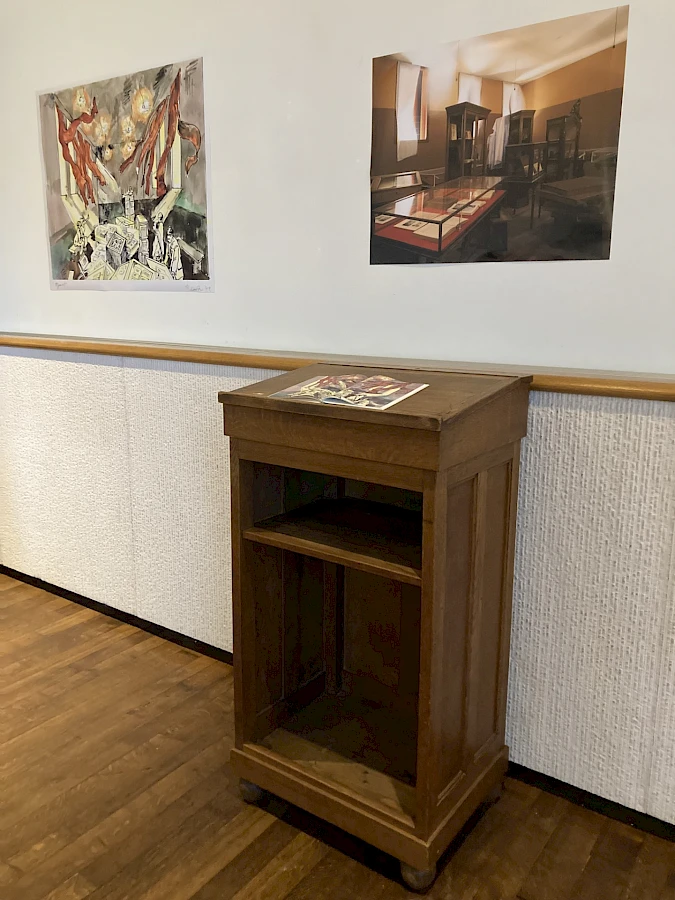
Documentation of Ilya and Emilia Kabakov, The Old Reading Room, 1999, at the Doelenzaal, University of Amsterdam Library, 2024.
In The Old Reading Room, the Kabakovs mirrored the university with its old (and colonially implicated) rooms onto itself. Located in a library building that struck the artists as cold and unsuitable, with its neon light and computers, their reading room, while described as ‘old’ and containing old furniture, was determinedly new. Surrounded by a (cold) wind blowing so as to make the curtains move, one could be within, but not of, the stifling culture of the modern, digitized and anonymous university. Within this meticulously designed (and expensive) room-within-a-room, they ‘reinstalled’ the institution as it would be in an alternative, more caring reality. This kind of scenario is rightly referred to as a ‘Borgesian map’.11 Rereading and overlaying an ossified reality with a different one that works in the interstices and through the disjunctures between word and image moves viewers and readers to think. And what better place to do that than in a university located in the centre of a city, over half of whose inhabitants were not born in the Netherlands, including me? We the majority, we ‘orphans’, need the Kabakovs’ gentle but substantive institutional intervention. I’m glad that they were here.
Another scene or vignette takes me to London’s South Bank, where Mike Nelson’s ‘Extinction Beckons’ retrospective took place at the Hayward Gallery in 2023.12 Nelson is a British artist in his late fifties, a Turner Prize nominee and a central figure in that post-imperial country. The show featured The Coral Reef (2000),13 a twenty-three-year-old work consisting of a succession of rooms that the artist explains as standing in for different ideologies. One could perform an iconographic analysis of The Coral Reef as indebted to the Kabakovs. This is not my intention here, even though Nelson himself acknowledges his debt to the artists. But the question does arise as to why a practice such as Nelson’s, that is so much ‘of the West’, would analyse society in a way that operates via absences, debris and ostensibly ‘normal’ items, such as machines taken from defunct UK industries? To return to and adapt the wording of the parable from above, ‘Western culture is apparently [not] so vital, its roots are [not] so deep and so alive, [Britain after Brexit is not] so productive that it absorbs, recasts and dissolves in itself all destructive actions by [even] its own children.’
At the time of my visit to the Nelson show, I was working in London with both the SPACEX partner MayDay Rooms (an activist archive) and the Warburg Institute. The latter was founded in the early years of the twentieth century by Jewish scholars in Germany who wanted to analyse, through images, the safety or otherwise of potential scapegoats in different societies and different places.14 In 1933 the library and research centre managed to flee to London. With a gaze sharpened by these institutions, I came across what appeared to me a Kabakovian trope in the Nelson exhibition. Alongside institutional accoutrements like pigeonholes, there were a series of noticeboards. These were part of the works and were sometimes cut to be incomplete, yet they also carried description labels of the kind used by the curators and Hayward staff to display information about the exhibition. Maybe the artist was engaging in critical play with an uncertain institutional voice, maybe the curators themselves were, or maybe the Brutalist building on the south bank of the River Thames instigated a slip between artwork and mediation? To me, under the influence of my other sites of study, the gesture silently exposed the state of UK institutions. I would suggest, further, that wherever we see the Kabakovs’ work, the experience might lead to similar revelations.
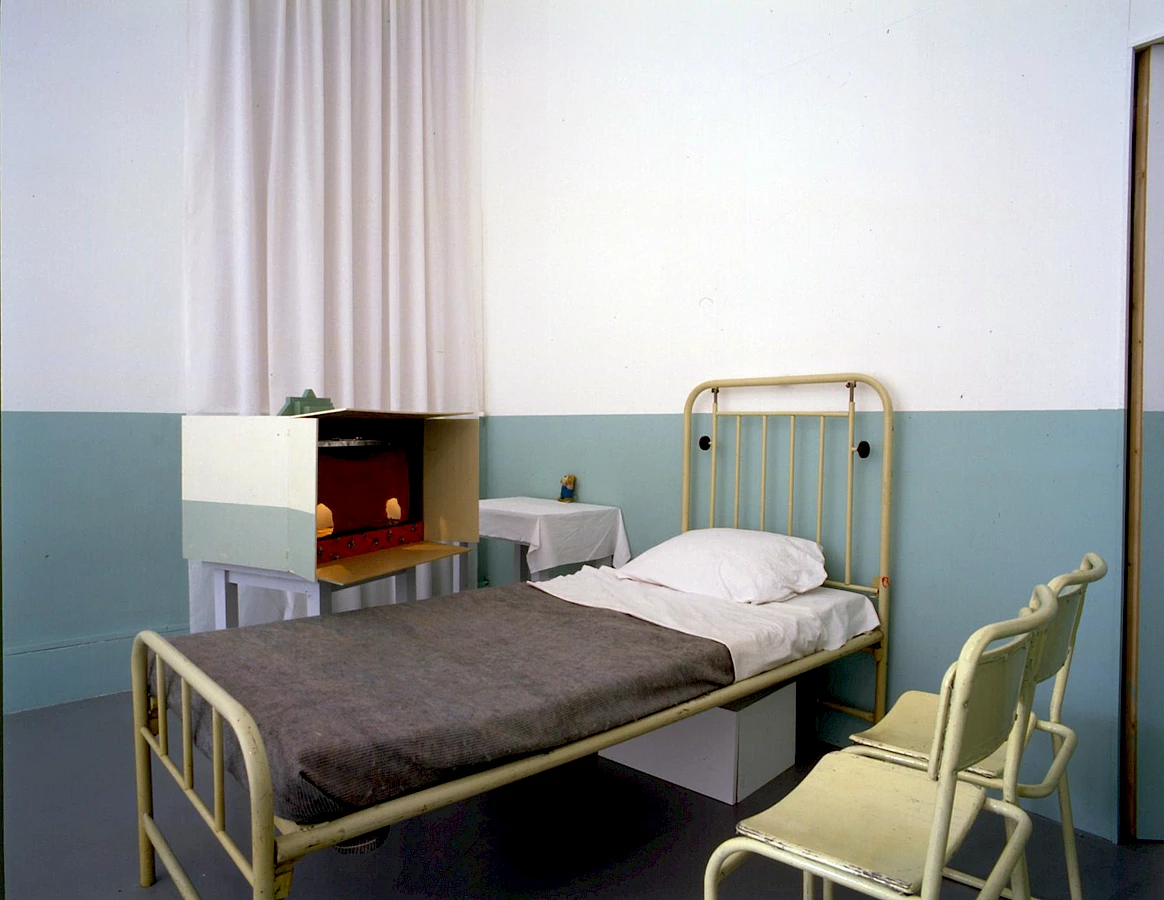
Ilya and Emilia Kabakov, The Mysterious Exhibition from the Children’s Hospital, 1998, IMMA, Dublin
We now proceed to scene number three, a museum very much aware of its building’s colonial past: the Irish Museum of Modern Art (IMMA) in Dublin. The museum is housed in the former, colonial Royal Hospital Kilmainham, established for the care and retirement of British Army veterans, whose ‘Self-Determination’ exhibition (2023–24) had an ambitious historical reckoning in its sights, as its title implies.15 Of those included in the exhibition, the installation that addressed the IMMA building most directly is the Kabakovs’ The Mysterious Exhibition from the Children’s Hospital (1998), a work perfectly suited to the museum’s difficult exhibition spaces, still hospital room-sized. Viewers could use the chairs and ‘visit’ the space of its installation, restored to its original function. As the title clarifies, there was no longer a British soldier, but a child notionally occupying the bed. There were more ‘double takes’, too. The gallery visitor was at once a hospital visitor who, from the patient’s perspective, viewed a populated gallery as a model-in-a-box wherein two minimalist works were displayed: a broken-off, cylindrical sculpture and an Arp-like, wall-mounted assemblage with a dot (in 3D) in the middle and a square, frame-like structure around it, both in red, resembling a bull’s-eye. Children’s books lay on the bedside table; anyone who has been in a hospital bed will be familiar with the childlike loss of agency it provokes. Patients are there to be observed (others can enter through the curtain at any time), however they most probably want to be elsewhere, for instance in a gallery where they could be the ones doing the observing. The installation was, characteristically for the Kabakovs, accompanied by a story, displayed on an institutional noticeboard, with the theme of art therapy – although of course it was unclear to what degree what was written was fictional. Suddenly, the visitor to the hospital that is a museum must come to reflect on the possibility that what they were doing was in some way healing; the various layers of the work had healing and recuperation as a common thread. A continuum was thus established between the original and current uses of the building, and it isn’t too far-fetched to think of the two as connected: a healing, a decolonizing moment of agency, and (per the exhibition title) self-determination.
To me, this work beautifully illustrates Ilya Kabakov’s description of public sculpture:
A public project for me is not a sculpture at all, but rather a kind of installation object that functions as an element of an already existing installation; it transforms even the most banal environment into the space of culture. Hence, what occurs is a transformation of the banal environment that surrounds the installation into a public project that reworks this environment and imparts to it another level of existence … . Although many components of our installation have been sculptural, what is important is that these sculptures do not draw attention to themselves. Rather, they appeal to the environment, proposing that we see ourselves together with that environment. They invite us to consider ourselves part of the environment and not merely as main characters against the background of the surrounding space … . The installations are constructed in such a way that they create the image of standing on the edge … . You are all the time looking at something that is slipping away, moving away from centre. It is a centrifugal and not centripetal movement … . The question then arises: where is the centre of the project that is supposed to be in the middle and meant to attract our attention? This centre is actually nominal. The viewer him/herself forms a centre by concentrating on his/her own personal … reaction … . All the public projects that we have undertaken are … meant to contain calming qualities. All of them are aimed at a principally positive meaning, owing to the fact that it is culture that ‘supports’ and will ‘support’ any work of art. This is the ethical ‘platform’ that was clear to us during the entire time we were realising these projects.16
This way of insisting on what is already there, understanding the viewer as an active and even central agent leads me to call the Kabakovs’ IMMA installation an ‘open work’, in the sense theorized in 1962 by Umberto Eco, on the basis of James Joyce’s literary work – an appropriate reference, given that this installation was in Dublin.17 By extension, this applies to other of their works as well.
There are many aspects of the Kabakovs’ oeuvre I am keen to explore further. Mikhail Epstein’s observations on voids or absences – for example, of how meaning is derived from discrepancies between word and image,18 and on the double takes inherent in their addressing both the benign art viewer and the institutional actor (e.g. the police interrogator) – resonate with my recent attempts to recoup Joyce for the margins,19 following Luke Gibbons in considering the writer as a force in the cultural construction of a thinking that is other than imperial or authoritarian.20 I see the Kabakovs as kindred spirits, similarly mythologizing everyday experiences of society’s ‘others’. Such thinking and standing together resonates with what Tina Campt, in A Black Gaze (2021), calls ‘adjacency’,21 a term I have previously explored in relation to Joyce’s work,22 which implies standing with those experiencing repression and violence, and refusing the expected averting of the gaze. Campt’s adjacency is expressed with the circumspection of what Tania Bruguera has called ‘political timing specificity’ – to be there and hold ground, but in a form of solidarity without triumphalism.23 I think of the rituals at Ilya Kabakov’s Moscow studio, showing albums to friends as a kind of bearing witness. Piotr Piotrowski has applied Giorgio Agamben’s term ‘bare life’ to Kabakov, an insight that also has affinity with Campt’s more recent coinage (as well as with Warburg’s work, on which Agamben has written).24
Moving to the next scene or work, I understand the hesitation that the Kabakovs expressed about showing The Toilet (1992) at documenta IX. Presenting a harsh and literal analysis of the state of the Eastern Bloc that had just literally ‘gone down the toilet’, the work furthers one of their central themes: the critique of forced communal living. Maybe the work was a little too triumphalist. What I appreciated about it, however, was how it made the refined audience of an art event, having paid a fairly hefty entrance fee, wait; wait as we once did, in front of the Konsum shop in East Germany, for bananas (rarely) or toilet paper. At documenta IX, one had to stand in line to see this dramatically conflated living space and doorless communal loo. Most Western visitors, unused to slum or tenement living, would have gazed at each other as voyeurs of an uncomfortable space, one lacking privacy, likely quietly relieved at their privilege. It is a shame that it was only at documenta 12, fifteen years after The Toilet was shown and a whole generation after 1989, that more Eastern European work was presented.
That it took so long for Eastern Europe to feature strongly in Kassel, just an hour’s drive from the former Iron Curtain, is certainly something that could dampen Ilya Kabakov’s enthusiasm about the vitality and productivity of Western culture expressed in the parable above. But it is also consonant with what I recall from my first decade and a half in the West, for instance when demonstrating as an undergraduate against a census in a Germany that wanted to ask too many questions. The GDR still existed then, still listened in when I talked on the phone to my family in the East. Society’s qualms about data privacy have seemingly all but vanished. Maintaining a belief in European culture may sound strange today, as if at odds with the Van Abbemuseum’s decolonial approach. But the idea of a possible Europe does persist, for figures such as Achille Mbembe, who speaks about the postcolonial project in these terms:
It invites us to an alternative reading of our modernity. It calls on Europe to responsibly live what it says are its origins, future, and promise. If, as Europe has always claimed, the goal of this promise really is the future of all of humanity, then postcolonial thought calls on Europe to constantly open and restart this future, in a singular manner, responsible for itself, for the Other, and before the Other. That having been said, Europe is no longer the center of the world.25
Mbembe asks Europe to do what it always promised – and what people behind the Iron Curtain (or ‘nylon curtain’, as it’s sometimes called with good reason) would, of course, cling to, hoping that ‘European culture’ was realized somewhere.
There are (at least) two sides to that belief in European culture, when considered via the Kabakovs’ practice. There is the ruthless and failing Soviet regime and then, after emigration in 1988, there is the West, from the outset referred to as always critical and destructive, even within culture. In Ilya Kabakov’s words:
[Among] many American artists … ignorance and suppression of the surrounding space seem to be axiomatic and are posited as goals from the outset. This tradition of the artist by which it seeks victory over the surrounding environment is, of course, a consequence of modernism … every place is absolutely empty for the modernist, a blank page on which he/she can write his/her immortal lines.26
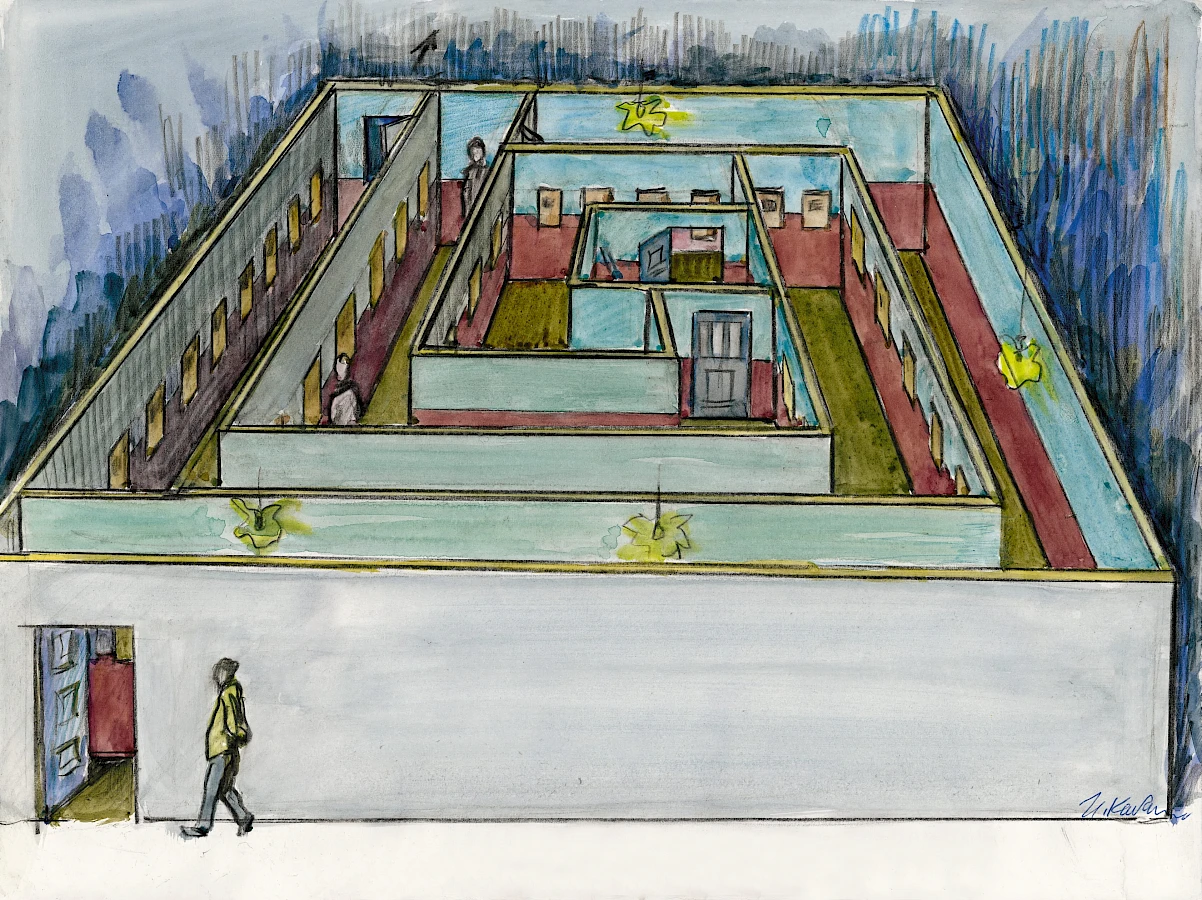
Ilya and Emilia Kabakov, Labyrinth (My Mother’s Album), 1990.
The last vignette takes me to Prague in 2024, where the centenary of Franz Kafka’s death was being celebrated with exhibitions and memorials. Kafka’s own restraint to the point of vanishing – expressed in his wish for his manuscripts to be burned, his focus on the small words in sentences, on ordinary people’s experiences in front of stifling, bureaucratic apparatuses – predates the Soviet era, of course. And yet, there is a sensibility linked to Joyce’s (or Beckett’s) anti-authoritarian work. This is work from the period we are accustomed to describing as modernism, but that doesn’t do what Ilya Kabakov ascribed to American (high) modernism. It is work that Deleuze and Guattari called ‘minor’ – and that, returning to Kabakov’s parable, is the experience of the orphaned child.
I wish that one of the several centennial Kafka exhibitions had included Labyrinth (My Mother’s Album) (1990) by the Kabakovs, with the little heap of dust and debris at the point where the viewers’ journey culminates. I find this moment incredibly moving. There was much absurdity in the ‘Kafkaesque’ show at DOX in Prague,27 but unfortunately the works there often lacked Kafka’s restraint. Born from authoritarian experiences in the Austro-Hungarian Empire, it was undoubtedly different to that engendered in the later Soviet Union, yet much is recognizable in what Boris Groys wrote about Ilya Kabakov:
[He] has discovered something here that is even more absurd than the Absurd itself: the Absurd isn’ [sic] recognized as absurd. Taboos are violated, boundaries transgressed, risks taken – and no one notices … . I find it relieving, even liberating.[[twentyeigh]]
Prague is not just the city of Kafka, but also that of Václav Havel. In The Power of the Powerless (1977), Havel sketches a picture with the help of two semi-fictional characters, not ten, like in Kabakov’s albums. Havel’s villain is the shopkeeper, who puts up a sign reading ‘Workers of the World, Unite’ in his grocery shop window. Not that anyone really reads it or thinks that he has done so out of conviction. The purpose is clear: to signal compliance. And because he does, he helps to create and uphold a situation where others have to follow suit. Havel’s hero is a brewery worker, who knows his trade better than the manager. He tries to make suggestions for improvement and eventually writes a letter about what to do for better beer. He is of course dismissed and penalized. As summarized by Timothy Snyder, in his introduction to Havel’s book:
The system is totalitarian not because some individual has total power, but because power is shared in conditions of total irresponsibility. There is no clear line between evil and good, power and servitude, Party and people, because ‘this line runs de facto through each person, for everyone in his or her own way is both a victim and a supporter of the system.’ … Freedom is not doing the things that you are inclined to do. It is reflecting upon what you ought to do, as your unrepeatable self, and just occasionally taking a risk and doing that thing.[[ttwentynine]]
Havel, who in 1977 was already talking about ecology, insisted that his book addressed the West, too, or any ‘normalized’, thoughtless, technologized life. The everyday absurdity that permeates the Kabakovs’ work speaks (to a large extent, and across geographic or historical boundaries) to the difference between apparatuses, institutions, states and so forth, that address people’s needs, and those that are working to serve their own interests, engaging in rituals that merely purport to address real-life issues. Those on the receiving end of the latter may be thoughtful and sharp in their analyses but must not speak the truth, as the regime has ossified to such an extent that it chooses to mete out violence instead of correcting its ways. What a reviewer calls:
the drab and oppressively decrepit details of quotidian existence in Russia [where Ilya Kabakov] made an art practice of conversing about it with brilliantly indirect, disengaged methods that result in an oblique but trenchant analysis … . The double official/unofficial life as artists, the contrast between the Soviet state as described and the experience of living it, the gap between knowing and being, created a strange alienation from immediate experience.30
This ‘it’ – that is, the kind of experience I have called that of the orphan (per Kabakov’s parable) – is, I argue, an affective layer that makes it crucial for us to speak about decolonial work and ‘delinking’ not only in relation to former colonial situations but also to practices responding, like the Kabakovs’, to authoritarianisms and being othered in a great variety of contexts.31
This is the point at which, in more and more comparable scenarios in more and more countries (the victims of the toeslagaffaire, the child benefit scandal in the Netherlands, for example), those in the West increasingly find themselves identifying with not only a Kafkaesque reality, but also with the unfortunate need to adopt strategies in their dealings with those in power that are recognizable from Ilya Kabakov, Kafka himself and others. Those of us invested in such matters need to get together and consider art’s role within and around them – and our own role. Where these are taken on board, as the Kabakovs showed us, while much goes down the toilet, much may also be connected and revealed.32 Responsibility, humility and thoughtfulness can be gleaned from Kabakov artworks. When we read between word and image, it is possible to distinguish between an emptiness that is stifling and ossified and one that is open and activating, between what Havel calls being within the truth of one’s life and being ‘willing to live within the lie’ as the normalized state of affairs.33 When we recognize from this vantage point the scary proximity of the Kabakovs’ work to where we find ourselves today, the task of ‘doing that thing’ (Havel) really begins. So, it is not just on the basis of having been born in East Germany that I formulate this reading. A socialization in critically-thinking circles was certainly important, but not identity as a category. Spending nearly a decade in the GDR helped, but so did a decade in the north of Ireland, as does the experience of a decade in Amsterdam. All and any of us who have been faced with the question of whether to state the blatantly obvious, logical, empathetic and caring thing, or to allow to continue that hollow, irresponsible ‘joy’ called, in the Eastern Bloc, normalization, that we feel today in our ecocidal, genocidal and uneven norms; everybody with such experience knows that other strategies are needed, strategies where the dissidence (if I can call it that) lies in working with the discrepancies between what word and image communicate.34
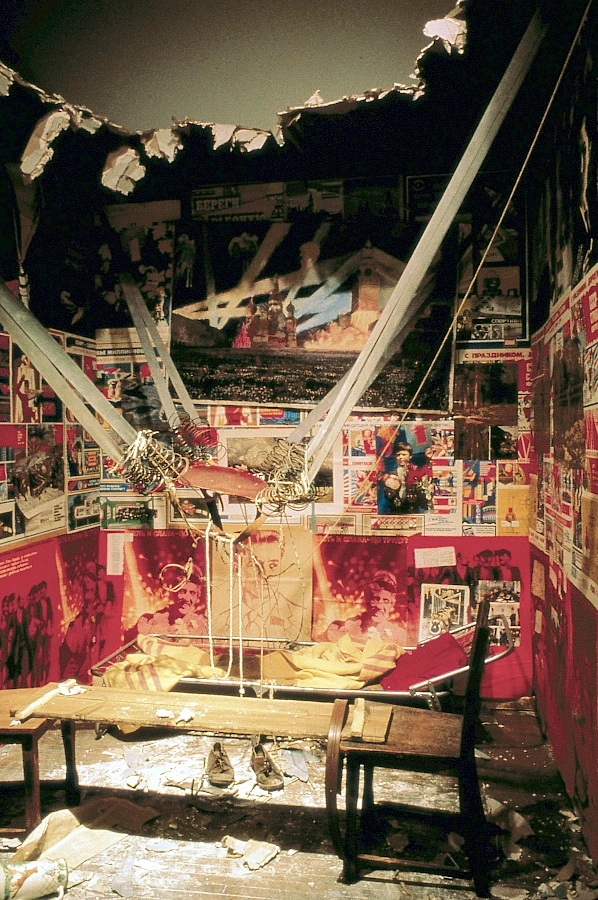
Ilya and Emilia Kabakov, The Man Who Flew into Space from His Apartment, 1985.
The Kabakovs’ works are not just installations. They are literally performative, and they transport us into a world outside of total irresponsibility (Havel), if only through recognition of the fact that these works were, are, and unfortunately, will be an appropriate response. And this cuts to the core of my field, of what is sometimes called ‘art history’, where I, for one, have to grapple with the growing realization that supposedly transparent, academic prose is not a universal vehicle, and not even the best one. For the moment, for me, there is the nearly eponymous SPACEX project that enables me (among many others) to counter, in a modest way, the spirit of Elon Musk’s all-conquering exoplanetary drive. Like Ilya Kabakov’s The Man Who Flew into Space from His Apartment (1985), it catapults me to partnerships in the art places that matter, such as the Van Abbemuseum. Here, after Mbembe (and of course with EU funding), I can try to ask Europe to do what it always said it would do. Here are kindred spirits in the ever-more-embattled art and academic sectors, who attempt to go beyond self-interest and identity-based solidarities. Tina Campt’s beautiful term ‘adjacency’ grasps it better: different but adjacent people face what we don’t know yet, and also what we already know all too well. The next question, asked subtly, with open eyes and suitable restraint, again has to be: What is to be done?
Related activities
-
–Van Abbemuseum
The Soils Project
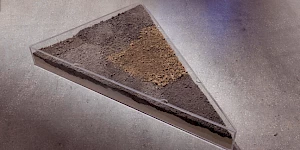
‘The Soils Project’ is part of an eponymous, long-term research initiative involving TarraWarra Museum of Art (Wurundjeri Country, Australia), the Van Abbemuseum (Eindhoven, Netherlands) and Struggles for Sovereignty, a collective based in Yogyakarta, Indonesia. It works through specific and situated practices that consider soil, as both metaphor and matter.
Seeking and facilitating opportunities to listen to diverse voices and perspectives around notions of caring for land, soil and sovereign territories, the project has been in development since 2018. An international collaboration between three organisations, and several artists, curators, writers and activists, it has manifested in various iterations over several years. The group exhibition ‘Soils’ at the Van Abbemuseum is part of Museum of the Commons. -
–VCRC
Kyiv Biennial 2023
L’Internationale Confederation is a proud partner of this year’s edition of Kyiv Biennial.
-
–MACBA
Where are the Oases?
PEI OBERT seminar
with Kader Attia, Elvira Dyangani Ose, Max Jorge Hinderer Cruz, Emily Jacir, Achille Mbembe, Sarah Nuttall and Françoise VergèsAn oasis is the potential for life in an adverse environment.
-
MACBA
Anti-imperialism in the 20th century and anti-imperialism today: similarities and differences
PEI OBERT seminar
Lecture by Ramón GrosfoguelIn 1956, countries that were fighting colonialism by freeing themselves from both capitalism and communism dreamed of a third path, one that did not align with or bend to the politics dictated by Washington or Moscow. They held their first conference in Bandung, Indonesia.
-
–Van Abbemuseum
Maria Lugones Decolonial Summer School
Recalling Earth: Decoloniality and Demodernity
Course Directors: Prof. Walter Mignolo & Dr. Rolando VázquezRecalling Earth and learning worlds and worlds-making will be the topic of chapter 14th of the María Lugones Summer School that will take place at the Van Abbemuseum in Eindhoven.
-
–MSN Warsaw
Archive of the Conceptual Art of Odesa in the 1980s
The research project turns to the beginning of 1980s, when conceptual art circle emerged in Odesa, Ukraine. Artists worked independently and in collaborations creating the first examples of performances, paradoxical objects and drawings.
-
–Moderna galerijaZRC SAZU
Summer School: Our Many Easts
Our Many Easts summer school is organised by Moderna galerija in Ljubljana in partnership with ZRC SAZU (the Research Centre of the Slovenian Academy of Sciences and Arts) as part of the L’Internationale project Museum of the Commons.
-
–Moderna galerijaZRC SAZU
Open Call – Summer School: Our Many Easts
Our Many Easts summer school takes place in Ljubljana 24–30 August and the application deadline is 15 March. Courses will be held in English and cover topics such as the legacy of the Eastern European avant-gardes, archives as tools of emancipation, the new “non-aligned” networks, art in times of conflict and war, ecology and the environment.
-
–MACBA
Song for Many Movements: Scenes of Collective Creation
An ephemeral experiment in which the ground floor of MACBA becomes a stage for encounters, conversations and shared listening.
-
Museo Reina Sofia
Palestine Is Everywhere
‘Palestine Is Everywhere’ is an encounter and screening at Museo Reina Sofía organised together with Cinema as Assembly as part of Museum of the Commons. The conference starts at 18:30 pm (CET) and will also be streamed on the online platform linked below.
-
HDK-Valand
Book Launch: Collective Study in Times of Emergency, Gothenburg
with Nick Aikens (L'Internationale Online / HDK-Valand) and Mills Dray (HDK-Valand), 17h00, Glashuset
-
Moderna galerija
Book Launch: Collective Study in Times of Emergency, Ljubljana
with Nick Aikens (L'Internationale Online / HDK-Valand), Bojana Piškur (MG+MSUM) and Martin Pogačar (ZRC SAZU)
-
WIELS
Book Launch: Collective Study in Times of Emergency, Brussels
with Nick Aikens (L'Internationale Online / HDK-Valand), Subversive Film and Alex Reynolds, 19h00, Wiels Auditorium
-
–
Kyiv Biennial 2025
L’Internationale Confederation is proud to co-organise this years’ edition of the Kyiv Biennial.
-
–MACBA
Project a Black Planet: The Art and Culture of Panafrica

Curated by MACBA director Elvira Dyangani Ose, along with Antawan Byrd, Adom Getachew and Matthew S. Witkovsky, Project a Black Planet: The Art and Culture of Panafrica is the first major international exhibition to examine the cultural manifestations of Pan-Africanism from the 1920s to the present.
-
–M HKA
The Geopolitics of Infrastructure

The exhibition The Geopolitics of Infrastructure presents the work of a generation of artists bringing contemporary perspectives on the particular topicality of infrastructure in a transnational, geopolitical context.
-
–MACBAMuseo Reina Sofia
School of Common Knowledge 2025
The second iteration of the School of Common Knowledge will bring together international participants, faculty from the confederation and situated organizations in Barcelona and Madrid.
-
NCAD
Book Launch: Collective Study in Times of Emergency, Dublin

with Nick Aikens (L'Internationale Online / HDK-Valand) and members of the L'Internationale Online editorial board: Maria Berríos, Sheena Barrett, Sara Buraya Boned, Charles Esche, Sofia Dati, Sabel Gavaldon, Jasna Jaksic, Cathryn Klasto, Magda Lipska, Declan Long, Francisco Mateo Martínez Cabeza de Vaca, Bojana Piškur, Tove Posselt, Anne-Claire Schmitz, Ezgi Yurteri, Martin Pogacar, and Ovidiu Tichindeleanu, 18h00, Harry Clark Lecture Theatre, NCAD
-
–
Collective Study in Times of Emergency, Amsterdam
Within the context of ‘Every Act of Struggle’, the research project and exhibition at de appel in Amsterdam, L’Internationale Online has been invited to propose a programme of collective study.
-
Museo Reina Sofia
Poetry readings: Culture for Peace – Art and Poetry in Solidarity with Palestine
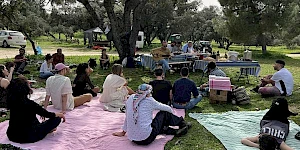
Casa de Campo, Madrid
-
WIELS
Collective Study in Times of Emergency, Brussels. Rana Issa and Shayma Nader
Join us at WIELS for an evening of fiction and poetry as part of L'Internationale Online's 'Collective Study in Times of Emergency' publishing series and public programmes. The series was launched in November 2023 in the wake of the onset of the genocide in Palestine and as a means to process its implications for the cultural sphere beyond the singular statement or utterance.
-
–Museo Reina Sofia
Study Group: Aesthetics of Peace and Desertion Tactics
In a present marked by rearmament, war, genocide, and the collapse of the social contract, this study group aims to equip itself with tools to, on one hand, map genealogies and aesthetics of peace – within and beyond the Spanish context – and, on the other, analyze strategies of pacification that have served to neutralize the critical power of peace struggles.
-
–MSN Warsaw
Near East, Far West. Kyiv Biennial 2025
The main exhibition of the 6th Kyiv Biennial 2025, titled Near East, Far West, is organized by a consortium of curators from L’Internationale. It features seven new artists’ commissions, alongside works from the collections of member institutions of L’Internationale and a number of other loans.
-
MACBA
PEI Obert: The Brighter Nations in Solidarity: Even in the Midst of a Genocide, a New World Is Being Born
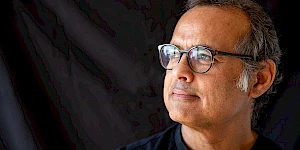
PEI Obert presents a lecture by Vijay Prashad. The Colonial West is in decay, losing its economic grip on the world and its control over our minds. The birth of a new world is neither clear nor easy. This talk envisions that horizon, forged through the solidarity of past and present anticolonial struggles, and heralds its inevitable arrival.
-
–M HKA
Homelands and Hinterlands. Kyiv Biennial 2025
Following the trans-national format of the 2023 edition, the Kyiv Biennial 2025 will again take place in multiple locations across Europe. Museum of Contemporary Art Antwerp (M HKA) presents a stand-alone exhibition that acts also as an extension of the main biennial exhibition held at the newly-opened Museum of Modern Art in Warsaw (MSN).
In reckoning with the injustices and atrocities committed by the imperialisms of today, Kyiv Biennial 2025 reflects with historical consciousness on failed solidarities and internationalisms. It does this across an axis that the curators describe as Middle-East-Europe, a term encompassing Central Eastern Europe, the former-Soviet East and the Middle East.
-
HDK-Valand
MA Forum in collaboration with LIO: Nour Shantout
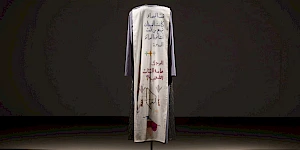
In this artist talk, Nour Shantout will present Searching for the New Dress, an ongoing artistic research project that looks at Palestinian embroidery in Shatila, a Palestinian refugee camp in Lebanon. Welcome!
-
MACBA
PEI Obert: Bodies of Evidence. A lecture by Ido Nahari and Adam Broomberg
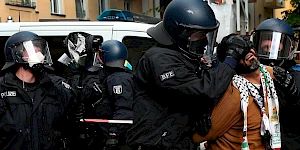
In the second day of Open PEI, writer and researcher Ido Nahari and artist, activist and educator Adam Broomberg bring us Bodies of Evidence, a lecture that analyses the circulation and functioning of violent images of past and present genocides. The debate revolves around the new fundamentalist grammar created for this documentation.
-
–
Everything for Everybody. Kyiv Biennial 2025
As one of five exhibitions comprising the 6th Kyiv Biennial 2025, ‘Everything for Everybody’ takes place in the Ukraine, at the Dnipro Center for Contemporary Culture.
-
–
In a Grandiose Sundance, in a Cosmic Clatter of Torture. Kyiv Biennial 2025
As one of five exhibitions comprising the 6th Kyiv Biennial 2025, ‘In a Grandiose Sundance, in a Cosmic Clatter of Torture’ takes place at the Dovzhenko Centre in Kyiv.
-
MACBA
School of Common Knowledge: Fred Moten
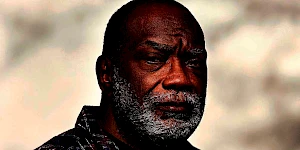
Fred Moten gives the lecture Some Prœposicions (On, To, For, Against, Towards, Around, Above, Below, Before, Beyond): the Work of Art. As part of the Project a Black Planet exhibition, MACBA presents this lecture on artworks and art institutions in relation to the challenge of blackness in the present day.
-
–MACBA
Visions of Panafrica. Film programme
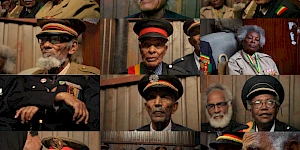
Visions of Panafrica is a film series that builds on the themes explored in the exhibition Project a Black Planet: The Art and Culture of Panafrica, bringing them to life through the medium of film. A cinema without a geographical centre that reaffirms the cultural and political relevance of Pan-Africanism.
-
MACBA
Farah Saleh. Balfour Reparations (2025–2045)

As part of the Project a Black Planet exhibition, MACBA is co-organising Balfour Reparations (2025–2045), a piece by Palestinian choreographer Farah Saleh included in Hacer Historia(s) VI (Making History(ies) VI), in collaboration with La Poderosa. This performance draws on archives, memories and future imaginaries in order to rethink the British colonial legacy in Palestine, raising questions about reparation, justice and historical responsibility.
-
MACBA
Project a Black Planet: The Art and Culture of Panafrica OPENING EVENT
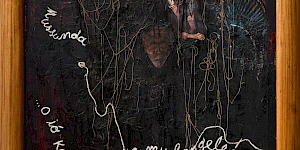
A conversation between Antawan I. Byrd, Adom Getachew, Matthew S. Witkovsky and Elvira Dyangani Ose. To mark the opening of Project a Black Planet: The Art and Culture of Panafrica, the curatorial team will delve into the exhibition’s main themes with the aim of exploring some of its most relevant aspects and sharing their research processes with the public.
-
MACBA
Palestine Cinema Days 2025: Al-makhdu’un (1972)
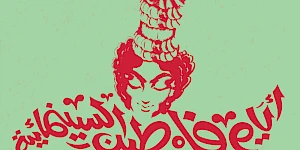
Since 2023, MACBA has been part of an international initiative in solidarity with the Palestine Cinema Days film festival, which cannot be held in Ramallah due to the ongoing genocide in Palestinian territory. During the first days of November, organizations from around the world have agreed to coordinate free screenings of a selection of films from the festival. MACBA will be screening the film Al-makhdu’un (The Dupes) from 1972.
-
Museo Reina Sofia
Cinema Commons #1: On the Art of Occupying Spaces and Curating Film Programmes
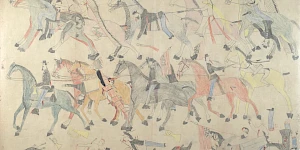
On the Art of Occupying Spaces and Curating Film Programmes is a Museo Reina Sofía film programme overseen by Miriam Martín and Ana Useros, and the first within the project The Cinema and Sound Commons. The activity includes a lecture and two films screened twice in two different sessions: John Ford’s Fort Apache (1948) and John Gianvito’s The Mad Songs of Fernanda Hussein (2001).
-
–
Vertical Horizon. Kyiv Biennial 2025
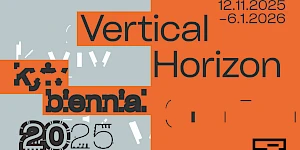
As one of five exhibitions comprising the 6th Kyiv Biennial 2025, ‘Vertical Horizon’ takes place at the Lentos Kunstmuseum in Linz, at the initiative of tranzit.at.
-
–
International Day of Solidarity with the Palestinian People: Activities
To mark International Day of Solidarity with the Palestinian People and in conjunction with our collective text, we, the cultural workers of L'Internationale have compiled a list of programmes, actions and marches taking place accross Europe. Below you will find programmes organized by partner institutions as well as activities initaited by unions and grass roots organisations which we will be joining.
This is a live document and will be updated regularly.
-
–SALT
Screening: A Bunch of Questions with No Answers
This screening is part of a series of programs and actions taking place across L’Internationale partners to mark International Day of Solidarity with the Palestinian People.
A Bunch of Questions with No Answers (2025)
Alex Reynolds, Robert Ochshorn
23 hours 10 minutes
English; Turkish subtitles -
HDK-Valand
MA Forum in collaboration with LIO: Adam Broomberg
In this MA Forum we welcome artist Adam Broomberg. In his lecture he will focus on two photographic projects made in Israel/Palestine twenty years apart. Both projects use the medium of photography to communicate the weaponization of nature.
-
MACBA
PEI Obert: Until Liberation: A Collective Reading and Listening Session by Learning Palestine
PEI Obert presents a collective session with Learning Palestine. At this historical juncture – amid the ongoing genocide in Gaza and the censorship and repression of all things Palestinian – Learning Palestine invites us to gather not only in refusal but also in affirmation.
Related contributions and publications
-
…and the Earth along. Tales about the making, remaking and unmaking of the world.
Martin PogačarLand RelationsClimatePast in the Present -
The Kitchen, an Introduction to Subversive Film with Nick Aikens, Reem Shilleh and Mohanad Yaqubi
Nick Aikens, Subversive FilmSonic and Cinema CommonslumbungPast in the PresentVan Abbemuseum -
The Repressive Tendency within the European Public Sphere
Ovidiu ŢichindeleanuInternationalismsPast in the Present -
Rewinding Internationalism
InternationalismsVan Abbemuseum -
Troubles with the East(s)
Bojana PiškurInternationalismsPast in the Present -
Right now, today, we must say that Palestine is the centre of the world
Françoise VergèsInternationalismsPast in the Present -
Body Counts, Balancing Acts and the Performativity of Statements
Mick WilsonInternationalismsPast in the Present -
Until Liberation I
Learning Palestine GroupInternationalismsPast in the Present -
Until Liberation II
Learning Palestine GroupInternationalismsPast in the Present -
The Veil of Peace
Ovidiu ŢichindeleanuPast in the Presenttranzit.ro -
Editorial: Towards Collective Study in Times of Emergency
L’Internationale Online Editorial BoardEN es sl tr arInternationalismsStatements and editorialsPast in the Present -
Opening Performance: Song for Many Movements, live on Radio Alhara
Jokkoo with/con Miramizu, Rasheed Jalloul & Sabine SalaméEN esInternationalismsSonic and Cinema CommonsPast in the PresentMACBA -
Siempre hemos estado aquí. Les poetas palestines contestan
Rana IssaEN es tr arInternationalismsPast in the Present -

Indra's Web
Vandana SinghLand RelationsPast in the PresentClimate -
Diary of a Crossing
Baqiya and Yu’adInternationalismsPast in the Present -
The Silence Has Been Unfolding For Too Long
The Free Palestine Initiative CroatiaInternationalismsPast in the PresentSituated OrganizationsInstitute of Radical ImaginationMSU Zagreb -
En dag kommer friheten att finnas
Françoise Vergès, Maddalena FragnitoEN svInternationalismsLand RelationsClimateInstitute of Radical Imagination -
Everything will stay the same if we don’t speak up
L’Internationale ConfederationEN caInternationalismsStatements and editorials -

War, Peace and Image Politics: Part 1, Who Has a Right to These Images?
Jelena VesićInternationalismsPast in the PresentZRC SAZU -
Live set: Una carta de amor a la intifada global
PrecolumbianEN esInternationalismsSonic and Cinema CommonsPast in the PresentMACBA -
Cultivating Abundance
Åsa SonjasdotterLand RelationsClimatePast in the Present -
Rethinking Comradeship from a Feminist Position
Leonida KovačSchoolsInternationalismsSituated OrganizationsMSU ZagrebModerna galerijaZRC SAZU -
Reading list - Summer School: Our Many Easts
Summer School - Our Many EastsSchoolsPast in the PresentModerna galerija -
The Genocide War on Gaza: Palestinian Culture and the Existential Struggle
Rana AnaniInternationalismsPast in the Present -
Klei eten is geen eetstoornis
Zayaan KhanEN nl frLand RelationsClimatePast in the Present -
Dispatch: ‘I don't believe in revolution, but sometimes I get in the spirit.’
Megan HoetgerSchoolsPast in the Present -
Dispatch: Notes on (de)growth from the fragments of Yugoslavia's former alliances
Ava ZevopSchoolsPast in the Present -

Glöm ”aldrig mer”, det är alltid redan krig
Martin PogačarEN svLand RelationsPast in the Present -
Broadcast: Towards Collective Study in Times of Emergency (for 24 hrs/Palestine)
L’Internationale Online Editorial Board, Rana Issa, L’Internationale Confederation, Vijay PrashadInternationalismsSonic and Cinema Commons -
Beyond Distorted Realities: Palestine, Magical Realism and Climate Fiction
Sanabel Abdel RahmanEN trInternationalismsPast in the PresentClimate -

Collective Study in Times of Emergency. A Roundtable
Nick Aikens, Sara Buraya Boned, Charles Esche, Martin Pogačar, Ovidiu Ţichindeleanu, Ezgi YurteriInternationalismsPast in the PresentSituated Organizations -

Present Present Present. On grounding the Mediateca and Sonotera spaces in Malafo, Guinea-Bissau
Filipa CésarSonic and Cinema CommonsPast in the Present -
Collective Study in Times of Emergency
InternationalismsPast in the Present -
S come Silenzio
Maddalena FragnitoEN itInternationalismsSituated Organizations -
ميلاد الحلم واستمراره
Sanaa SalamehEN hr arInternationalismsPast in the Present -
عن المكتبة والمقتلة: شهادة روائي على تدمير المكتبات في قطاع غزة
Yousri al-GhoulEN arInternationalismsPast in the Present -

Archivos negros: Episodio I. Internacionalismo radical y panafricanismo en el marco de la guerra civil española
Tania Safura AdamEN esInternationalismsPast in the Present -

Re-installing (Academic) Institutions: The Kabakovs’ Indirectness and Adjacency
Christa-Maria Lerm HayesInternationalismsPast in the Present -
Palma daktylowa przeciw redeportacji przypowieści, czyli europejski pomnik Palestyny
Robert Yerachmiel SnidermanEN plInternationalismsPast in the PresentMSN Warsaw -

Masovni studentski protesti u Srbiji: Mogućnost drugačijih društvenih odnosa
Marijana Cvetković, Vida KneževićEN rsInternationalismsPast in the Present -
No Doubt It Is a Culture War
Oleksiy Radinsky, Joanna ZielińskaInternationalismsPast in the Present -
Cinq pierres. Une suite de contes
Shayma NaderEN nl frInternationalisms -
Dispatch: As Matter Speaks
Yeongseo JeeInternationalismsPast in the Present -
Speaking in Times of Genocide: Censorship, ‘social cohesion’ and the case of Khaled Sabsabi
Alissar SeylaInternationalisms -
Reading List: Summer School, Landscape (post) Conflict
Summer School - Landscape (post) ConflictSchoolsLand RelationsPast in the PresentIMMANCAD -
Today, again, we must say that Palestine is the centre of the world
Françoise VergèsInternationalisms -
Isabella Hammad’ın icatları
Hazal ÖzvarışEN trInternationalisms -
To imagine a century on from the Nakba
Behçet ÇelikEN trInternationalisms -
Internationalisms: Editorial
L'Internationale Online Editorial BoardInternationalisms -
Dispatch: Institutional Critique in the Blurst of Times – On Refusal, Aesthetic Flattening, and the Politics of Looking Away
İrem GünaydınInternationalisms -

Until Liberation III
Learning Palestine GroupInternationalismsPast in the Present -
Archivos negros: Episodio II. Jazz sin un cuerpo político negro
Tania Safura AdamEN esInternationalismsPast in the Present -
Cultural Workers of L’Internationale mark International Day of Solidarity with the Palestinian People
Cultural Workers of L’InternationaleEN es pl roInternationalismsSituated OrganizationsPast in the PresentStatements and editorials -
Poetry Against Language Dioxide
Rana IssaInternationalisms -
The Object of Value
SlinkoInternationalismsLand Relations -
Translated into Socialism: An experiment in internationalism
Merve Elveren, Tevfik Rada, Sezgin BoynikInternationalisms