The Fifth Estate: On Museums, Public Imagination and the Vanishing Space for Collectivity
In this wide ranging essay, written in the context of the Flemish government's announcement to redraw the Flemish museological landscape, curators Philippe Pirotte and Els Silvrants-Barclay reflect on the status of the museum in today's political climate. Lamenting the current appetite for managerialism and efficiency they call for a recognition of the vital and generative relations between collections, contemporary art, place and collective imagination. The essay was written by Pirotte in conversation with Silvrants-Barclay. The Dutch text was translated to English by Charles Esche.
I. A house for collective reflection
In the Austronesian part of the world, they are called rumah adat: traditional community houses where ritual objects symbolizing communal memory and value are preserved. The rumah adat, literally the ‘house of customary law’, is both an archive and a mirror. It is a place where a community recognizes, reinterprets and reinvents itself. The objects that reside there are never dead relics but living interlocutors in a continuous redefinition of what it might mean to live together. In a Western context, one way of understanding the role and social relations of the contemporary art museum might be in terms of the rumah adat. Such museums are places in society where values, tensions and imagination are made visible. Beside their role as depositories of art, they also record what Jacques Rancière calls the ‘distribution of the sensible’,1 or the way in which societies negotiate what is allowed to become visible, audible and thinkable. In these terms, museums can never be neutral infrastructures. They are necessarily politically charged perceptual machines and places where, more fundamentally, a democratic society can also exercise dissent.
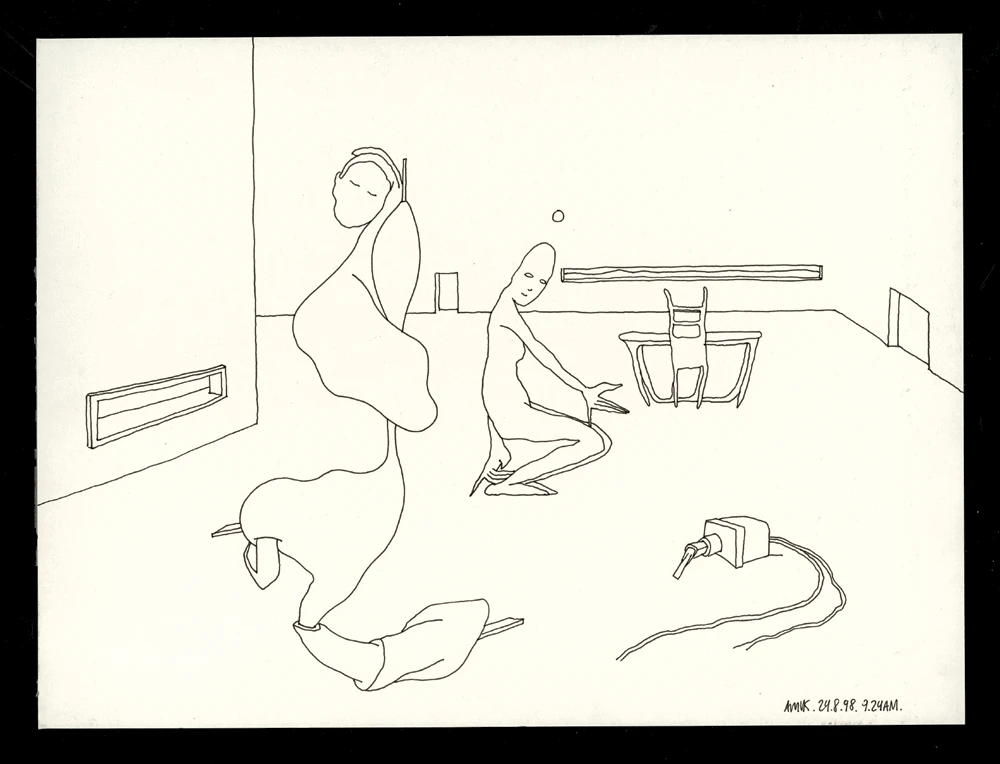
Anne-Mie Van Kerckhoven/AMVK, Museum, 1998. Courtesy the artist
The contemporary art collection plays a crucial role here. The artworks gathered by the museum build stories that (should) return us again and again to the places and communities that give them life and meaning. The artworks are literally ‘ballast’. They provide a counterweight to our turbulent relationship with reality. In that sense, the ongoing ‘incompleteness’ of the collection is precisely its added value. Its gaps fuel the conversations that resonate in this Western rumah adat. These gaps are precisely the reason to continually rewrite and supplement the stories of the collection with new works of art: to constantly reimagine the world from within the heart of the museum.
It is this function of the museum that is becoming increasingly difficult to sustain, and not only in Flanders or Belgium. The social relationship with art and heritage is increasingly transactional. As Belgian citizens, as in some other cultural systems, we pay for our museums threefold: through the art we generate as a society and often entrust to our institutions as donations; through the taxes we pay to finance these institutions; and through an entrance ticket that grants us access to what is actually already ours. Free museum visits, once commonplace for public collections, are increasingly dismissed as an idealistic anachronism, even by socialist politicians. The fact that free access is no longer a given says a lot about how the ideological self-image of our society has shifted. An interest in participatory public meaning-making through dynamic engagement with collections has become an internalized obsession with market logic. Elsewhere, things can, apparently, be done differently: access to most public collections in the United Kingdom, for example, is free of charge, as are some private foundations.
At the same time, in a globalized world, a trend has emerged in which private collections or large franchises, such as Tempora (based in Belgium) and Nomad (based in Scotland), provide public museums and art galleries with perfectly packaged ‘exhibition goods’.2 These travelling spectacles stop locally anchored collections playing their role as ‘conversation pieces’ for stories and imaginations to be built and rebuilt in specific communities. The same market-driven mindset has increasingly forced museums to prove their value in terms of visitor numbers and spectacular forms of attention. The focus is no longer artistic, educational or community-oriented, but on the ‘Key Performance Indicators’ or ‘KPIs’ that convince policymakers of the economic relevance of institutions. Museums thus become deliverers of commercial ‘targets’ rather than sites where meaning is built. The public becomes the consumer; the space for wonder is a paid experience provided within a fixed time slot. In this process, it is hardly surprising that long-established museums can be thoughtlessly sold off or dismantled, often without any real ideological pushback.
II. The crisis of governance
The recent announcement of the Flemish government to redraw the Flemish museum landscape fits seamlessly with its appetite for managerialism and efficiency. They plan to scrap the construction of a long-promised new building for the Museum of Contemporary Art in Antwerp (M HKA), turn the museum into an arts centre, and uproot its collection to the City Museum for Contemporary Art (S.M.A.K.) in Ghent. Behind terms such as ‘optimization’ lies an ideological reduction of art to a luxury object, through which the agonistic and situated dimensions of contemporary art are exchanged for a politically safe aesthetic or performative pseudo-criticism, making the museum vulnerable to being instrumentalised by a nationalist agenda. The potential for dissensus is thus detached from the collection and its acquisition policy, and cast off to the so-called arts centre, a place in which art can, in the words of the minister, ‘spark clashes’.
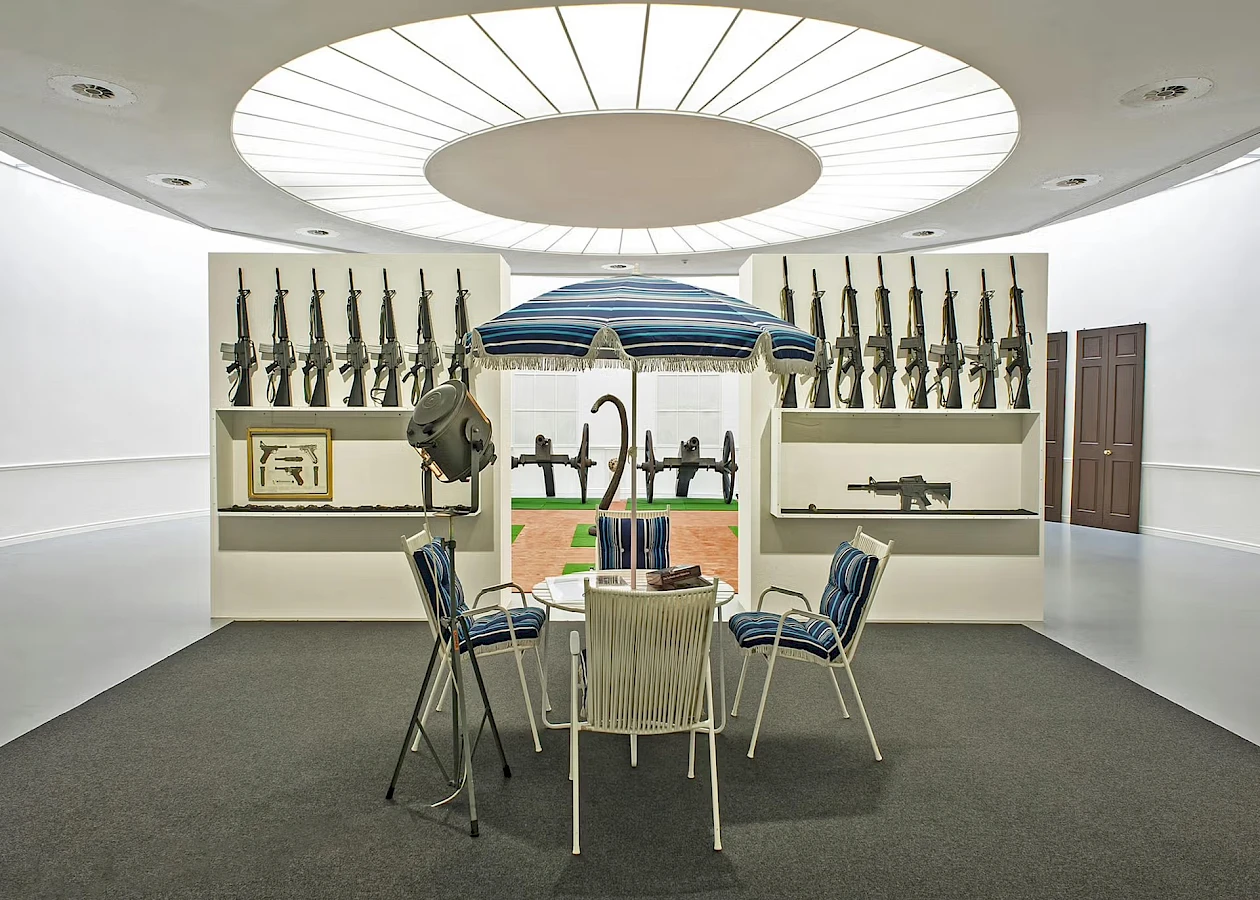
Marcel Broodthaers, Décor: A conquest, 1975. Photograph: C. Clinckx. Exhibited in M HKA as part of the retrospective 'Soleil Politique', 4 October 2019 - 19 January 2020
This strained metaphor reveals the strategies of both the minister and the authorities more generally: they want to shape the possible forms of oppositional cultural activity and ensure that any resistance is rendered ineffective from the outset, just as the minister’s comment reduces art’s potential to little more than a mildly entertaining annoyance. This decoupling of art form heritage, which the proposed move to an arts centre entails, substantially diminishes its capacity to historicize or canonize, meaning programmes end up in the structural amnesia of repetitious project cycles from which they are pushed into oblivion. And this, even though we know that the public museum must assume its corrective responsibility through the archive – especially for art practices and ephemeral art forms that have not been absorbed by the art market or entered the circuit of galleries and private collectors.
Sadly, in recent decades museums felt the government breathing down their necks to keep the entertainment circus running, with little support to maintain and develop the museum’s historical function. The proposed cancellation is not simply of a building but of an archiving, urban laboratory that has collection building as its strategic goal. M HKA was built on the foundation of the International Cultural Center (ICC), which attracted both local artists such as Panamarenko and international artists such as James Lee Byars and Gordon Matta-Clark, and was itself the continuation of a spirit of urban experimentation initiated by G58 in the Hessenhuis. Once M HKA was established, new generations of artists including Anne-Mie Van Kerckhoven, Luc Tuymans, Otobong Nkanga and many others made Antwerp a centre for artistic friction, and the museum documented and collected all of this activity in a living archive of artistic experimentation and urban imagination that is of lasting local and international consequence.
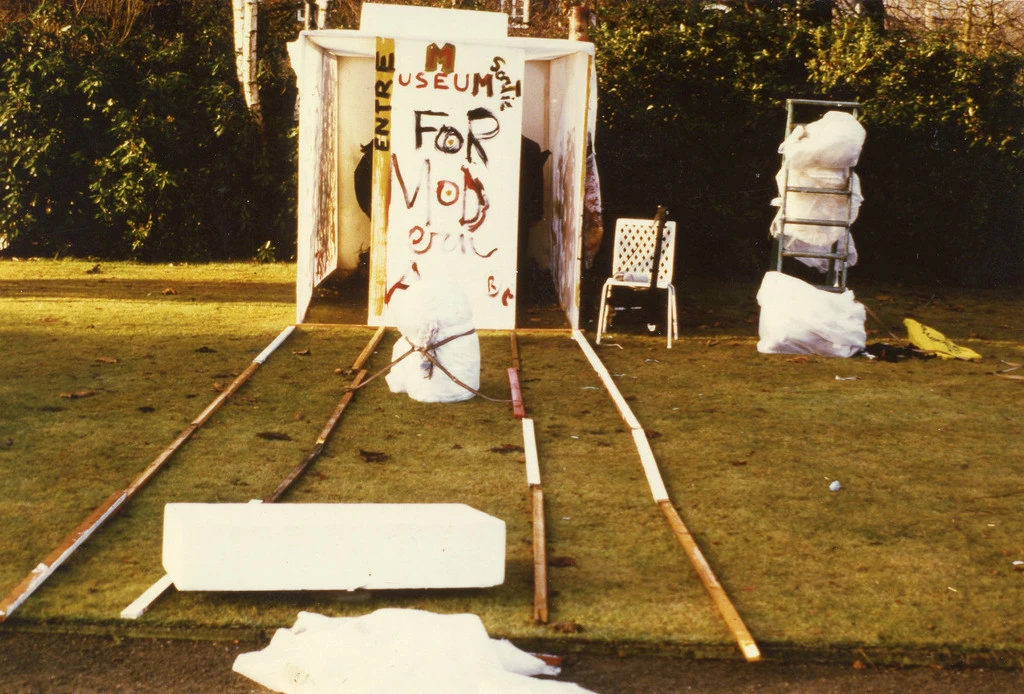
Fred Bervoets and others, First Museum of Modern Art, Belgian Institute for World Affairs, temporary installation and performance, 31 December 1983 - 01 January 1984, Antwerp. Courtesy M HKA & the artist
The fact that housing this heritage in Antwerp does not receive any political support despite its own so-called ‘return on investment’ logic, is incomprehensible, especially in a place like Flanders, which is so self-consciously proud of its cultural achievements. Invoking budget problems in one of the richest regions of Europe is treacherous, especially at a moment when our northern neighbours in the Netherlands have just approved a £359 million renovation project for the Museum Boijmans Van Beuningen in Rotterdam. Yet, it is also simply symptomatic of a policy that wants to regard museum directors as business CEOs and views museums merely as marketing vehicles in need of restructuring. The fact that the director of the other major art museum in Antwerp, the Royal Museum for Fine Arts (KMSKA), has no background in art history is not a coincidence, nor is the fact that the museum’s controversial scenography is little more than a grotesque form of populist branding. The appointment of the consultant and former city councillor Kristl Strubbe to the new museum conglomeration in Bruges illustrates the same ideological shift. In short, management and political affiliation take precedence over artistic expertise, and, while this phenomenon is more widespread elsewhere in Europe, Flanders seems to be embracing it with relish.
In the process, artists, curators and researchers are reduced to 'content providers' who are expressly excluded from shaping the system itself. The authorities fail to guide or evaluate these institutions according to good governance and fair practice, even when the field itself has asked for experiments in this direction. It is true that there is now an official decree on good governance in the Flemish public sector, but this is only binding on governmental institutions, and not all our museums fall into this category. Certainly, after reports of disturbing incidents about mismanagement at S.M.A.K. and elsewhere,3 it would be wiser to follow the example of the Netherlands, where compliance with the ‘fair practice code’ has effectively been made a condition of retaining state subsidy.4
Behind all this lies a fundamental disinterest within Flemish politics and policy – sometimes it amounts to active hostility – towards the potential of museums as places where the community can archive its imagination, cultivate doubts about itself and keep its history open and incomplete. Equally abandoned is the idea that museums have a responsibility to serve as role models for fair pay, good working conditions and healthy financial procedures built on the core values of solidarity, diversity, trust, sustainability and transparency.
III. The conquest of the collection
The decision to put M HKA’s collection under S.M.A.K.’s supervision is more than merely an operational adjustment. It is a symbolic power grab that seeks to recode the regime of visibility. While M HKA has had long-standing structural problems and arguably sloppy governance, it nevertheless established a progressive, internationally recognized exhibition practice. It was connected beyond Flanders through its active participation in L’Internationale, a European confederation of museums including MACBA, SALT and Van Abbemuseum. By abolishing M HKA as a museum and designating S.M.A.K. as the only contemporary art collecting institution in the area, the Flemish government has chosen to turn its back on that wider horizon in favour of an inward-looking, centralizing model where superficial gloss and representativity takes precedence over multilayered social and artistic significance.
L’Internationale argues for a radically different museum model: polyphonic collections brought together in a supra-regional confederation that shares expertise internationally. Its narratives resonate with emancipation, social struggle and postcolonial complexity, translated for the local context by each museum. M HKA had anchored itself and its collection in that complex discourse to reflect, from Flanders, on its regional, European and international entanglements. The now-defunct collaboration of Flemish contemporary art museums (Contemporary Art Heritage Flanders, 2009-2023) outlined the framework for the potential of such a polyphonic museum landscape on a regional scale, while preserving the distinct character of the individual institutions. However, the new governmental logic now merges these collections into a series of ‘masterpieces’ – trophies of Flemish cultural pride alone. What was once an archive of frictions, hospitality and solidarities becomes a repository of symbolic capital.
This is not an aesthetic shift but an ideological one. It is a nationalization (or rather Flemishization) of cultural memory. The danger is clear: works of art will become emblems of identity again, rather than instruments of reflection, dissent and dialogue with other ways of thinking. The authorities’ actions also undermine the intricate polyphony of institutions in Flanders and Belgium to complement, contradict and challenge each other. While their collections are always incomplete, coincidental and subjective, that is precisely what gives them their uniqueness. Their potential for dialogue and interaction is what makes them vibrant.
It is crucial that these collections can build up relationships, rather than be lumped together. This relationality should not only engage the artworks themselves, nor different audiences, but also the places whose stories and images the collections give voice to. This relationship with place ensures that the museum, understood as a rumah adat, does not merely talk ‘about’ its subjects, but also ‘beside’ and ‘with’ them, anchoring and situating itself in concrete terms. Only from this proximity does the museum become political, because only then are the images and stories that the collection gathers and preserves made legible and usable for a community, initiating a process through which collection and community can shape each other.
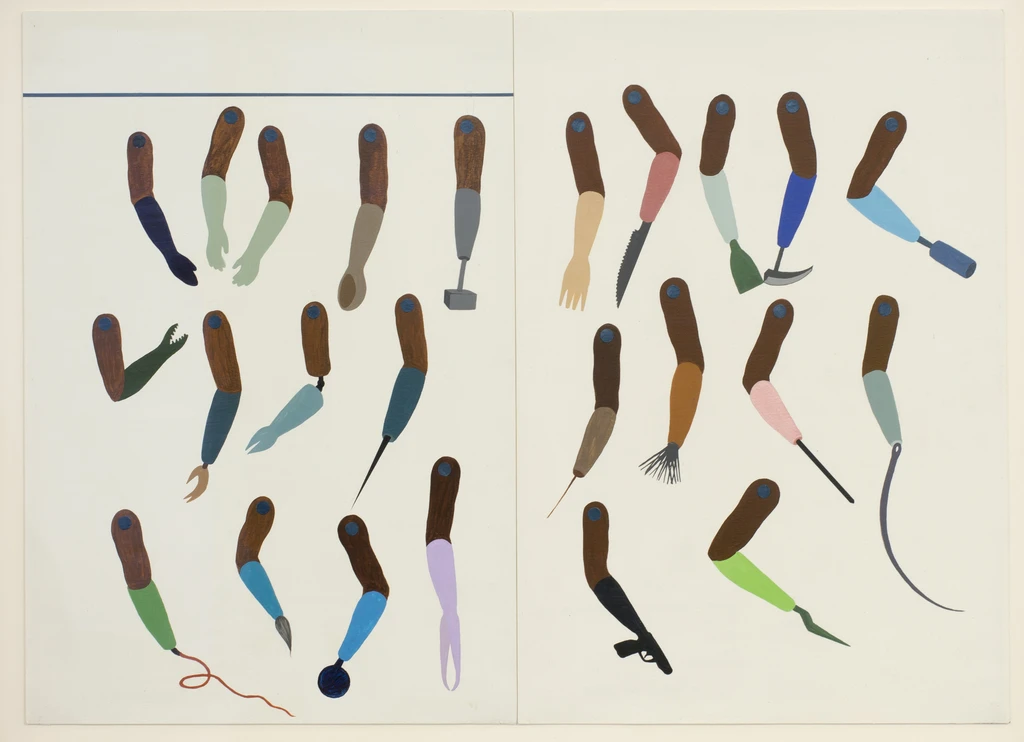
Otobong Nkanga, Social Consequences II: The Choice We Make, 2009. Courtesy the artist
This process requires a form of maintenance, which is tedious but crucial work, without which a museum is little more than a warehouse for goods passing through. This maintenance also requires care and labour that often goes unrecognized, and forces museums to slow down and work with artworks whose value might not be immediately clear. Yet the friction produced by this ‘maintaining’ is important. It is precisely because of its ‘ballast’ that the collection compels us to return to it again and again, to question our choices, and to rewrite, activate, and supplement its stories. At the same time, maintenance should not become nostalgic. Following the rumah adat, the artworks in such a collection must be able to take account of what they sit ‘beside’ and ‘with’ and adjust themselves accordingly. The ‘unfinished’ collection remains alive because it is experienced in the present as an ambiguous diachronic presence and never as a form of simple representation.
By limiting specificity, temporality, and diversity to the playground of a programme, we lose the ability to accommodate multiple narratives through heritage, while the biggest city in Flanders becomes unable to construct its own histories through and with artworks. Despite all its shortcomings, M HKA fulfilled that function. It was a home for what was constantly on its way to becoming an artistic canon, one that linked it to local, regional and international contexts while remaining alive and always contestable. At the same time, the people of Antwerp are deprived of forming meaningful relations with the museum landscape because, without a collection that can be loaned, it becomes much harder to collaborate with international institutions. This is, in effect, is nothing more than a humiliation imposed from above.
IV. Sham philanthropy and the false solace of private museums
The fact that the parameters for assessing public institutions are so easily reduced to questions of efficiency reflects a broader cultural shift. As in many Western countries, institutions in Flanders find themselves caught between nationalization and privatization. On the one hand, museums are being compelled to represent national pride while applying managerial logic to their collection ‘assets’, while, on the other hand, other cultural symbols are outsourced to private partners without any legal obligation to public accountability. One such example is the Phoebus Foundation, which is based on the profits of Katoen Natie, a logistics company that earns its income in part from public resources such as renting out storage facilities. Indeed, the main depot of the M HKA collection itself is in the hands of Katoen Natie, because the Flemish government and the museums seem to be unable to set up professional art storage facilities.
The Phoebus Foundation in turn owns a large art collection extending from the fifteenth century to today and is in the process of restoring the art deco Boerentoren in Antwerp into an event location where it will display part of its holdings. This prestigious project in the centre of the city is presented as a gift and seen by many as proof of the value of cultural entrepreneurship. However, as the M HKA depot demonstrates, the line between private initiative and public support is razor thin and the Boerentoren project certainly benefits from (in)direct forms of state aid such as permits, heritage advice, public infrastructure works and political goodwill. While the exact extent of the value of this support is unclear, it is also undeniable.5
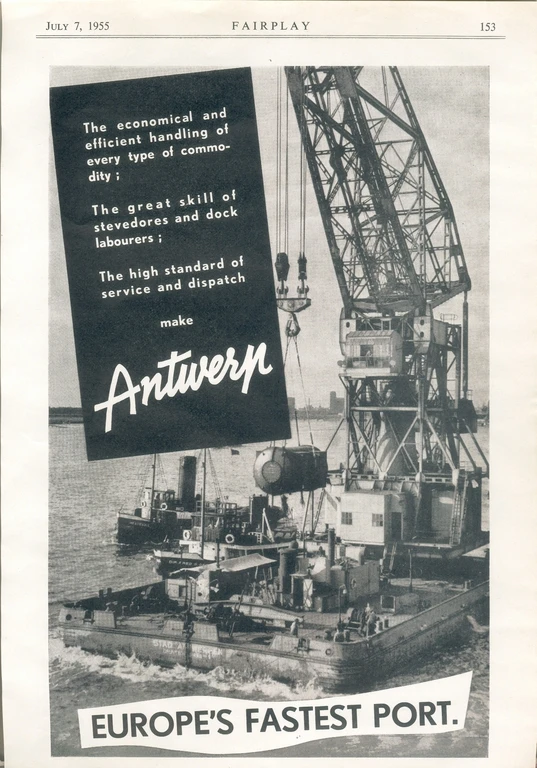
Allan Sekula, Antwerp Europe's Fastest Ship Port Advert [title given by Allan Sekula, after its description in these terms in PayPal document], published in the UK weekly magazine Fairplay on 7 July 1955. Purchased by Allan Sekula through eBay on 14 May 2010. Part of Allan Sekula, The Dockers' Museum, 2010-2013, object nr. 20. Courtesy M HKA and the artist.
The resulting contrast is sharp. Where public institutions have to ‘rationalize’, private ambition is given an aura of innovation. The message is clearly that space should be given to those who bring their own money, while those who rely on public support must be punished.
The fact that public institutions suffer cutbacks while private initiatives receive political backing raises a fundamental question about the role of government: Should it finance projects that already enjoy robust private protection, or should it fund initiatives that are unlikely to receive market support to keep the cultural landscape diverse and pluralistic? Our position is that public funds should not be used to subsidize commercial success in culture but to maintain a field that encompasses the vulnerable and unprofitable. The task of public subsidy is to archive histories that can serve as cultural touchstones for society in the future, and to support the places where experiments and diversity arise. When the government withdraws from this role, the cultural landscape inevitably narrows: from diverse and critical to uniform and predictable.
In this respect, Flanders, unlike its European neighbours, remains an amateurish bureaucracy that is all too happy to allow public money to flow into the private pockets of its local barons. Although compulsory government support for private initiatives in exchange for tax reductions has its own problematic aspects, our neighbouring countries do provide a legal framework for such activities.
In France, the Loi Aillagon (2003) was intended to ensure that private foundations enjoying tax benefits would have to collaborate structurally with public institutions. Billionaire Bernard Arnault, for example, received tax benefits only on condition that his organization contributed to public institutions such as the Musée d’Orsay and the Centre Pompidou. In principle, patronage should be there to strengthen public infrastructure. Nevertheless, private initiatives have been able to opportunistically bend the law to their will, so that prestigious projects by Fondation Vuitton, Fondation Cartier or the Bourse de Commerce of billionaire François Pinault (with, in a painful reversal, Aillagon as director) risk overshadowing or even humiliating public institutions. It is therefore time for France to revise the law to bring it back to its original intent.
In the UK, the ‘Cultural Gifts Scheme’ links tax relief to the actual transfer of works of art or long-term loans to public museums. Unlike in France, philanthropy is less of an individual prestige project and more of a social contract. Arts Council England oversees the integrity of the process, evaluates the ‘quality’ of the donations and advises on their acceptance. HM Revenue & Customs oversees compliance with tax laws. However, there are reasons to be cautious. The success or failure of these gifts and loans largely depends on the agreed value between the expert panel and the donor’s valuations. In Germany, the system of the public-private Stiftung guarantees that when private art initiatives receive public support, government representatives also sit on the board. In this way, public responsibility remains fundamentally anchored in private initiatives. Even the Netherlands imposes strict criteria through its use of the ANBI status (Algemeen Nut Beogende Instelling, or Public Benefit Organization). In order to receive tax mitigations, institutions must apply for ANBI status, and by doing so they ensure their contribution to the public interest through transparent governance, cooperation with the public sector and demonstrable social relevance.
Flanders and Belgium, on the other hand, partly thanks to the confusing levels of administration, have created a parallel world in which private collectors enjoy public recognition without democratic scrutiny. ‘Philanthropy’ thus becomes part reputation management, part real estate strategy, but rarely community care. It is crucial that a legislative framework is drawn up in such a way as to prevent culture washing by patrons. In the United States and the UK, some public museums have ceased cooperation with donors even when they are more or less dependent on private income. Examples include the Sacklers or British Petroleum, donors whose profits are generated by environmentally dubious or even criminal actions.
It is sometimes argued that in authoritarian contexts, private institutions offer more freedom than state museums. They are thought to accommodate dissent, support young artists and protect critical voices where public institutions are muzzled by anti-democratic laws or bureaucratic (self-)censorship. But whenever freedom is privatized it is also precarious: it shifts the right to dissent to a dependence on well-intentioned patrons. The question is not only whether art can breathe, but who decides when the oxygen is cut off. Private museums may be necessary, but they are never sufficient. They offer shelter, not community. They create hospitality only as long as the host desires it. They are pavilions of self-importance, not rumah adat. So the real question is not whether private museums can offer freedom, but why public museums are losing their liberty and financial capacity, and furthermore what structures are needed to protect and restore what is being lost.
V. The fifth estate
Public museums, we have tried to argue, are not neutral repositories, but instruments of collective reflection. They belong to what, in an extension of Montesquieu’s Trias Politica, could be called a ‘fifth estate’. Traditionally, the executive, legislative and judicial branches of government are supplemented by the press and media as a watchdog alert to the abuse of power. The effectiveness of this fourth estate today is questionable. Even if it did function well, universities and museums embody a different domain of public knowledge and imagination that must remain beyond the direct reach of politics and must not be surrendered to the free market. They form the intellectual infrastructure of democracy: places where thinking about values, representation and community can take place. A civilization that considers itself democratic has a duty to maintain such places – not because they are economically profitable, but because they enable members of society to question what others might take for granted.
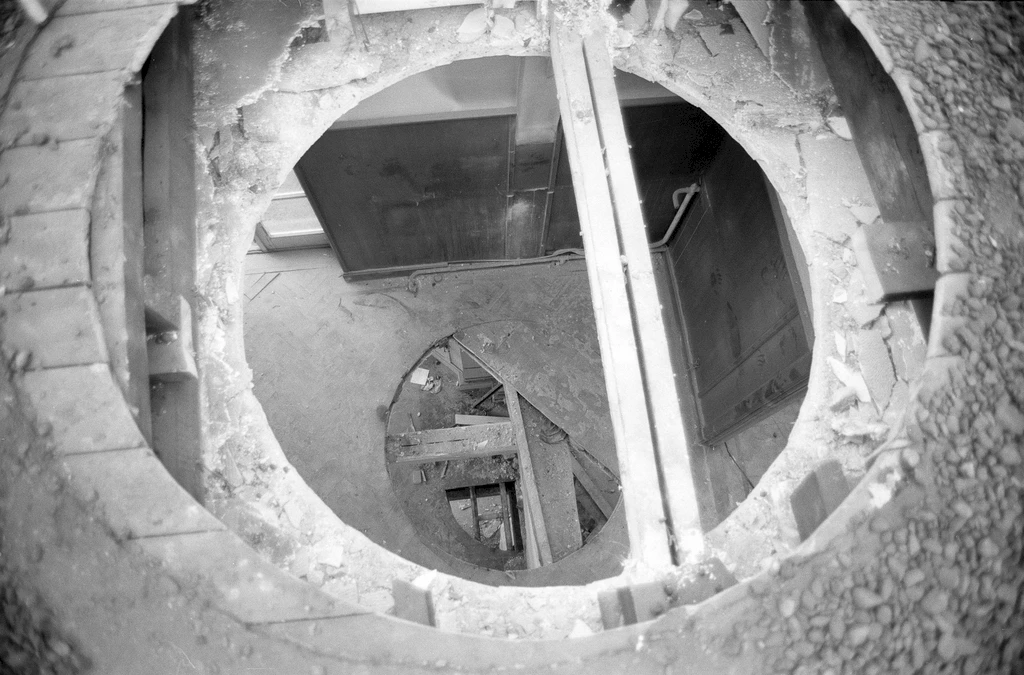
Gordon Matta-Clark, Office Baroque, 1970. Photo: Flor Bex
In their acclaimed book The Undercommons: Fugitive Planning & Black Study, Fred Moten and Stefano Harney write that our institutions – universities and, by extension, museums – should be places of the commons: places where knowledge, imagination and research are removed from the regime of efficiency, productivity and measurability. At the same time, they describe how that space of collective imagination – that domain of thought outside the logic of state control and market value – is under threat. As in Moten and Harney’s account of the university, the museum under current conditions has already lost its role as the obvious guardian of the public domain. Instead, it can only play a role as a refuge for things outside itself and on the margins of its policy brief. What remains is a paradox: the museum is, like the university, an institution from which one can only steal for the undercommons, as Moten and Harney suggest.6 That is to say, it can only be reinvented underground and parasitically by those who still dare to believe in the public sphere as a shared space of dissent and imagination.
VI. Epilogue: the disappearing house of the community
The rumah adat of artistic Antwerp had for some time been located both inside and outside the actual museum. Now that the inside is in danger of disappearing, the question becomes: What remains of and for the community that both cared for and criticized it? Without a voice in the polyphony, there is only an imposed consensus. Without multiple specific places that mobilize imagination and contestation out of historically grounded heritage, all that remains is propaganda that must convince us in Flanders of the wonders of our ‘Flemish Collection’. Museums that only serve efficiency, ticket sales and branding are sites without a soul. M HKA may have been dysfunctional in terms of its governance and communication, but an artistic community found itself in the undercommons, impelled to ‘steal’ meaning, artistic memory, experimentation, hospitality and urban imagination, and in doing so to embody the real museum. That is why the public institution that was M HKA was embraced. It served as an unlikely refuge that understood that public museums should be criticized, because critique is the crucial foundation on which public institutions in a democracy should ultimately be built. This is also why, despite all their dysfunctionalities, we must defend our public universities, our public institutions, our public museums, as the embodiment of our sorely needed fifth estate.
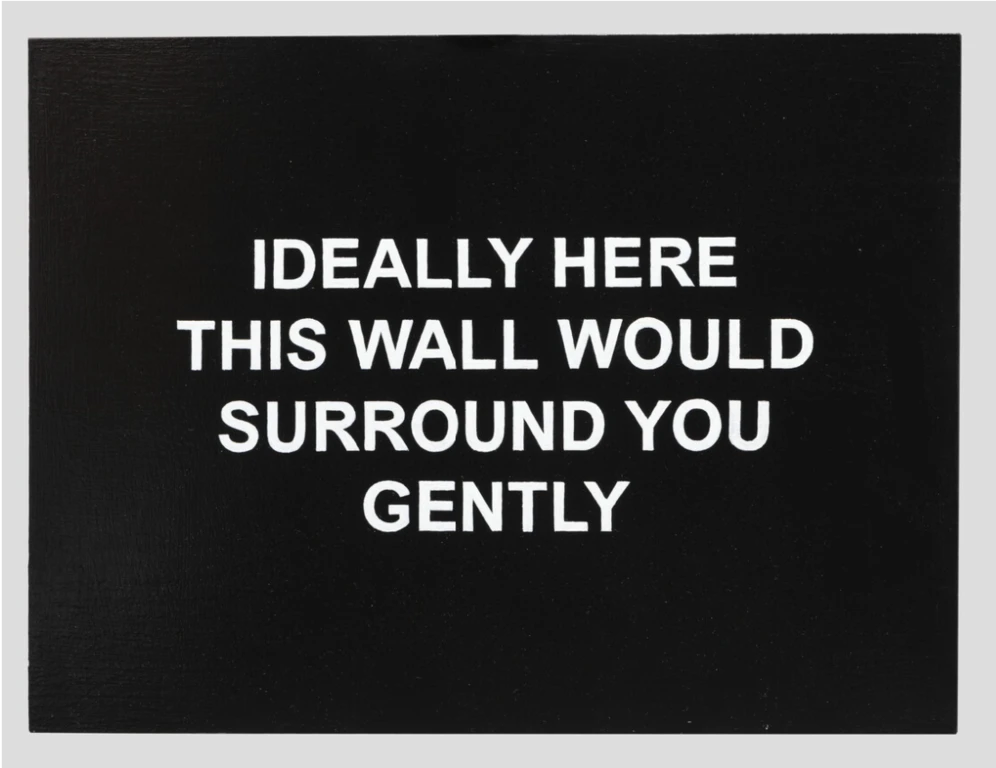
Laure Prouvost, Ideally here this wall would surround you gently, 2021. Courtesy the artist
Related contributions and publications
-
Prácticas lumbung para resistir y colaborar desde el arte
Constanza Yévenes BiénzobasEN eslumbungSituated OrganizationsMuseo Reina Sofia -
Algunos términos que guían a lumbung press: Definiendo “edición”
Erick BeltránEN eslumbungSituated OrganizationsMACBA -
A conversation about the project 'A Temporary Futures Institute'
Anders Kreuger, Maya Van LeemputDialoguesM HKA -
Art Museums and Democracy
Charles Esche, Manuel Borja-Villel, Bart de BaereDialoguesM HKAVan AbbemuseumMuseo Reina Sofia -
Monoculture – A Recent History
M HKA -

Hauntological Relations of Monocultures
Florence ChevalMonocultureM HKA
Related activities
-
–MACBA
The Open Kitchen. The fermented seed, colonialism and extractivism

The MACBA Kitchen is a working group situated against the backdrop of ecosocial crisis. Participants in the group aim to highlight the importance of intuitively imagining an ecofeminist kitchen, and take a particular interest in the wisdom of individuals, projects and experiences that work with dislocated knowledge in relation to food sovereignty.
-
MACBA
The Kitchen: Workshop by Marina Monsonís
The Kitchen is a meeting place open to the participation of all, especially people and organizations that want to share their knowledge and experiences around the kitchen.
-
–MSN Warsaw
Multicultural Youth Center
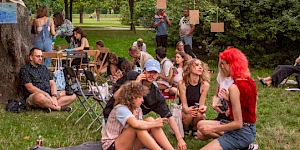
The Museum of Modern Art in Warsaw, together with the confederation of museums L'Internationale, is establishing a Multicultural Youth Center. This is a unique space for 16-24 year olds to explore and develop their creativity, make new friends and hang out in a friendly and supportive environment.
-
–MACBA
Where are the Oases?
PEI OBERT seminar
with Kader Attia, Elvira Dyangani Ose, Max Jorge Hinderer Cruz, Emily Jacir, Achille Mbembe, Sarah Nuttall and Françoise VergèsAn oasis is the potential for life in an adverse environment.
-
MACBA
Mobile Garden. A Place to Meet
An open space, a social space. How could the Museum be more open to the needs of the neighbourhood?
-
Museo Reina Sofia
School of Commoning Practices
This exchange programme gathers different schools organized by volunteers and migrant communities in Athens (Open School for Migrants) and Madrid (School of Rights, Escuela de Español and Situated mediation School) in order to share their knowledge, exchange strategies and reflect on the experience of working together with migrant communities.