The Theatre of Operations: Infiltrations and eavesdropping – report of a conversation between Yasmina Reggad and Nadine Atallah
The following conversation took place at the study day ‘Questioning Colonial Legacy: Contemporary Art Through the Prism of Memory Issues’ organized by Maureen Murphy and Magali Ohouens, which brought together several pairs of artists and art historians in Paris in December 2023. Yasmina Reggad and Nadine Atallah were among the participants. An undercover spy with the codename Ammar infiltrated the event; to this day, both their identity and the objective of their mission remain unknown. However, the report they wrote has been leaked. What follows is an excerpt. English translation is by Siegrun Bahar Salmanian.
Ammar:
Yasmina Reggad: we dreamt of utopia and we woke up screaming is the English translation of a sentence borrowed from the Infrarealist Manifesto (1976) by Roberto Bolaño, a Chilean writer living in Mexico at the time. When I lived there myself in the early 2000s, I came across this text when I was hoping to participate in the tertulias, literary salons, which were not much more feminist than in the time of the Infrarealists.
Ammar:
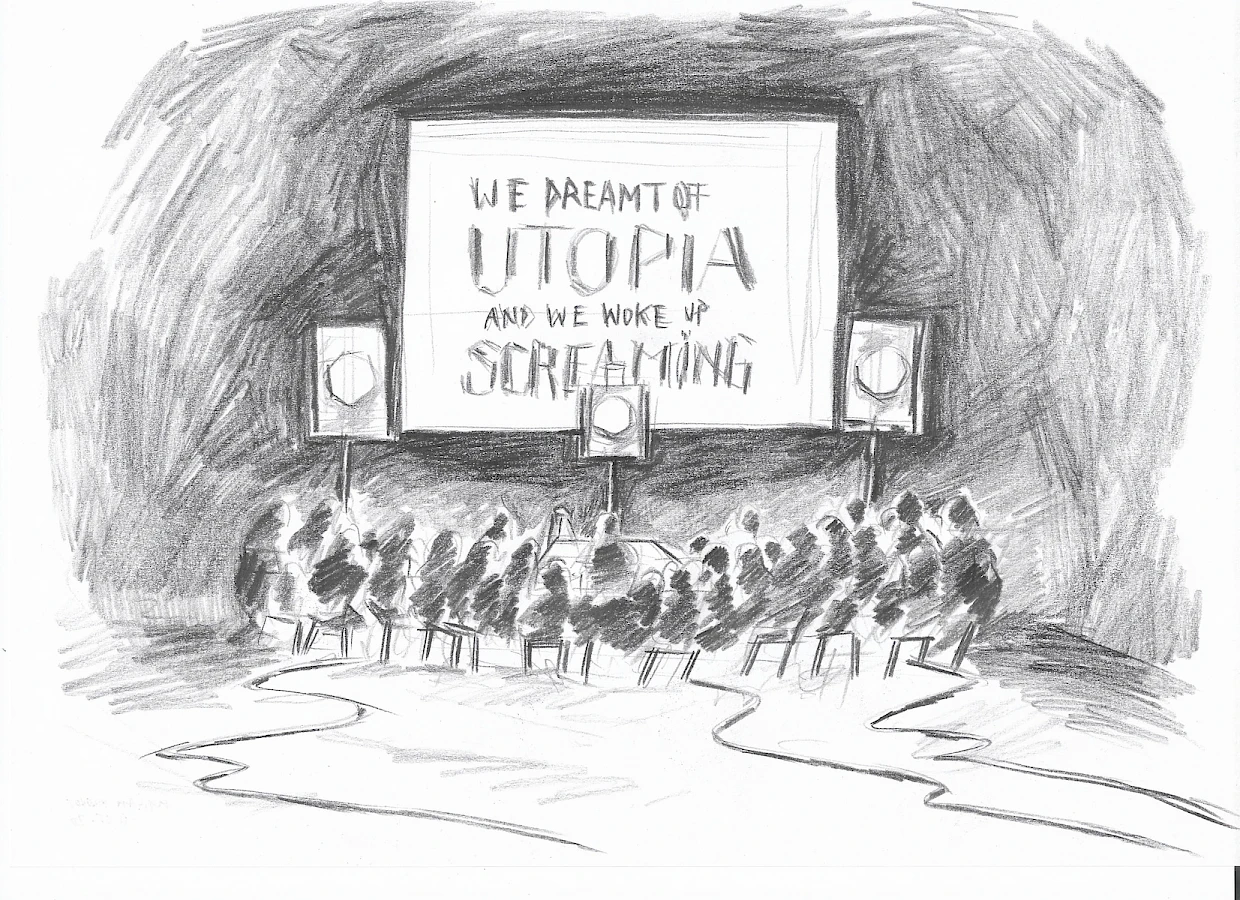
Yasmina Reggad, Episode 1. La Radio des images qui s’écoutent (The radio of images you listen to), 2021. Sketch by Myriam Pruvot and Yasmina Reggad
The Infrarealist Manifesto by Bolaño acknowledges the failure of the political utopias of the twentieth century, while at the same time calling for a mobilization against the established order and the avant-gardes – for a kind of counter-revolution through irreverence and irony. This sentence of the manifesto tells us that we cannot quite know whether we will wake up to horror or to joy, behind walls or free. In any case, it invites us to go further, to overcome ourselves.
we dreamt of utopia and we woke up screaming is a long-term, ongoing research project comprising a series of existing and forthcoming episodes. While the dramaturgic and performative principles remain broadly the same from one episode to another, each episode tells a different story. The first, ‘The radio of images’, a title borrowed from a Radio Alger, Chaîne III (Algerian Radio, Channel III) slogan,1 sheds light on the importance of Algerian Radio and Television company (RTA) broadcasts for liberation movements and revolutionaries across the world. After Algeria gained independence on 5 July 1962, it reaffirmed its determination to support other peoples’ independence and anti-colonial and anti-imperialist struggles through material, financial, military and political assistance. Activists and political figures from all over (de tous horizons) therefore flocked to Algiers. Delegations from Congo, the Canary Islands, Portugal, Brazil, Chile, Rhodesia (nowadays Zambia and Zimbabwe), Namibia, South Vietnam, Angola, Cape Verde, Guinea-Bissau and Mozambique, among others, settled in Algiers. Nelson Mandela had an office there, as did the Black Panthers; Palestine had an embassy. Even the Breton Liberation Front and its namesake in Québec were represented in Algiers. These revolutionaries-in-exile benefitted from military training, but most importantly, they found in RTA, as the national Algerian radio station, a channel to send messages across the world: to their people and their supporters, as well as to their enemies. On 15 November 1988, it was on these same airwaves from Algiers that Yasser Arafat proclaimed the Palestinian Declaration of Independence, written by the poet Mahmoud Darwish. This excitement led Amílcar Cabral, the founder of the African Party for the Independence of Guinea and Cape Verde (PAIGC), to state as early as 1968 that ‘Muslims go on pilgrimage to Mecca, Christians to the Vatican, and national liberation movements to Algiers’.
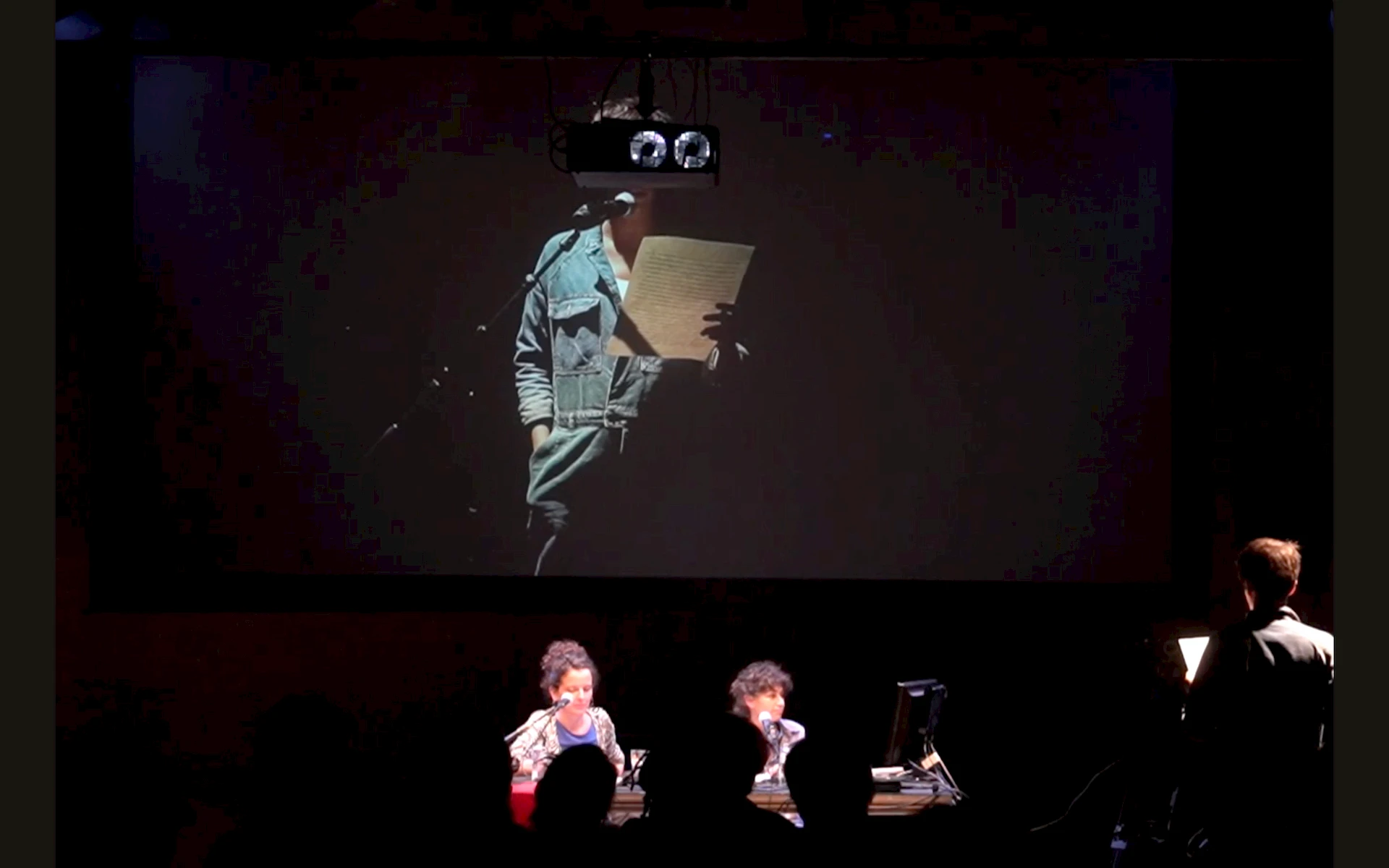
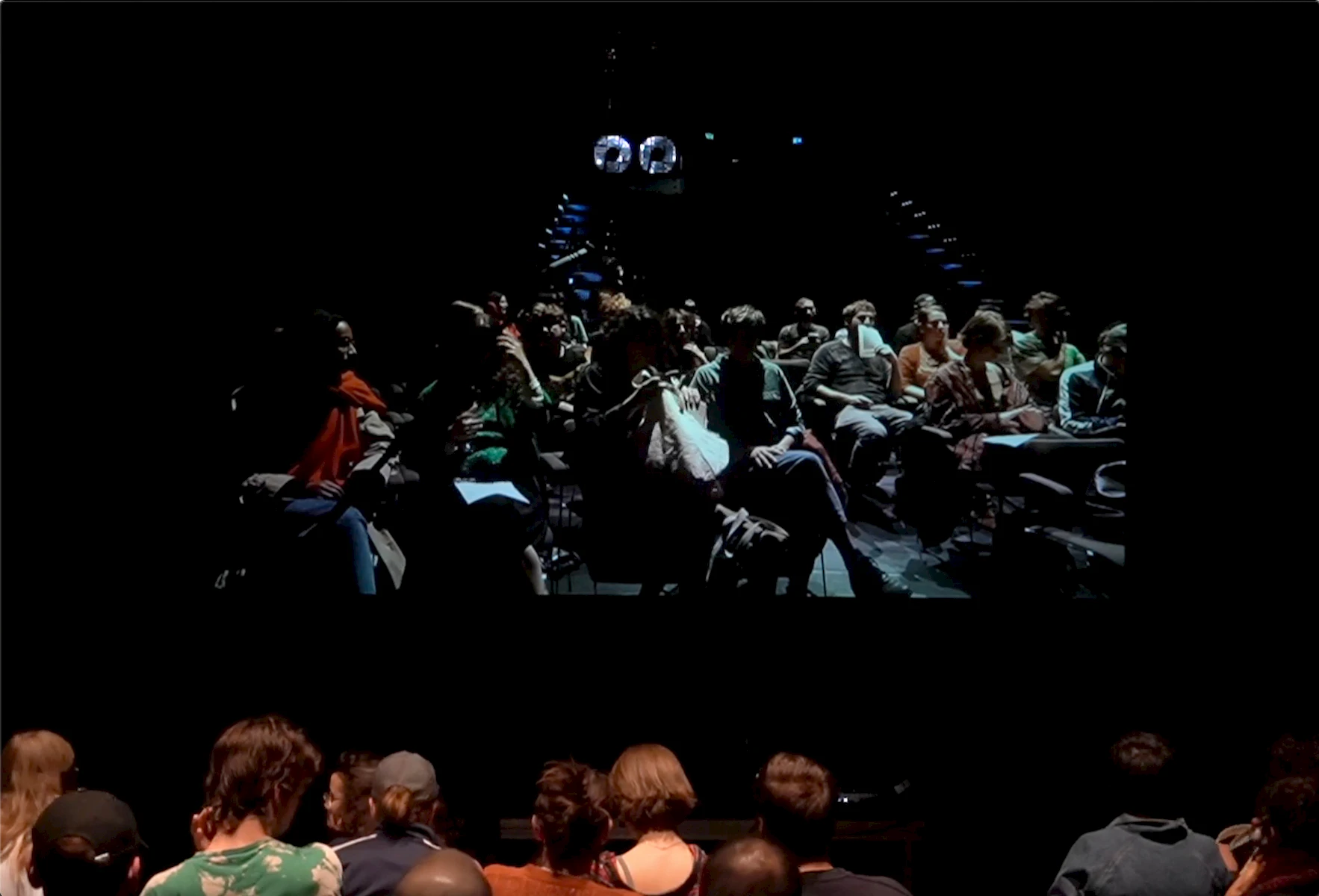
Nadine Atallah: we dreamt of utopia and we woke up screaming, Episode 1, ‘The radio of images’, is not a historical lecture about the role of the RTA in transnational, anti-colonial struggles. It is itself a refusal of a lecture in favour of a collaborative form. It is a performance which you mostly stage in the theatre, and in the case of the ‘Listening Session’ it becomes a direct, activist radio station – like Radio AlHara in Bethlehem or Chimurenga’s Pan-African Space Station from Cape Town. The way the piece is arranged recalls radio transmissions which combine various sonic sources. We hear your voice, articulating the story; the sonic archives of the RTA, filled with a remarkable presence of music; an AI, which contributes additional information; and voices of activists of today, who both read existing texts and are part of the audience while you are broadcasting live. The performance evolves – through encounters and invitations to create – differently in each city. This living form is, I think, very meaningful to you. You insist on the importance of radio as a medium which brings people together.
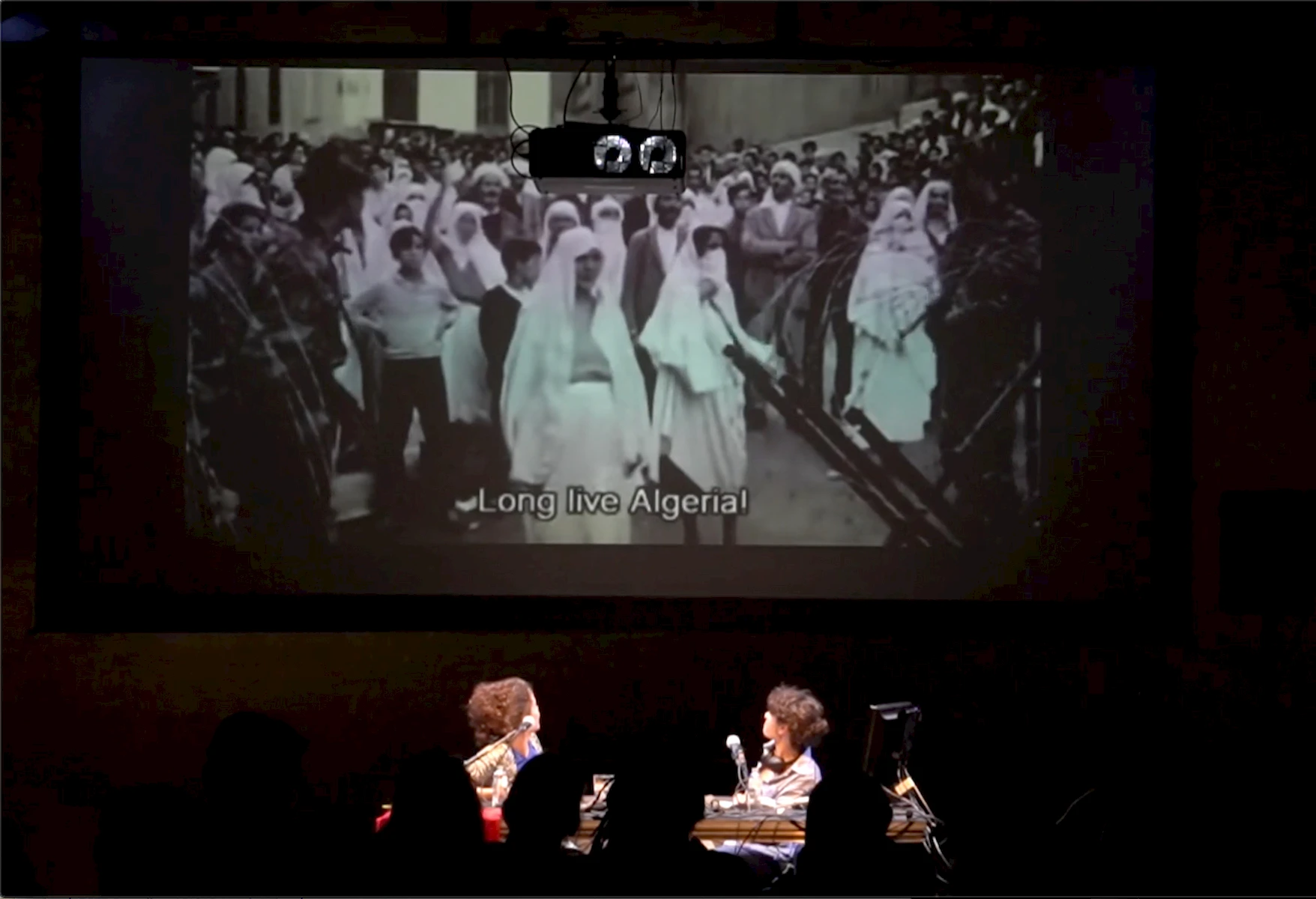
Yasmina Reggad, 'Listening Session', documentation still, Beursschouwburg, 2022. Courtesy the artist
Ammar:
YR: In May 2016, the researcher and film programmer Léa Morin invited me to Casablanca to give a lecture about my research on the RTA. Since I am exploring more than twenty years of a very complex history across several territories and continents, I wasn’t at ease with the format, nor with standing still behind the lectern. So, instead of giving a lecture, I basically improvised a performance, inspired by the format of radio documentary. By inviting members of the audience to participate in reading texts or transcripts, I, in a way, created the sound archives that I did not have – or which simply didn’t exist, since when I initiated the project, I did not have access to any RTA archives.
My aim with the work is not only to talk about international solidarity through the case of Algeria but to embody it, to affirm a shared legacy and to try to put it into action today. My dramaturge is Frantz Fanon. Fanon is someone who didn’t only type texts on his typewriter: he spoke, he stated, he dictated and his secretary Marie-Jeanne Manuellan noted everything down. Like him, I want my writing to become vocal, oral and acoustic. I rely on A Dying Colonialism (L’an V de la révolution algérienne [1959])2 and in particular on a crucial chapter, ‘This is the Voice of Algeria’, from which I select excerpts that are read during the performance.
JEU DE PAUME, PARIS, 15 OCTOBER 2019
VOICE: LYDIA HADDAG:
Since 1956 the purchase of a radio in Algeria has meant, not the adoption of a modern technique for getting news, but the obtaining of access to the only means of entering into communication with the Revolution, of living with it. … Having a radio meant paying one's taxes to the nation, buying the right of entry into the struggle of an assembled people. … Having a radio seriously meant going to war.
[Excerpts from A Dying Colonialism by Frantz Fanon, Éditions François Maspero, 1959]
Ammar:
YR: In A Dying Colonialism, Fanon describes how the medium of the radio was appropriated by revolutionaries in exile and the Algerian population at large. He writes that acts of solidarity emerged among the Algerian people around the radio and through listening. More than that, the Algerian nation itself emerged out of the voice of the Algerian revolution in exile, a voice that was collectively listened to, at times also imagined and reproduced to disseminate its messages to the largest possible audience.
Fanon speaks of listeners as both radio transmitters and receivers. In order to test this tactic of the Algerian people, the activation of a political form of listening and a practice of solidarity, I perform amid the audience, seated with everyone else.
What does it mean to listen together, when we have been told that the radio is a one-way medium?
we dreamt of utopia and we woke up screaming brings the genres of documentary radio and documentary theatre into conversation. I use and make visible certain production methods of documentary radio, while simultaneously blending them with modes of production that come from a position of non-expertise: I play at becoming a radio host. Everything is visible, from the live production to the people who give their voice and who are – literally – thrust into the spotlight. Sophie Delafontaine, my sound engineer, uses sonic spatialization to create the feeling of being inside a radio station. She works at my side, in the middle of the audience.
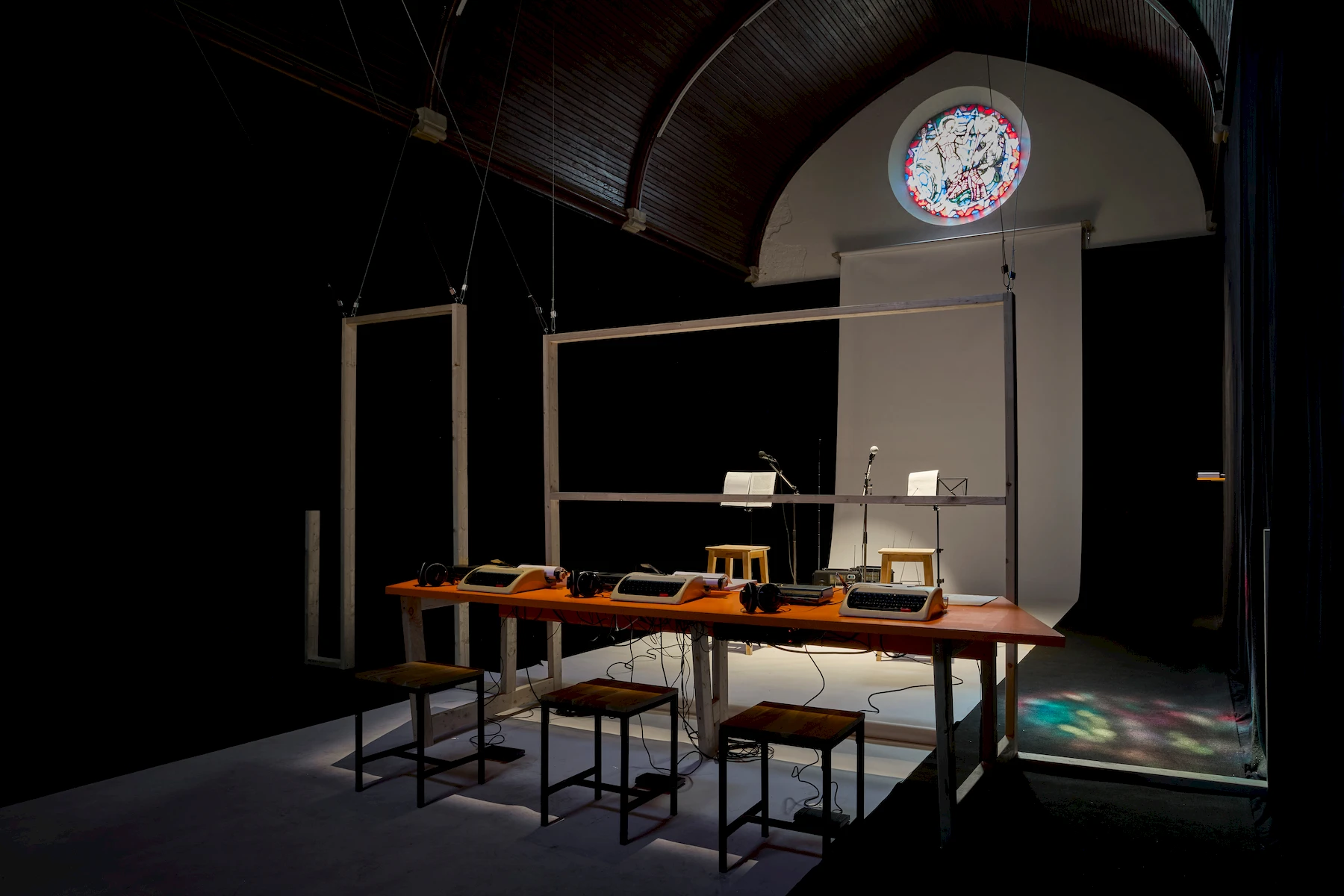
Yasmina Reggad, all before… all after… Kunsthal Extra City, 2025. Photo: WeDocumentArt
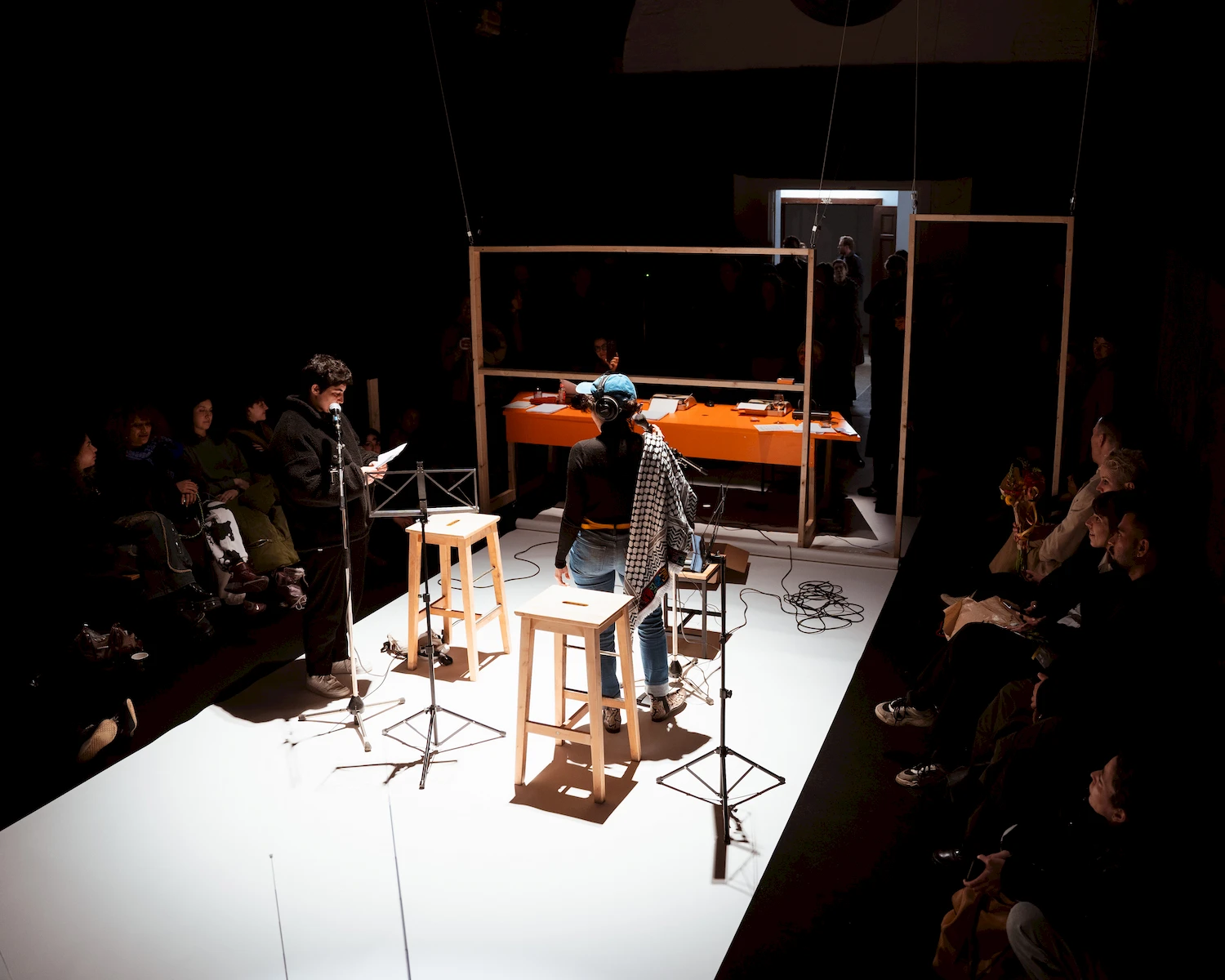
Yasmina Reggad, all before… all after… Kunsthal Extra City, 2025. Photo: Brent Mertens
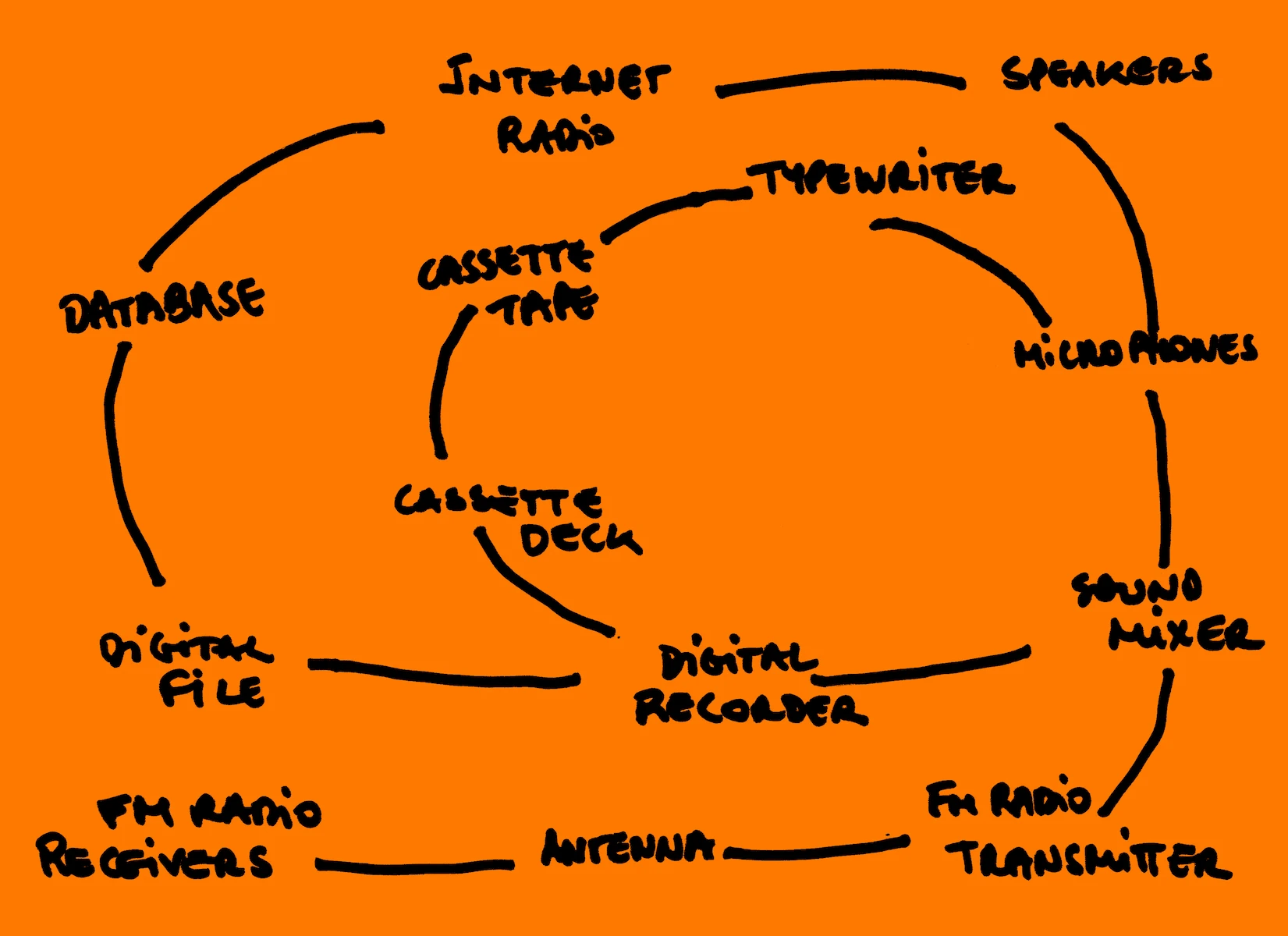
Yasmina Reggad, sketch for the poster of the exhibition all before… all after… Kunsthal Extra City, 2025
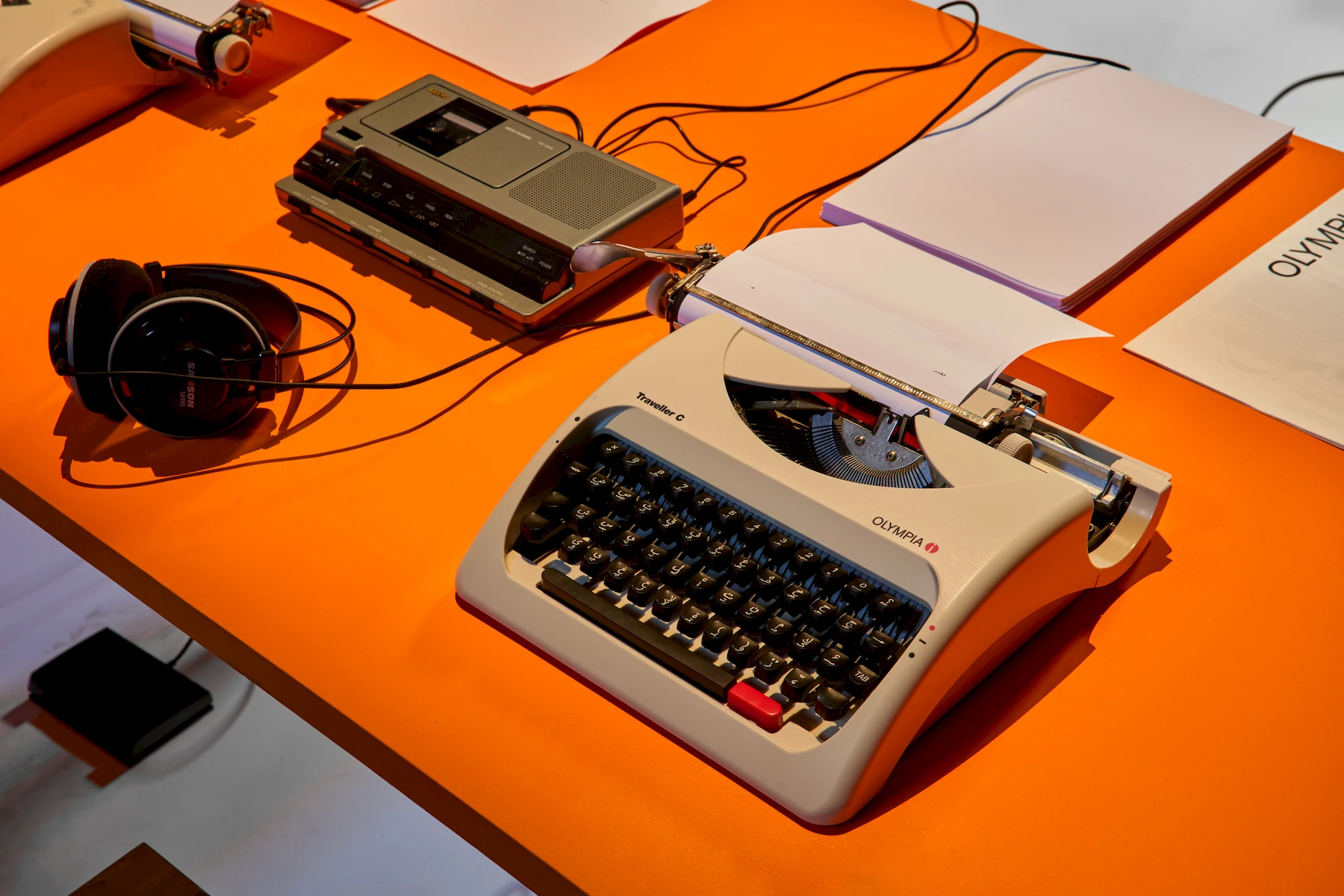
Yasmina Reggad, all before… all after… Kunsthal Extra City, 2025. Photo: WeDocumentArt
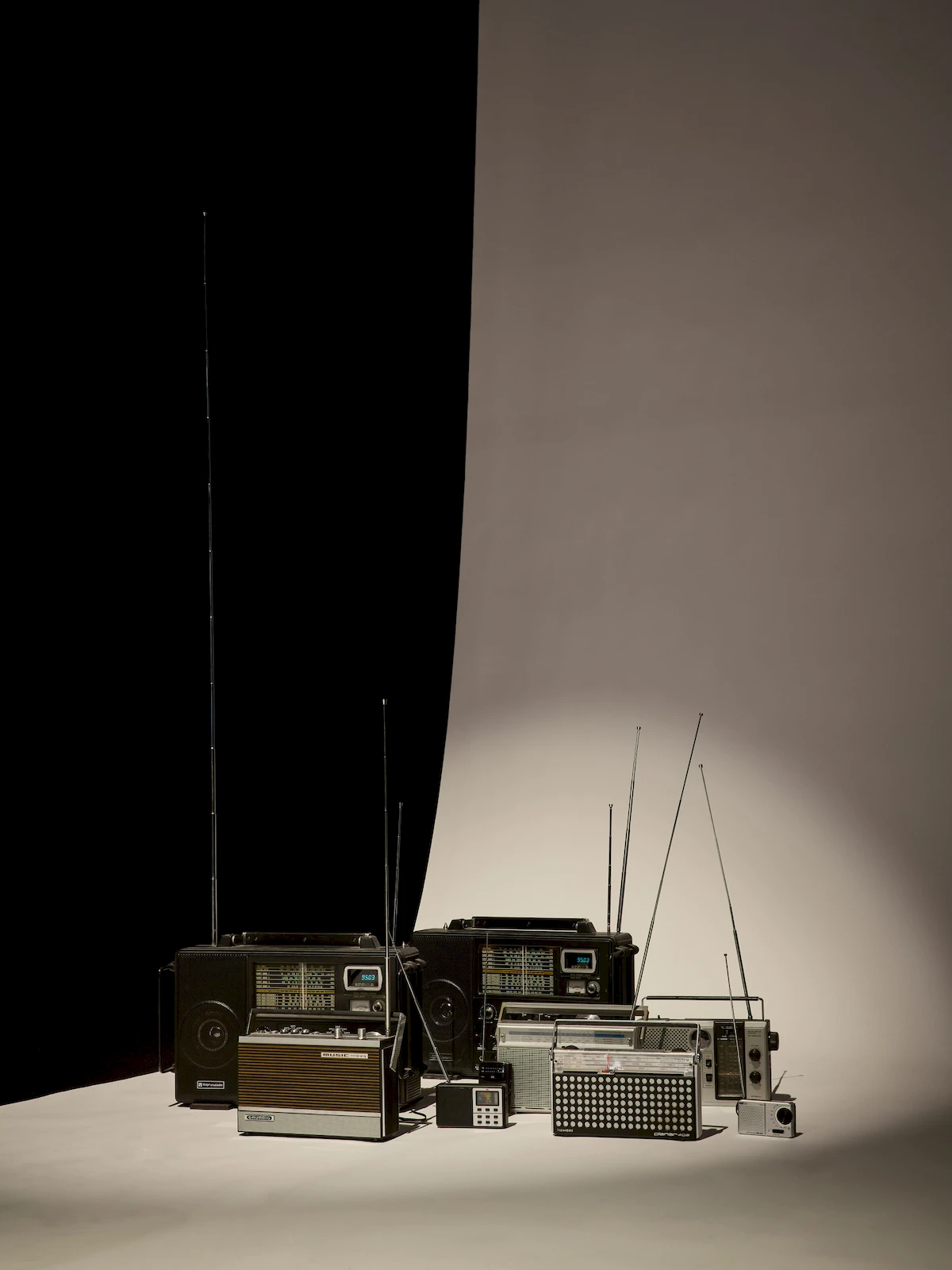
Yasmina Reggad, all before… all after… Kunsthal Extra City, 2025
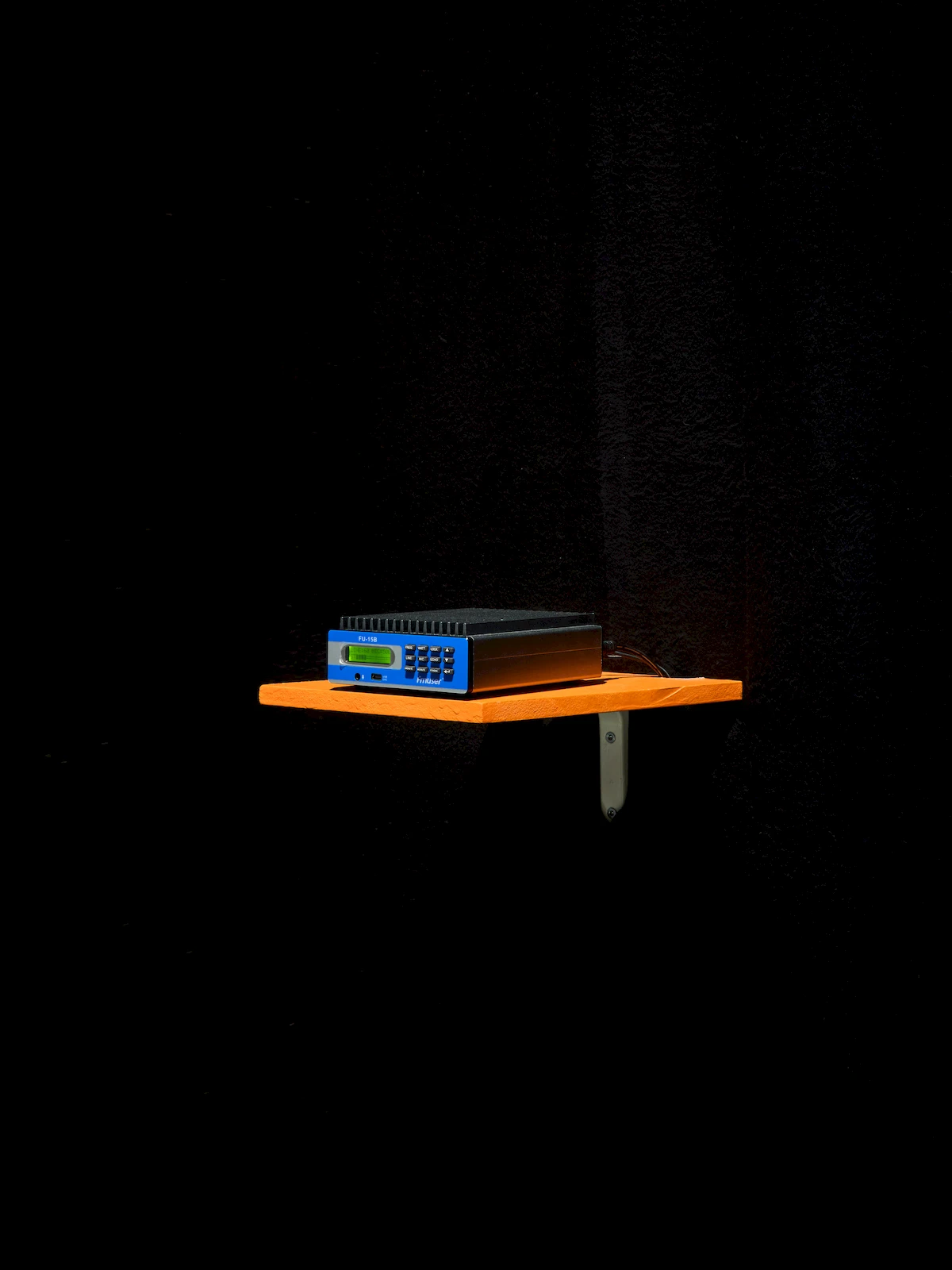
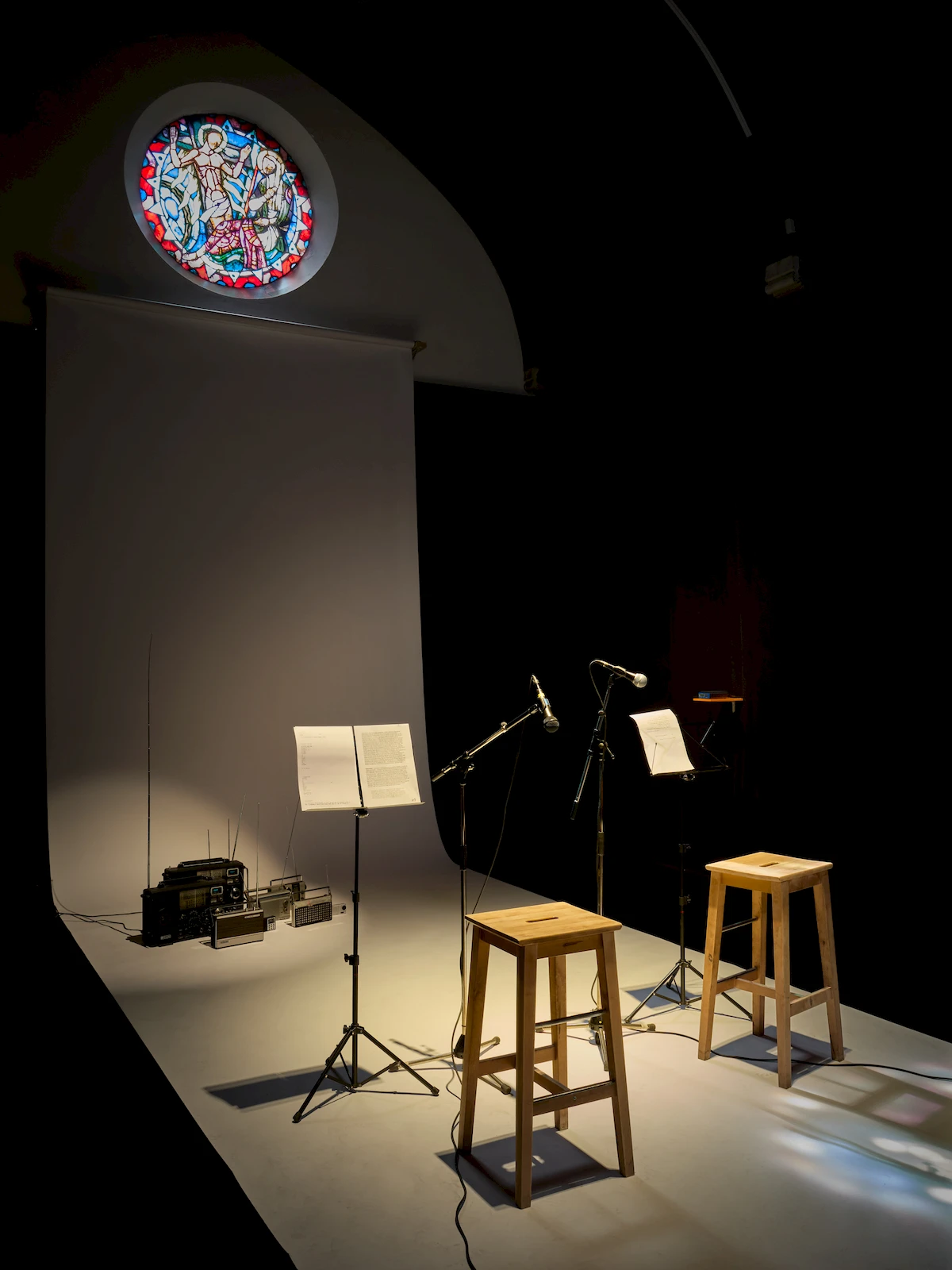
NA: As you continued your research, you were able to access the RTA archives as well as other documents, particularly audio recordings, which helped bring this history to life. It is worth recalling that you are trained as a historian, specializing in the history of the Middle Ages. You are both experienced with rigorous research methods and already engaged with the silences of history: you know how to give them contours. Since few publications exist on the RTA and the transnational independence movements based in Algeria, one might consider that, with we dreamt of utopia and we woke up screaming, you are contributing to the writing of a lesser-known history of the world. You choose a very free form of writing in which multiple narrative registers shed light on a historical reality while simultaneously troubling it. The story that you develop in the performance is not linear; it follows your document-based research and the strategies you devised to uncover elusive, fragmentary documentary material. Your performance then translates and reconfigures that documentation into a non-chronological form. Can you tell us more about your sources and where they come from?
YR: I don’t know whether my persistence stems from the determination cultivated during my research on the tenth and eleventh centuries, but I had to make four or five trips to find the archives of the RTA in Algeria. A radio journalist even tried to convince me that such archives didn’t exist. But I insisted, and after that, I became known as the ‘gold digger’ at the Algerian Radio headquarters on Boulevard des Martyrs! I eventually learned that much of what exists in the national Algerian archives dating from after 1962 has not been processed yet. Access is highly restricted because no inventory of the contents of the boxes is available.
After immense efforts, I was given two CDs which contain about twenty digitized audio documents dating from 1962 to 1994. These include radio broadcasts concerning the Canary Islands, Portugal, the Polisario Front, Palestine and the Non-Aligned Movement. In the meantime, I searched for other sources and traces of what was being broadcasted from Algeria. The period of the Cold War was a paradise for eavesdroppers and spies. Even radio broadcasts were under surveillance, especially those from the African continent, the Arab world and Eastern Europe. Some people, mostly in the US and Great Britain, were trained to scan the radio broadcasts of the target countries, to listen and transcribe specific excerpts. Their transcripts therefore remain incomplete: they mirror radio content that was edited and translated into English and occasionally annotated by agents, such as with bracketed notes concerning the quality of the reception. I was able to get access to this material thanks to the Foreign Broadcast Information Service (FBIS) which is now available for consultation in North American university libraries. The FBIS, known as the monitoring centre of the Central Intelligence Agency (CIA), is the equivalent of the French Radio-Electronic Monitoring Group (Groupement des contrôles radioélectroniques – GCR) which equally had a monitoring centre in Algiers during the revolution.
NA: Let us speak about translation: You interpret sonic and textual documents in a performative and radio format, and the contents of the RTA’s archives – like those of the FBIS – exist in multiple languages. When the CIA agents translate from Arabic into English, for example, you translate back into French. When you make us listen to a voice such as Antonio Cubillo’s, the leader of the Canary Islands Independence Movement, it appears in Tamazight, in French, in Arabic and in English. This back-and-forth of languages reveals a solidarity that is being built through communication on a transnational scale. You speak four languages yourself; this allows you to both grasp the meaning of a large, polyglottal archive and to speak to much of the world – and, in a sense, to make it speak. The multilingualism of such detours via the CIA-monitored transmissions casts a shadow of espionage that contrasts with the freedom of revolutionary messages broadcast from Algeria. This also serves as a reminder that these freely emitted waves were, in the many countries struggling for independence, mostly received clandestinely. Your performance is structured by a polyphony: you add your own voice as a narrator of the archival recordings, and you also include an AI, which you named Didascalie, acting as a fact-checker and providing complementary information about the narrated events.
YR: Indeed, I speak French, English, Portuguese and Spanish but not Arabic – or, more precisely, not the Algerian Darija. Imagine the radio sets of the 1960s and 1970s: their design featured buttons labelled with the names of cities, reproducing an East–West divide. It was enough to turn the dial to listen to languages and to notice stations that were jammed or inaudible because they were being disrupted by the army, as in Spain or Portugal under dictatorship. Cubillo’s lengthy introduction to La Voz de Canarias Libre (The Voice of the Free Canary Islands) broadcasts is delivered in four languages, thereby targeting its intended listeners. The spoken languages trace the contours of major geopolitical questions Cubillo related to and make visible the independence-seeking strategies he adopted. For my part, I read this period from a South-to-North perspective. My commitment to preserving the original languages of my archives and documents allows me to continue this dialogue sonically for a contemporary audience.
In my performance I speak in the first person, and Didascalie, the synthetic voice generated by artificial intelligence, is my alter ego. I love writing her script. She is funny, precise and ironic, born out of a self-assessment of my own internalized ableism; I confront this in the creative process. I became interested in the tactics employed by deaf and blind people to disrupt our extremely discriminatory societies. Sometimes, in a clumsy way, these practices nevertheless come to enrich my artistic vocabulary, and although the task is difficult, I use screens in the stage design, featuring surtitles and transcriptions of excerpts of the speech. Printed copies of the script are also available before and during the performance. In addition, Didascalie guides and articulates scenographic instructions aloud. I am inspired by Alt Text for images, the descriptive captions found on social media. Although there are surtitles, Didascalie stubbornly dubs foreign languages and provides a voice-over for certain visual documents. She reads out the credits and footnotes, identifying the provenance of the material. It is very important for me to share this information, to move from fiction to a narrative anchored in reality. Through these gestures, I also want to recall the importance and power of radio for the organization of liberation movements at the time, which addressed a largely illiterate listenership.
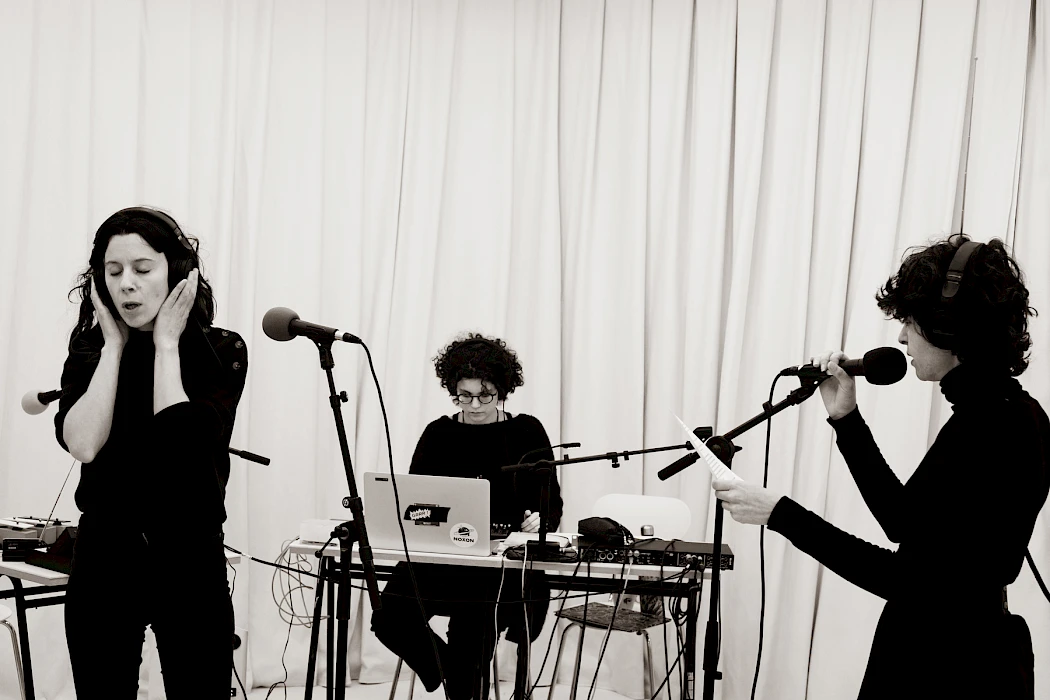
Yasmina Reggad, Episode 1. La Radio des images qui s’écoutent, 2021, KANAL-Pompidou. Photo: Valérie Nagant
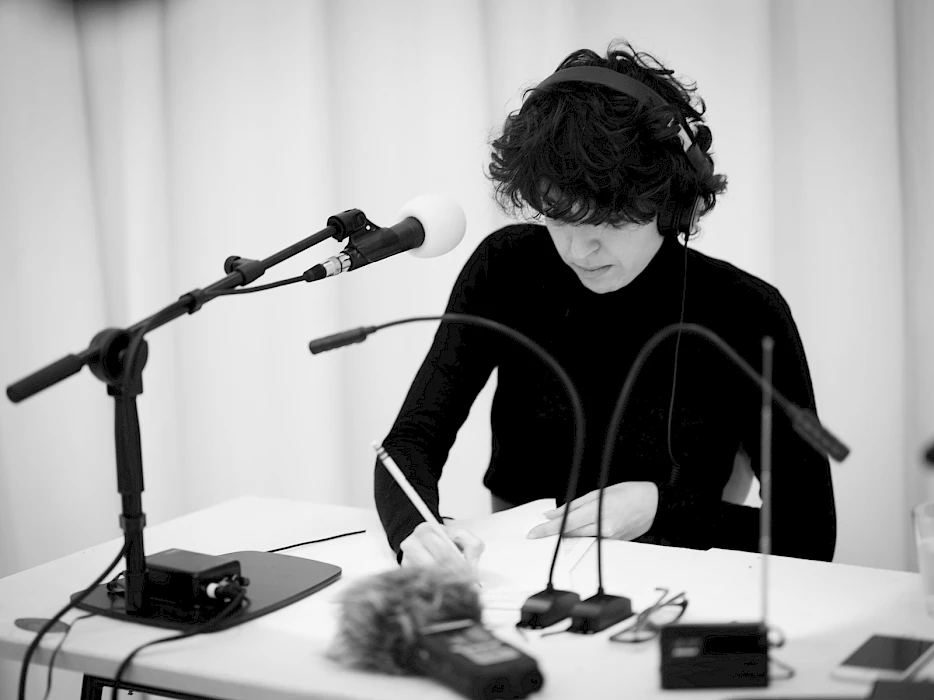
NA: In addition to your voice, whether in the form of Yasmina or Didascalie, there is a ‘choir’ – you call it the Solidarity Choir – composed of activists from each city where you perform. Their presence contributes to the patchwork of voices and narrative registers which make up your performance. It also forges a strong link between history and the present by situating you within a network of activists to which you belong.
YR: I am an activist. Half of my life, every day, is devoted to advocating for undocumented migrants and right now with my Palestinian comrades, as well as against police violence. Within my artistic work, I try to engage in activism that is internationalist – pan-Arab and pan-African activism. In every city I perform, I gather a Solidarity Choir formed by activists and people who identify as women and/or non-binary people. They perform their history in their mother tongues by appropriating texts spoken and written in the past, which they repeat with another texture and character. These words still resonate today; they explain or recall their singular experiences of displacement. In this way, we activate solidarities of the past and together sketch militant cartographies of our present-day cities.
Reality tends to overwhelm us. And this is exactly what happened when the young women of the feminist bloc in Algeria claimed their space of expression during the Hirak protests: they took up the words of the South African singer Miriam Makeba, when she sang in Arabic ‘Ana Hurra fi al-Jazā’ir’ (I am free in Algeria). They ‘echo’, or amplify, their own voices by recalling the promises of emancipation embedded in their mothers’ and grandmothers’ contributions to the Algerian Revolution.
NA: In the performance, we hear the song of Miriam Makeba, followed by the songs of young female activists during the Hirak protests, which led to the resignation of President Abdelaziz Bouteflika in 2019. It sounds like a continuation of the struggles for freedom. When Makeba sang those words at the Pan-African Festival of Algiers in 1969, she was forced into exile. She was a symbol of both the anti-apartheid struggle and of Pan-African solidarity movements since she was adopted by Algeria, who issued her a passport in 1972. In this history, and in your performance, these struggles are embodied by the voices of women. You are committed to making them heard when they are so often inaudible and ignored.
When engaging with these minor histories, it is very frustrating to find only male figures, both in the archives and in the collective memory of that period. This is why we need to double our efforts to uncover the truth, or create artistic stitches to repair it. We remember Rádio Voz da Liberdade (Radio Voice of Freedom) – an Algiers-based Portuguese resistance radio station during the dictatorship of António Oliveira Salazar – as ‘the radio of Manuel Alegre’, the poet and politician who was one of its main voices. We conveniently forget that it was a woman, Maria Stella Piteira Santos, who, starting in July 1963, took the microphone from Algiers to address her compatriots and comrades in Portugal and in exile. This is just one example. While my performance raises the question of who listens, I’m also concerned with who speaks and from where they speak. The text by Frantz Fanon, for example, is always performed by women of North African descent, and no one seems to notice or care. I renamed him “Frantz Fanette”. To voice and thus embody it helps me ponder the questions that I keep asking myself: who is this Algerian woman in the chapters ‘Algeria Unveiled’ and ‘The Algerian Family’ in A Dying Colonialism? Who is this masked Black woman in Black Skin, White Masks (Peau noire, masques blancs [1952])?3 In this way, I echo a feminist critique of Fanon’s work, particularly his nationalist and decolonial theory, which fails to consider Algerian women as genuine historical subjects, participants in the formation of the Algerian nation.
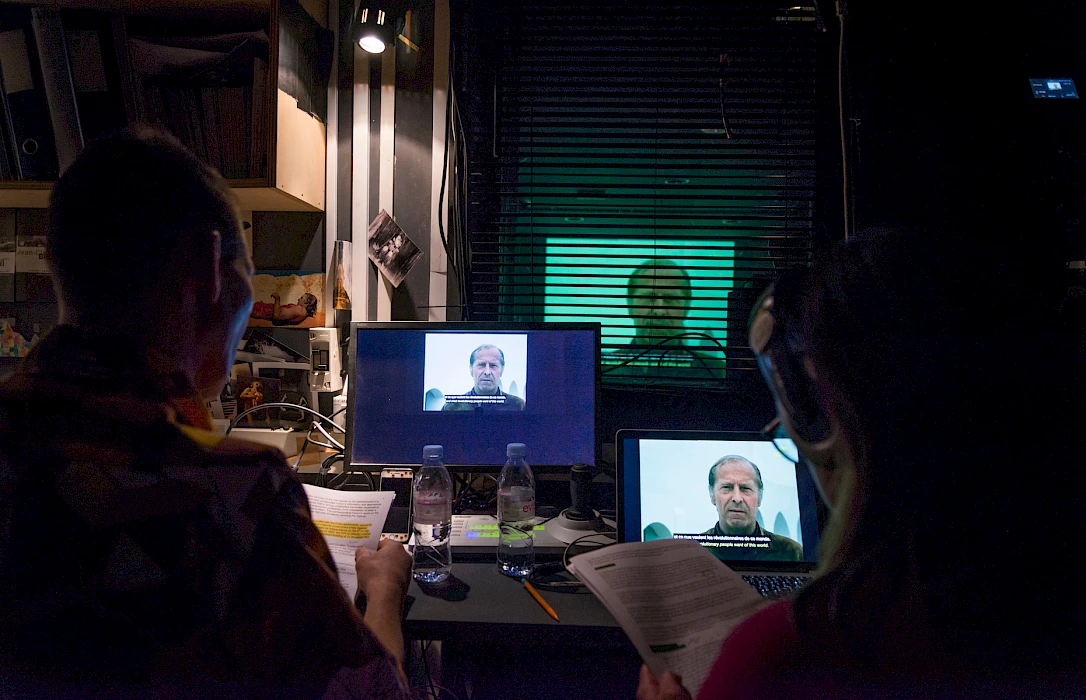
Yasmina Reggad, Episode 1. La Radio des images qui s’écoutent, Jeu de Paume, 2019, feat. a still from the documentary film Algier – Hauptstadt der Revolutionäre (Algiers, Capital of Revolutionaries), 1972, by Claude Deffarge and Gordian Troeller in collab. with Didier Baussy. Photo: Adrien Chevrot
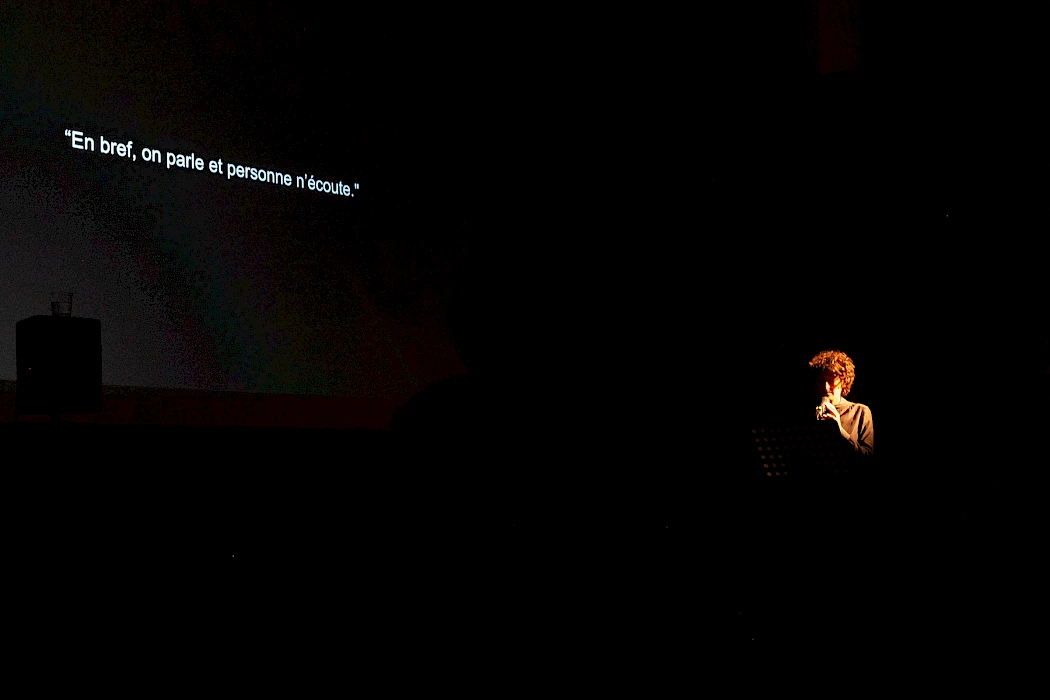
Yasmina Reggad, Episode 1. La Radio des images qui s’écoutent, Mucem - Les rencontres à l’échelle Festival, 2021. Photo: Lola Reboud
NA: One of the most important aspects of your performance is undoubtedly the fact that, for you, it constitutes a proposition for the reactivation of struggles – and particularly anti-colonial struggles – in today’s world.
YR: The performance is indeed a space that allows me to experience the effectiveness of a shared political project. I attempt to activate a hypothesis of solidarity shaped by the futures dreamed of by the Global South. This solidarity belongs to a past of which I consider myself to be an heir. I am not sure if it works, but I am beginning to formulate a response. I bring moments from history into dialogue with the present-day realities of the city or country hosting us, or with events that affect me and the communities among which I live.
The fifty-six activists who form the different Solidarity Choirs bring with them a new audience, largely made up of people who don’t go, or almost never go to the theatre, and who finally feel invited, in these spaces, by their activist circles. These histories are transmitted through a group of racialized people who activate their solidarity in the act of listening together with the rest of the audience.
MARSEILLE, 31 MARCH 2012
VOICE: DANIELLE MICHEL-CHICH, JOURNALIST AND ESSAYIST, SPEAKING FROM THE AUDIENCE:
In 1956 I was at the Milk Bar. I am somewhat moved by this confrontation that you refused in private, Miss, and which I am therefore obliged to pursue in public. I need to tell you that you killed my grandmother and severed one of my legs. I say this without hatred, without anger and without any desire for revenge, because I have come a long way. And I wrote a book about it. I came a long way … because I understand your struggle. … But, Miss, if you acknowledge this act as a murderous one, however justified it may have seemed - once again your cause was just. But if you acknowledge that it was murder – because it was – my grandmother had nothing to do with the settlers you were fighting. If you were to acknowledge that, you would grow from this. And we could approach a positive phase of debate between France and Algeria. … Let us try to speak honestly to one another so that we may advance our dialogue and go further.
[APPLAUSE]
VOICE: ZOHRA DRIF, LAWYER AND ALGERIAN POLITICIAN, FORMER MEMBER OF THE FLN, ON STAGE:
I am sure I will shock you again, but quite honestly, this is not a problem you should be putting to me. Demand it from all the French powers that came to enslave my country and who refuse to leave [applause] [inaudible]. … Of course, on a personal and human level, all these dramas – yours or ours – are distressing. I can tell you about hundreds of dramas like your own that we lived through. … But we were not in a personal confrontation; we were in a war. ... When the bombardments of the Allies rained over the very beautiful city of Dresden, I imagine there were many civilian deaths … people who in that moment were in that specific place, at the very moment the bombs fell from the skies. But humanly, they are human beings, I totally understand. Unfortunately, you and we were caught in a storm beyond our control.
[Panel discussion about the Algerian war 'fifty years later', co-organized by Marianne, France Intern and El-Khabar at the Théâtre de la Criée ]
Ammar:
The investigation continued from 8 to 13 April 2024 at Roma Tre University in Italy with COLLETTIVOSTIENSE 234, some of whose members were present in the room on 15 December 2023, and from 10 to 13 October 2025 at ‘New Radicalisms’ in Rotterdam in the Netherlands, two locations where the activities of the suspect Y. Reggad resumed. The agent followed her to Antwerp, Belgium, where, starting on 28 March 2025, she was joined by Nadine Atallah at Kunsthal Extra City. Finally, the agent followed her back to Paris, where she was at the École du Louvre from 10 to 12 September 2025. The investigation is ongoing.
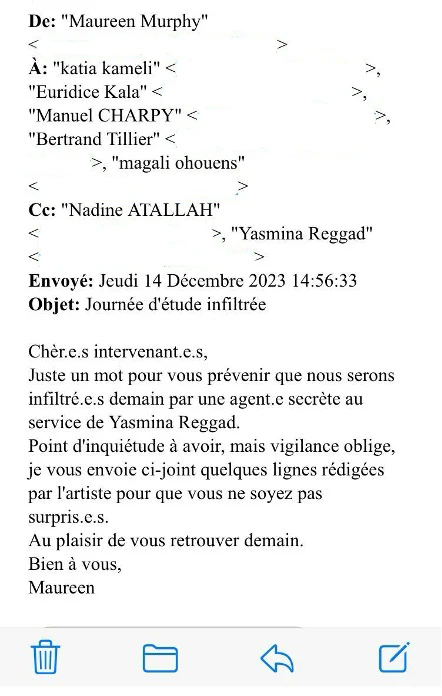
[English translation:
Dear participants,
Just a note to warn you that we will be
infiltrated tomorrow by a secret agent
in the service of Yasmina Reggad.
No reason to be worried, only cautious.
However, under a duty of care,
I am attaching a few redacted lines
from the artist so that you are not
surprised.
A delight to be meeting you tomorrow.
Best regards,
Maureen]
Related contributions and publications
-
The Kitchen, an Introduction to Subversive Film with Nick Aikens, Reem Shilleh and Mohanad Yaqubi
Nick Aikens, Subversive FilmSonic and Cinema CommonslumbungPast in the PresentVan Abbemuseum -
Live set: Apotome
Khyam AllamiSonic and Cinema Commons -
Opening Performance: Song for Many Movements, live on Radio Alhara
Jokkoo with/con Miramizu, Rasheed Jalloul & Sabine SalaméEN esInternationalismsSonic and Cinema CommonsPast in the PresentMACBA -
Mix tape: Let's funk up all genders!
Materia Hache / Others to the FrontEN esSonic and Cinema CommonsSituated OrganizationsMuseo Reina Sofia -
Live set: Una carta de amor a la intifada global
PrecolumbianEN esInternationalismsSonic and Cinema CommonsPast in the PresentMACBA -
Broadcast: Towards Collective Study in Times of Emergency (for 24 hrs/Palestine)
L’Internationale Online Editorial Board, Rana Issa, L’Internationale Confederation, Vijay PrashadInternationalismsSonic and Cinema Commons
Related activities
-
–MACBA
Song for Many Movements: Scenes of Collective Creation
An ephemeral experiment in which the ground floor of MACBA becomes a stage for encounters, conversations and shared listening.
-
–MACBA
Visions of Panafrica. Film programme
Visions of Panafrica is a film series that builds on the themes explored in the exhibition Project a Black Planet: The Art and Culture of Panafrica, bringing them to life through the medium of film. A cinema without a geographical centre that reaffirms the cultural and political relevance of Pan-Africanism.
-
Museo Reina Sofia
Cinema Commons #1: On the Art of Occupying Spaces and Curating Film Programmes
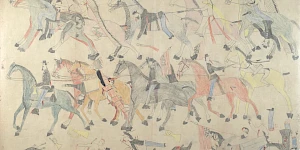
On the Art of Occupying Spaces and Curating Film Programmes is a Museo Reina Sofía film programme overseen by Miriam Martín and Ana Useros, and the first within the project The Cinema and Sound Commons. The activity includes a lecture and two films screened twice in two different sessions: John Ford’s Fort Apache (1948) and John Gianvito’s The Mad Songs of Fernanda Hussein (2001).
-
Museo Reina Sofia
Sonic and Cinema Commons
Sonic and Cinema Commons is a research, programming and publishing project that explores how cinema and sonic experiences generate spaces for the formation of interpretive communities, foster collective debate and prefigure proposals for the commons. Co-organised with L’Internationale Online, 2025 and 2026.
-
–SALT
This Porous Earth: Screening, Talk, and Workshop Program
This Porous Earth is a screening, talk, and workshop program at Salt Beyoğlu exploring the relationships between cinema and the natural world through the material properties of film itself.