Reading time
19 min
To share this contribution please copy the url below
EN

The Object of Value


Artist Slinko takes different manifestations and interpretations of Kazymyr Malevych’s Black Square – from the early twentieth century to today – as the frame through which to reflect on her home region of Donbas, Ukraine. Through a constellation of text, image, archive and a beer named ‘Hell’ Slinko considers questions of representation, abstraction and value in the context of ongoing imperial destruction. The piece is based on a lecture performance the artist gave at the summer school ‘Landscape (post) Conflict’, hosted by IMMA and NCAD, Dublin, July 2025.

Since war is not an act of senseless passion but is controlled by its political object, the value of this object must determine the sacrifices to be made for it in magnitude and also in duration.

– Carl von Clausewitz, 18321


In his still-influential On War (1832), Carl von Clausewitz describes the pursuit of a political object that drives nations to wage war. If the value of this object is high enough, Clausewitz argues, war becomes an acceptable means of obtaining it. If the effort needed to secure the object exceeds its value, the war must be abandoned. In other words, to achieve peace, the object of value must become worthless.

In this text, I want to think through abstraction and representation by focusing on my homeland region of Donbas in eastern Ukraine and examining its stereotyping as a wasteland.
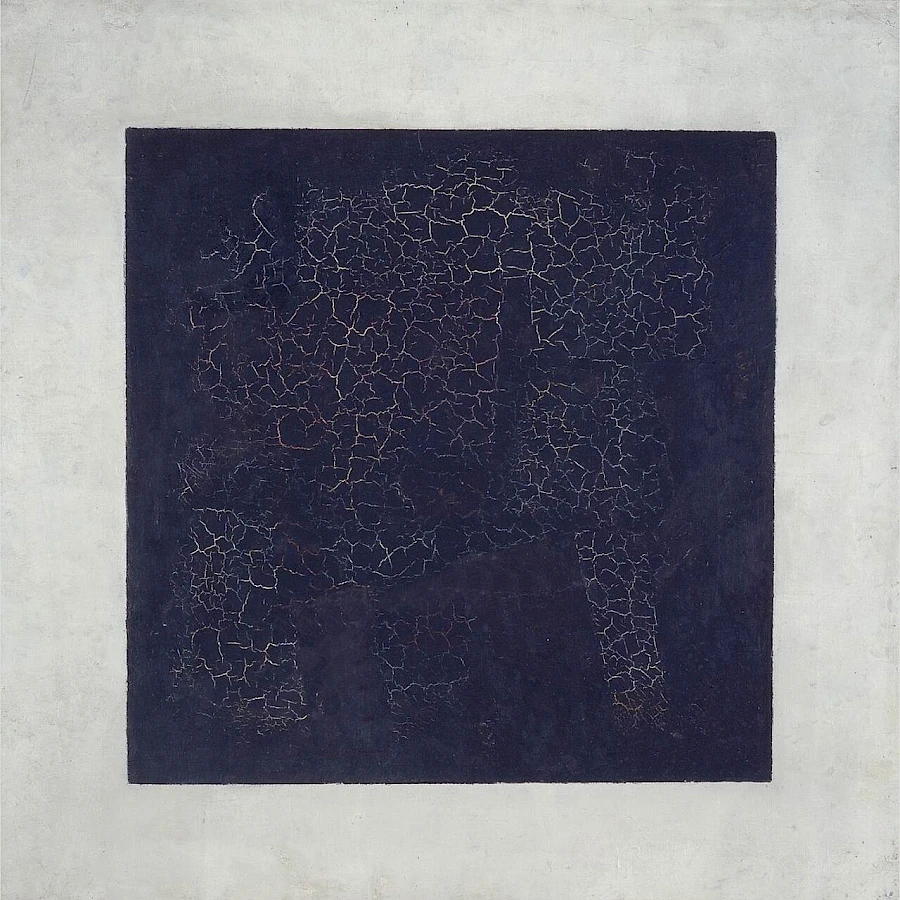
Kazymyr Malevych, Black Suprematic Square, 1915, oil on linen canvas, Tretyakov Gallery, Moscow

First, let me consider an object valued at 85 million dollars: the 1915 Black Square painting by Kazymyr Malevych,2 part of the State Tretyakov Gallery’s collection in Moscow. The Black Square first appeared in 1913 as a stage design for the Cubo-Futurist opera Victory Over the Sun, in which the protagonist sought to abolish reason by capturing the sun and destroying time.
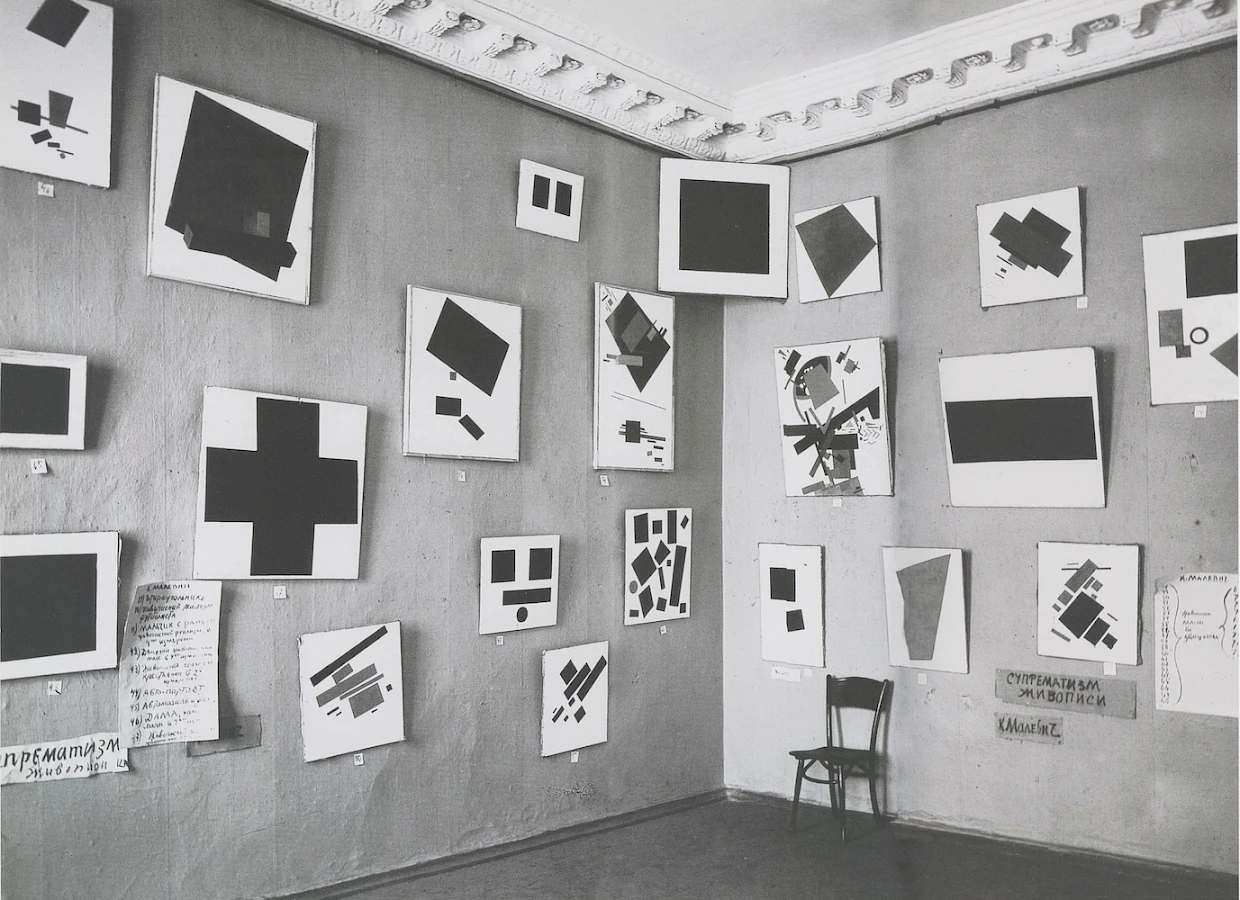
‘The Last Futurist Exhibition of Painting 0,10', Petrograd, 1915-1916

The play was a failure, but Malevych became convinced he had made a major breakthrough. Two years later, he presented the Black Square at ‘The Last Futurist Exhibition’ and announced the birth of a new artistic movement, Suprematism:

By Suprematism I mean the supremacy of pure feeling in creative art. To the Suprematist, the visual phenomena of the objective world are, in themselves, meaningless; the significant thing is feeling.3

Over the next twenty years Malevych produced many Suprematist works, but the Black Square never ceded its importance. Malevych used it as insignia on his students’ lapels and produced no fewer than three other versions of the original painting.

Never lacking in confidence or grandiosity, he was convinced that Suprematism was a world-shattering event, declaring the Black Square the ‘zero point of painting’. Even in the context of the First World War and the end of the Russian Empire, he advocated the supremacy of pure feeling over objective reality.
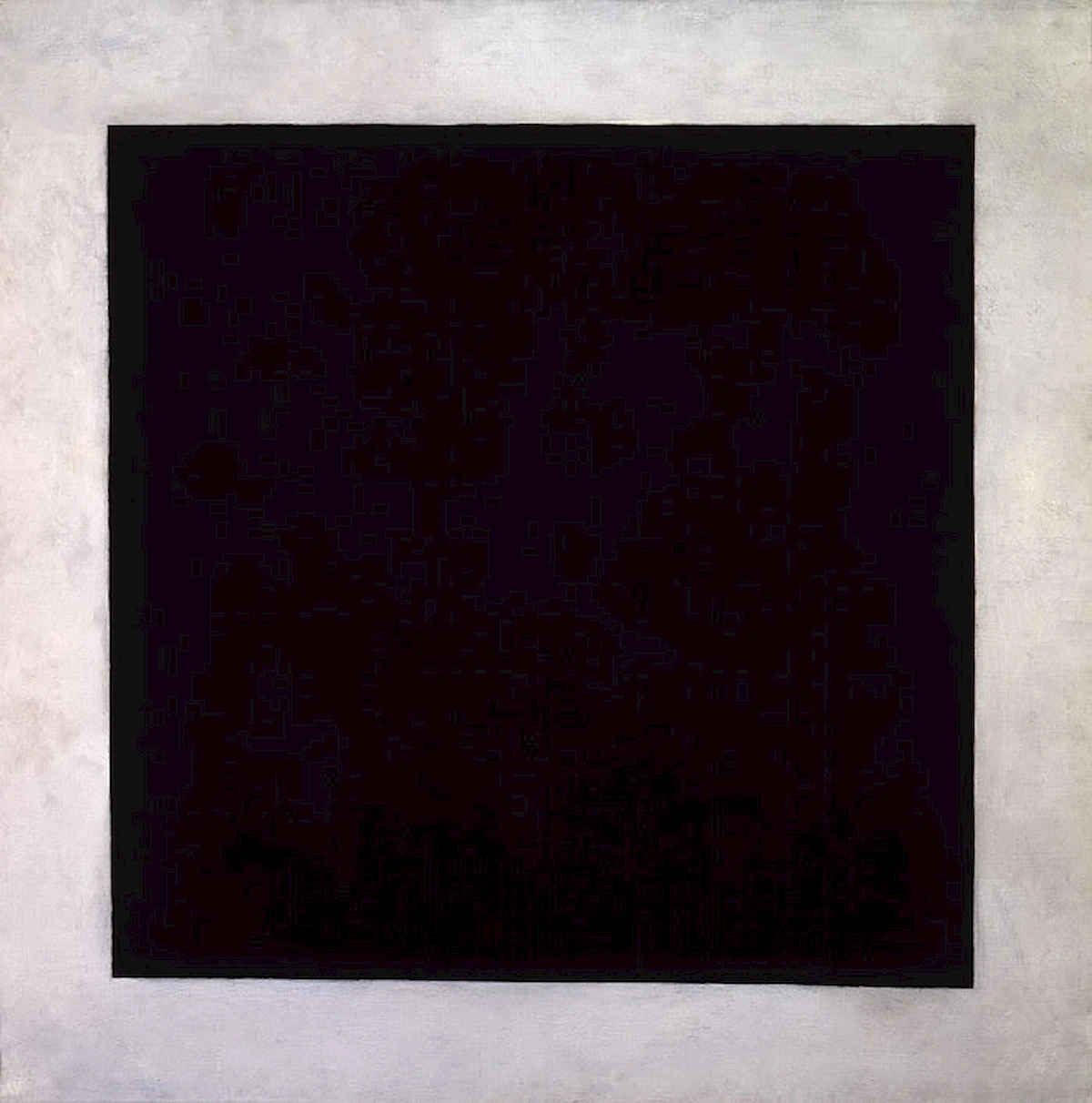
Kazymyr Malevych, Black Square, 1923, The Russian Museum, Saint Petersburg
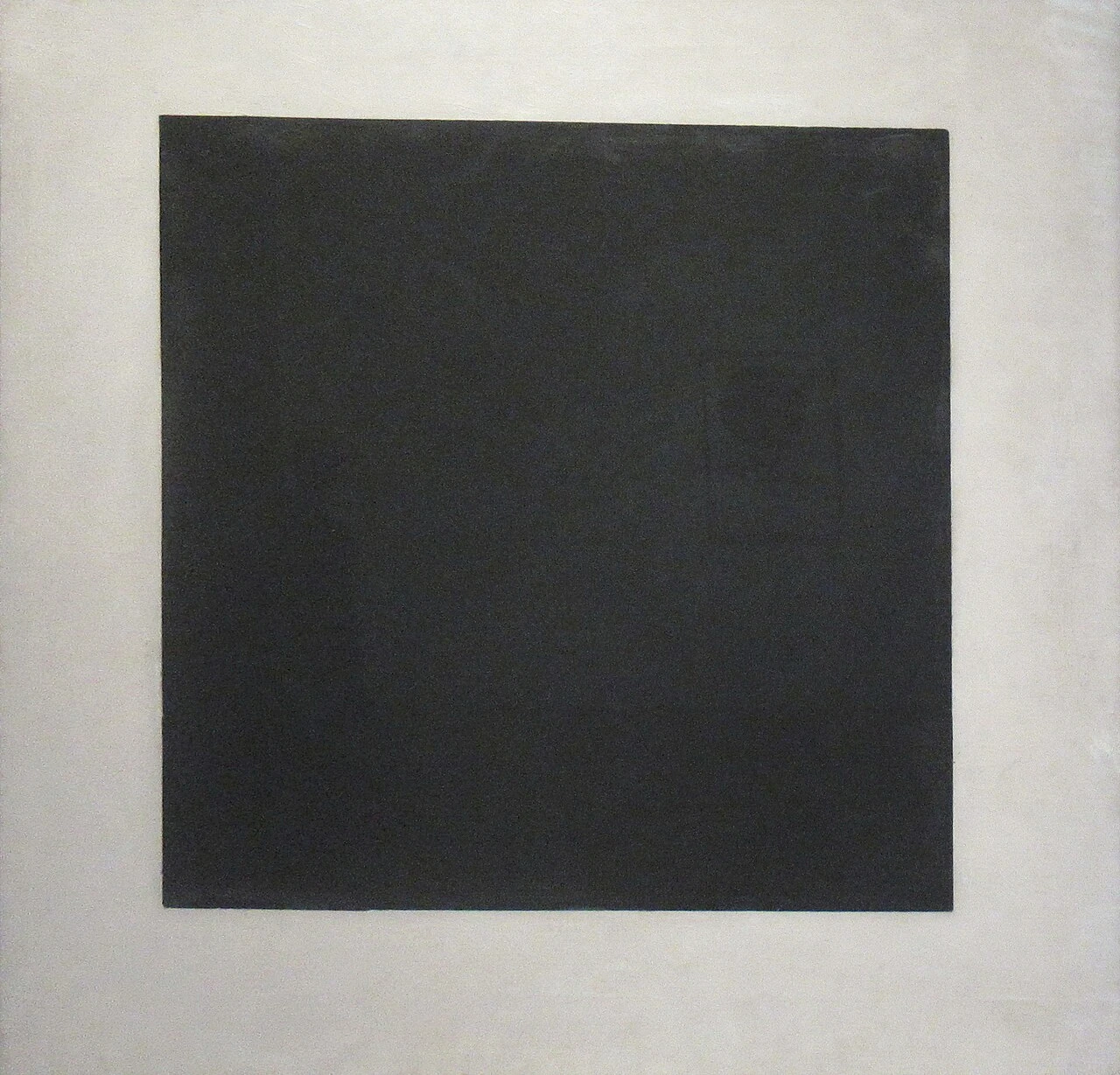
Kazymyr Malevych, Black Square, 1929, Tretyakov Gallery, Moscow
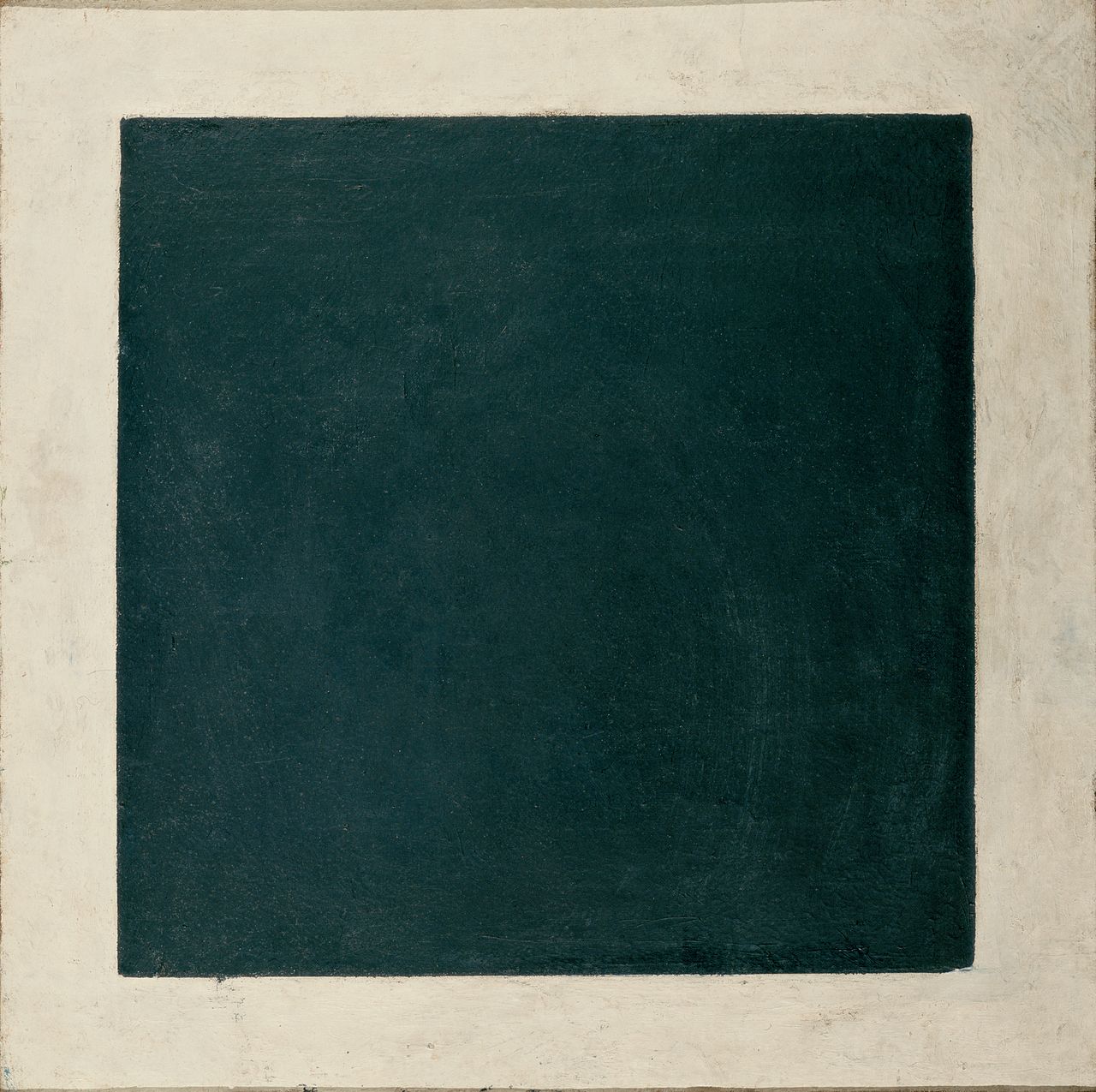
Kazymyr Malevych, Black Square, c. late 1920s–1930s, Tretyakov Gallery, Moscow

The Black Square even followed Malevych to his grave. Laid beneath a Black Square painting, his coffin was transported in a truck adorned with a Black Square. His burial site, a cube containing the artist’s ashes, was marked with the Black Square. In supreme irony, the burial site was destroyed in the Second World War: thus, the artist dissolved into the pure abstraction of the non-objective world.
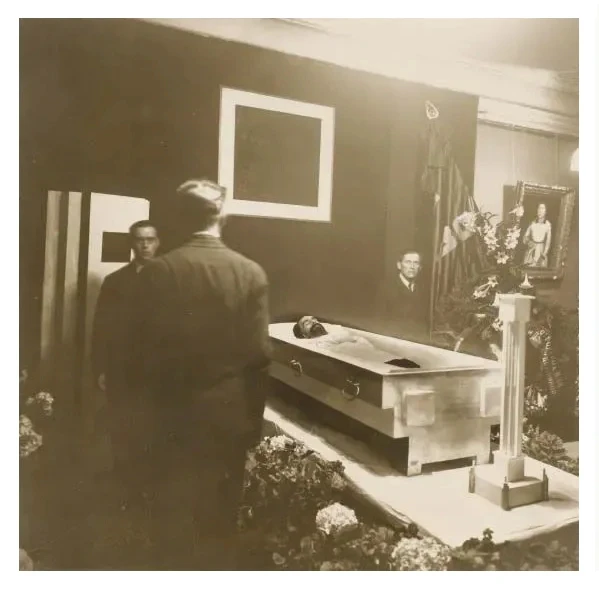
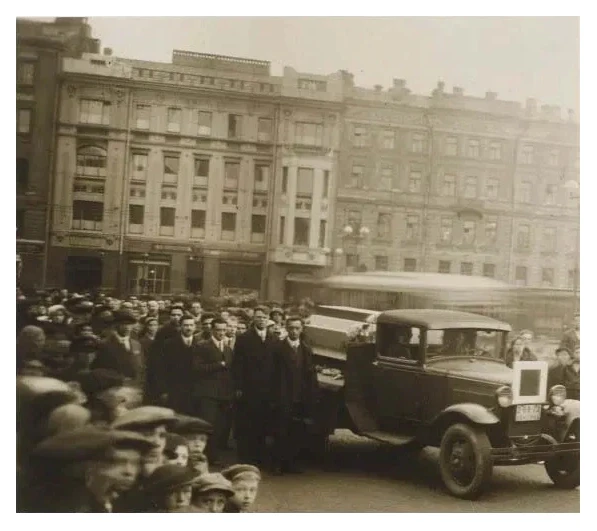
Kazymyr Malevych’s Funeral, © Foundation Khardzhiev

The Square: Sarah Pierce

When I arrived at IMMA in February 2024, I felt severed from a certain object of great value to me: a small village in Donbas that ceased to exist after the bombing in March 2023. To paraphrase Malevych’s words, the objective world in which this village existed as my family’s homeland had become meaningless. My attachment to this place was now a pure feeling liberated from its object.

A question grew in my mind: What was this feeling, exactly? Each time a new Donbas settlement was pronounced destroyed, the question expanded. It now demanded a coherent answer to systematic obliteration. From bits and pieces in Telegram channels, war reports, podcasts and news, and from the rubble, the question sought to assemble meaning.
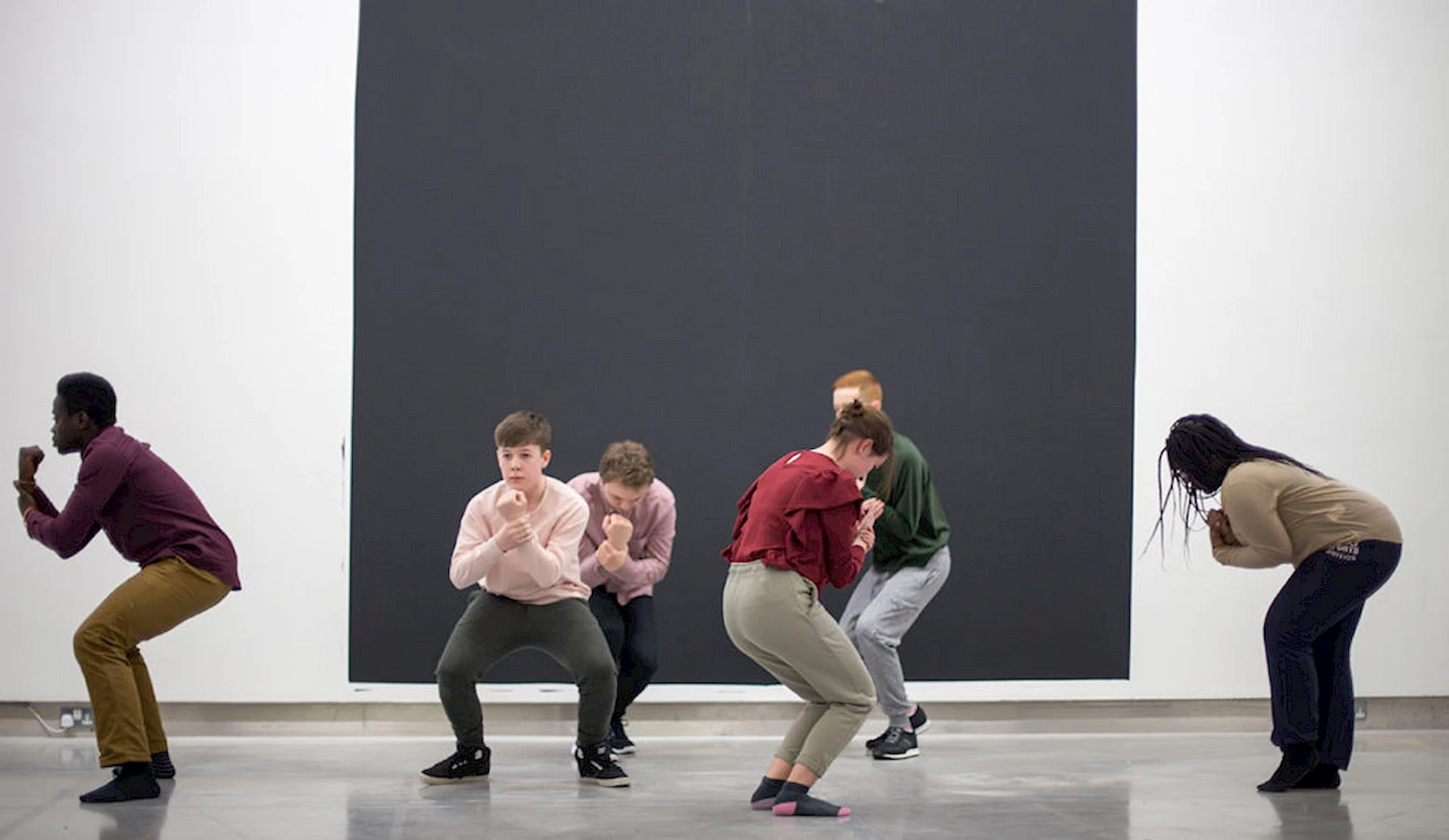
Sarah Pierce, The Square, 2017, performance and installation, commissioned by Jennie Guy for 'It’s Very New School at Rua Red', South Dublin Arts Centre, Tallaght

At IMMA, a black square appeared. It was painted by a group of artists on the wall of Sarah Pierce’s studio.4 During the workshop, Sarah’s instructions were simple: paint a 1 x 1 m square without using measurement tools or speaking to each other. Later we were to speak to the square directly. I failed at that task. I could not address this square without thinking of Malevych’s Black Square.

The Black Square bothered me because it represented the cultural fight over the term ‘Russian Avant-Garde’. With the start of the current war, Ukrainian cultural workers put a lot of effort into reclaiming historic accuracy: Malevych was of Polish descent, born in Kyiv and raised in Ukraine. The default ‘Russian’ label is liberally attached to him and other artists of his day. This is not surprising; the Russian Empire was a multiethnic state where anyone with ambition gravitated towards Moscow or Saint Petersburg.

But the imperial centre of gravity entailed a significant trade-off: to gain access to power and resources, one had to speak Russian; and once one spoke Russian, one was Russian in the eyes of the Empire. Of the long list of the so-called Russian Avant-Garde, many artists were Ukrainian, Polish, Belarusian, Latvian, Lithuanian, Finnish, German, Moldovan, Armenian, or of other ethnicities. We can debate whether they identified as Russians, with the Russian Empire, or whether this question even arose. For Malevych, the answer came during his second arrest in 1930; the OGPU records show his nationality as Ukrainian.5 Still, it was the vaguely defined Russian culture that reaped the benefits of his cultural production.

With the fall of the Russian Empire in 1917, the logic of coloniality and cultural extraction did not fall away but was rather repurposed by the new Soviet state. Later, the Russian Federation inherited the Soviet state as its successor. Today, the state museums in Moscow and Saint Petersburg continue to own the most valuable artifacts of complex and shared histories and to control the narratives around them.

These were the thoughts racing through my head when my turn came to address the black square at IMMA. I did not see it as abstraction, a coat of fresh paint, or a Brechtian learning play. I’m not even sure I saw a square. Instead, I saw the feeling finally taking shape, and it took me back to Ukraine and the black coal seams of Donbas.

Donbas: an enigma

Donbas is an industrial region in eastern Ukraine, and its name is an abbreviation of Donets Coal Basin. While stereotypes about Donbas often paint it as pro-Russian, apolitical, or filled with Soviet nostalgia, the region’s true identity remains an enigma. Home to ethnically diverse groups including Ukrainians, Greeks, Tatars, Moldovans, Jews, Armenians, Georgians, Azeris, Belarusians and Poles, Donbas also has a significant Russian minority.
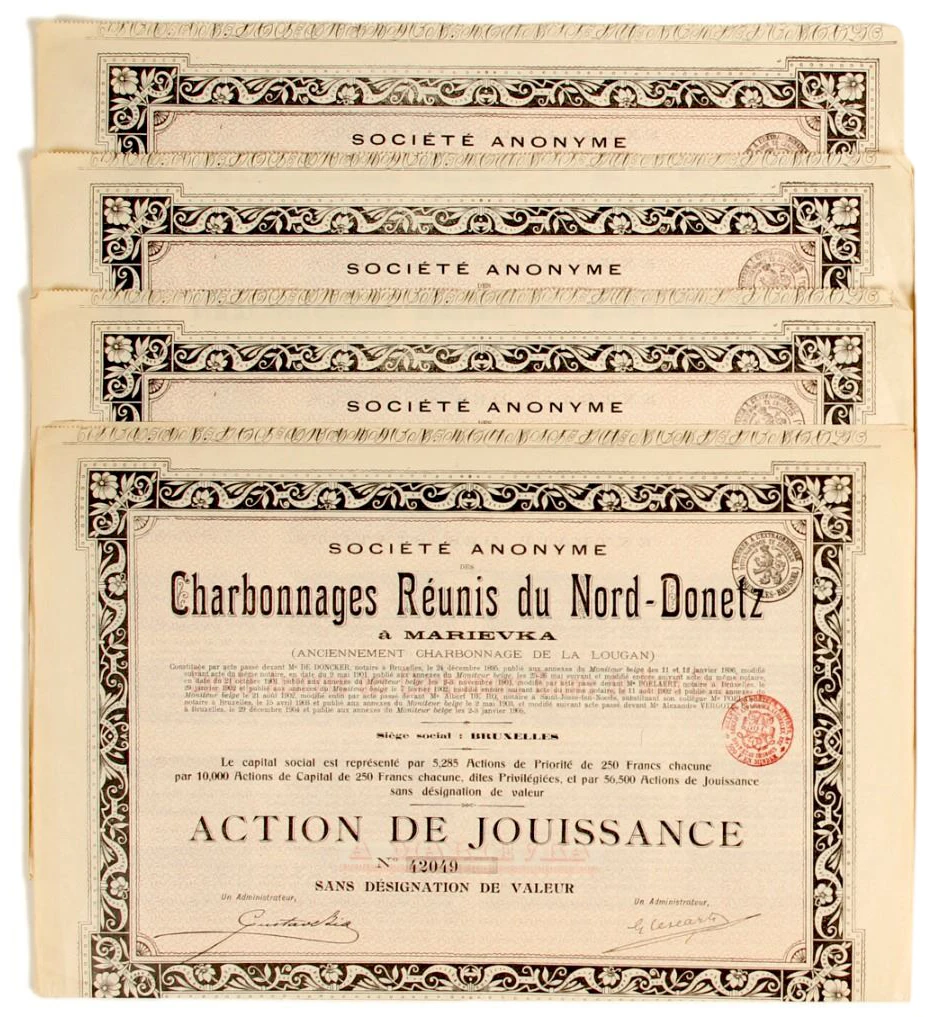
An example of a pre-revolutionary mining security issued by the Société Anonyme des Charbonnages Réunis du Nord-Donetz à Mariévka, a Belgian-financed coal company operating in the Donets Basin, late 19th–early 20th century
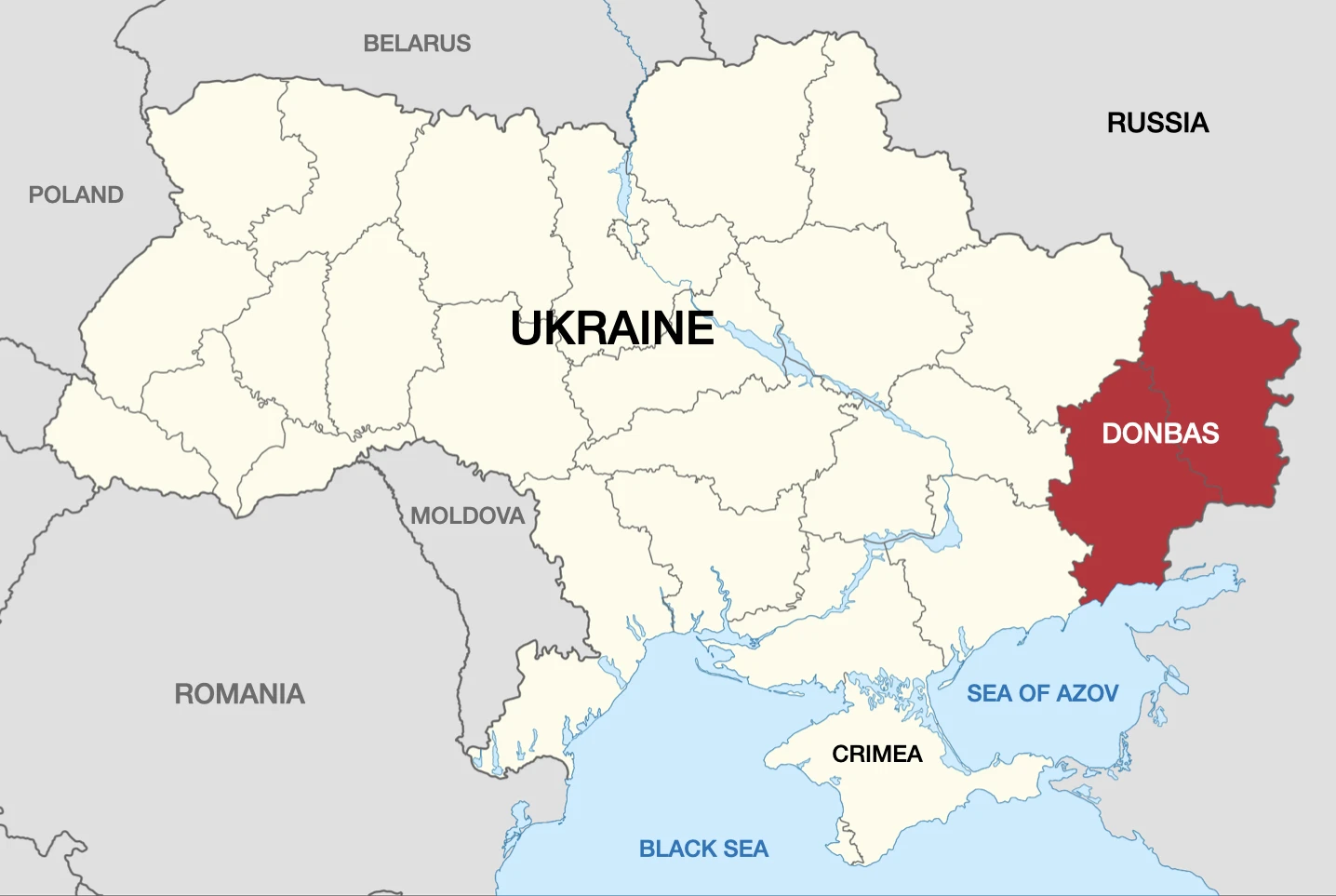
Contemporary map of Ukraine
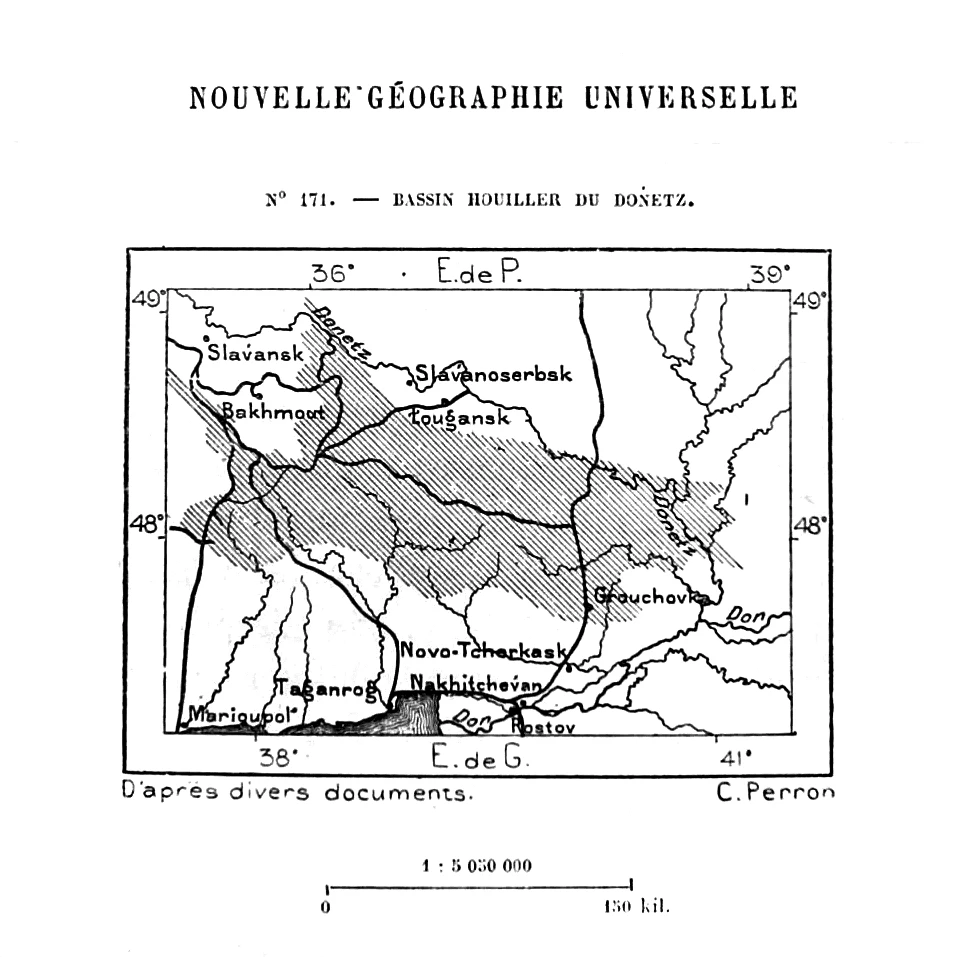
Map from  Élisée Reclus, Nouvelle géographie universelle: la terre et les hommes. Volume 5: L’Europe scandinave et russe. Paris: Hachette et cie, 876-94, Plate No. 171: Bassin houiller du Donetz. Map by C. Perron

Historically, Donbas was and remains a borderland, embodying the spirit of the Wild Field it was when a sparsely populated, nomadic steppe.6 From its early nomadic days and Cossack settlements through industrialization and economic decline, Donbas has been the subject of contestation. It truly emerged on the world scene with the discovery of coal deposits in the nineteenth century. The Russian Empire promptly began leasing Donbas lands to investors from Belgium, Germany, France, Great Britain, and Switzerland. By the beginning of the twentieth century, foreign capital accounted for 70 percent of the coal mining and 86 percent of the iron ore mining industries. The Wild Field, which had been opaque to the eye of the Empire, was now defined as an extractive resource, setting Donbas on a trajectory of both economic pride and dispossession, and shaping its multicultural and international identity. It became a place of opportunity and escape, as Hiroaki Kuromiya writes:

What is remarkable about the Donbas is that even at the height of Stalinism it continued to maintain some elements of the free steppe, providing refuge to the disenfranchised, to outcasts, fugitives, criminals, and others. … Throughout its history, the Donbas has been politically unmanageable. 7
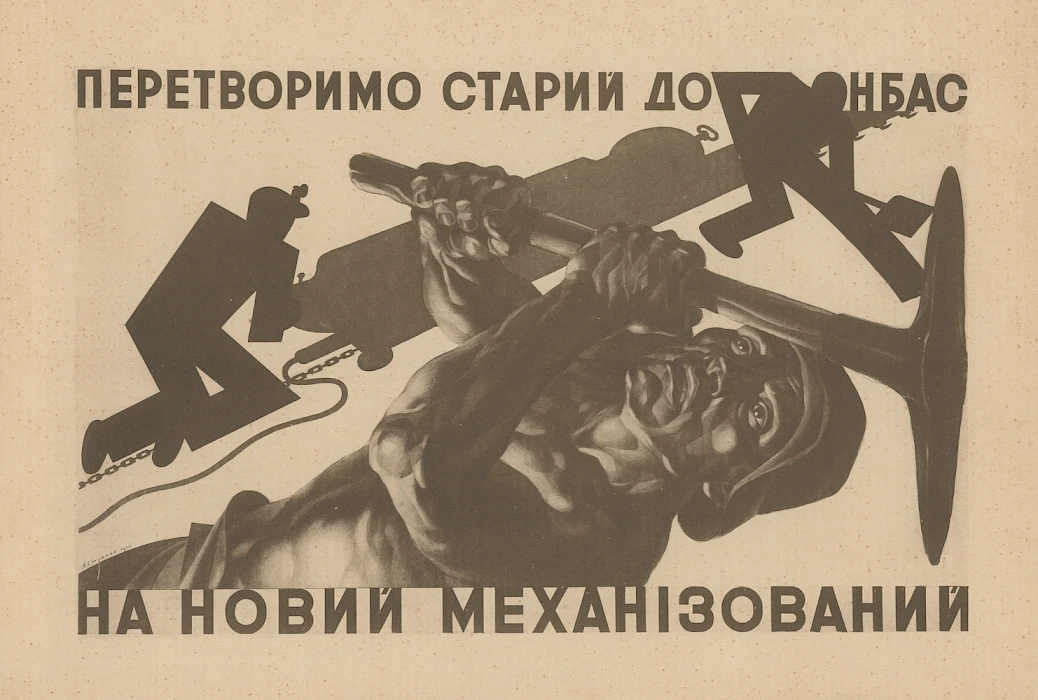
'Let’s Make Old Donbas into New Mechanized', Adolf Strakhov
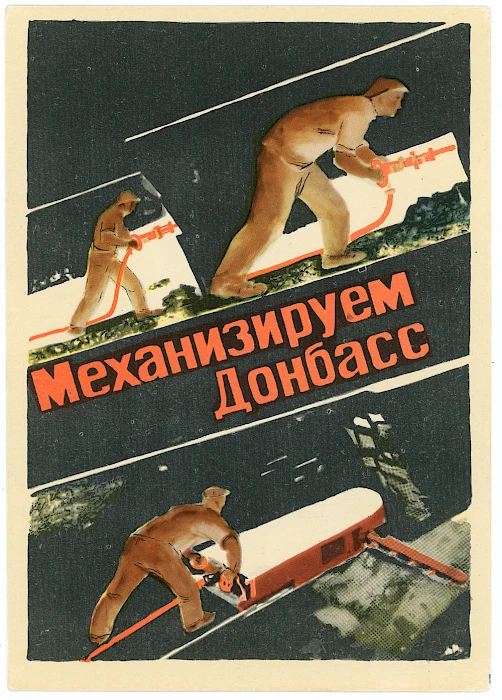
'Mechanizing Donbas', Alexandr Deyneka

Many of Donbas’s persisting stereotypes stem from the Soviet imagery of nation-state building. As early as 1921, the region was recast as the heart of Soviet Russia, a new political regime under the same imperial lingua franca. Although the Soviet state was multi-ethnic, the label ‘Russian’ was deliberately imposed to convey uniformity, making it ‘Russian Avant-Garde’, ‘Russian Revolution’ and ‘Soviet Russia’, and labelling Donbas ‘Russian’.
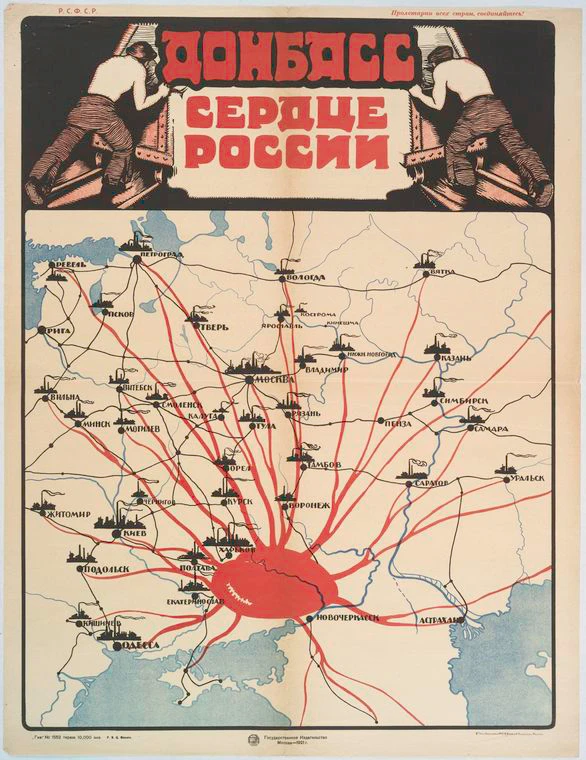
Soviet poster, 1921. Source: New York Public Library

In this image, the phrase ‘Donbas, the heart of Russia’, is framed by two half-naked, faceless miners straining into the darkness. Donbas itself appears as a red blob, its tendrils reaching out to cities, factories, and plants. To understand this image as a harbinger, let me provide some historical context.

The poster dates to 1921, the year of Ukraine’s first famine and civil war, and marks the start of Donbas’s rapid industrialization and Russification. Coal and steel factories drew overwhelmingly Russophone workers, while state policies elevated Russian as the sole language of education, industry and administration, largely confining indigenous Ukrainian to the countryside. This was followed by the Great Famine (Holodomor) of 1931–33, the Great Terror of 1937–38, the Nazi occupation of 1941–43, and the post-war famine of 1946–47. Looking at this image, I can’t ignore its cannibalistic metaphor, with the state feeding its military-industrial complex on the body of Donbas.

If Donbas was the heart of Soviet industry, then coal was at the heart of the Donets Basin. Donbas’s seams are rich in anthracite, the purest and highest-grade coal. It is shiny black and burns with a blue flame. Used for heating, metallurgy and other heavy industries, anthracite is embedded in Donbas’s identity and quite literally in the bodies of its inhabitants.
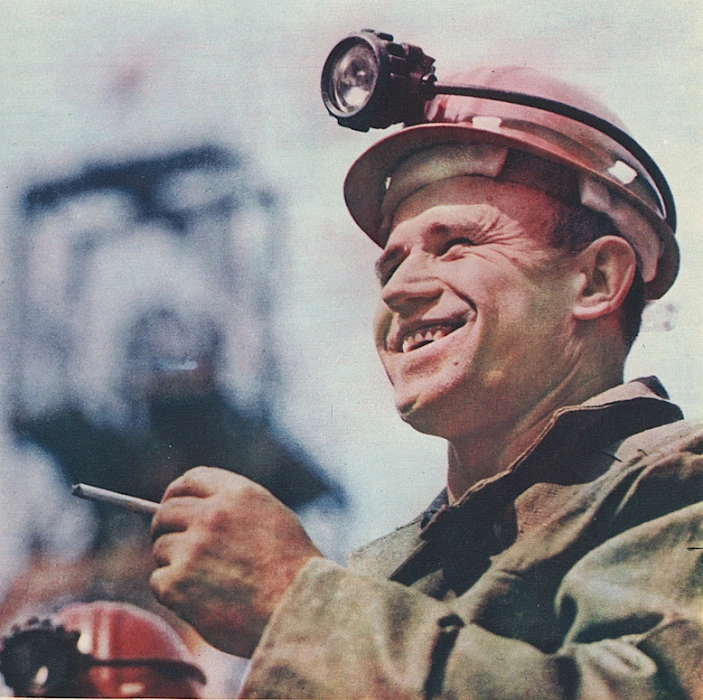
Hero of Socialist Labor, miner of the 'Kapitalna' mine, Y. I. Hrynovetskyi, Makiivka, 1972. Photo Album, Kyiv: Mystetstvo Publishers
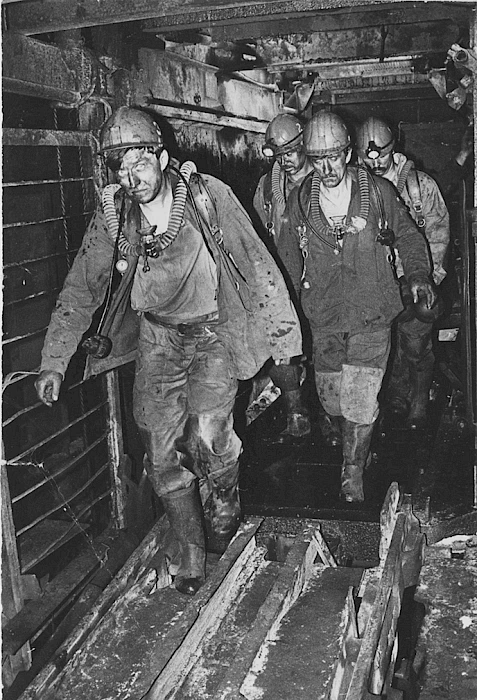
Personal archive, found press photo, 1990s

Mining anthracite means working at depths of 350–600 metres. It’s incredibly hot down there, and time becomes imperceptible. During Stalin’s industrialization, forced labour in unsafe conditions was common and workers could be imprisoned for the smallest infractions. As coal production intensified, so did the image of Donbas as a region of proud coal miners digging their way to socialism.

By the end of the USSR, picture-perfect coal miners had become abstractions, alienated from themselves and from the objective reality of their lives. Where the blackness of the mines had once held the promise of a bright future, extraction had produced a meaningless void. The now-failing coal industry continued its pursuit of efficiency, rendering Donbas’s land ever more abstract: a cross-section of soil, core samples, pressure calculations and coal impurity studies. Riddled with endless mineshafts, Donbas became a hollowed-out political enigma.
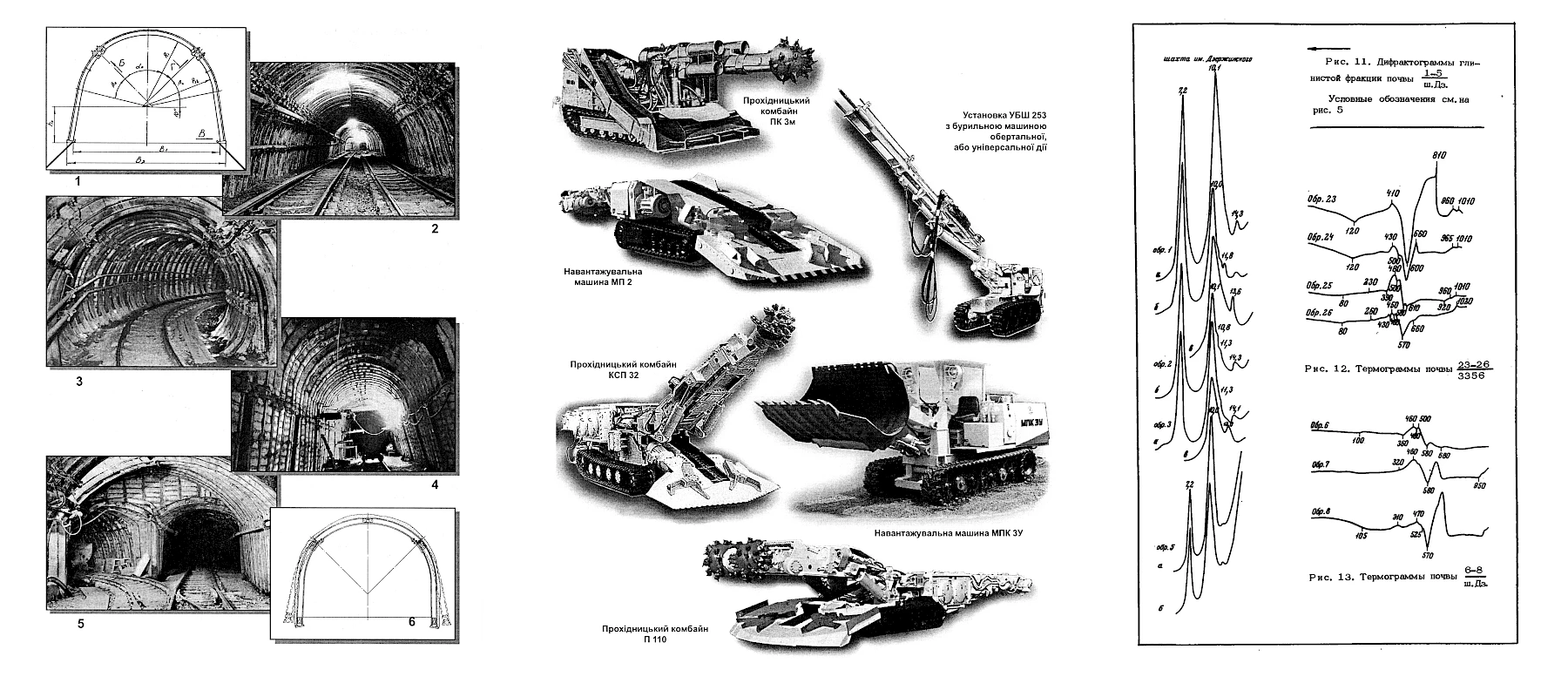
Left: Designs of mine roof supports. Centre: Samples of Tunneling Equipment. (H, Pinkovskyi, 2006. The Dniprodiproshakht Institute and the Coal Industry of Ukraine: A Documentary Edition, Dnipropetrovsk: PP Lira LTD, 2006) Right: Clay Material in Soils and Parent Materials (A, Feofilova, Fossil Soils of the Carboniferous and Permian of the Donets Basin. Transactions, no. 270. Moscow: Nauka, 1975)

After the collapse of the Soviet Union, Donbas experienced a steep economic decline and rapid privatization. This created a permanent underclass of once-heroic miners, gave rise to illegal coal mining, organized crime and a new class of oligarchs. In the 1990s, Donbas was one of the most dangerous regions in Ukraine, with frequent assassinations and rival criminal factions. Those who survived became known as ‘Donetskiye’, a new political class that exerted power over the local population and extracted favours from Kyiv.

It was in this landscape of disenfranchisement and inequality that the Kremlin saw an opportunity to undermine Ukrainian independence by destabilizing Donbas. The Russkiy Mir Foundation, which envisions a Russia transcending the Federation’s borders, began operating in Luhansk in 2009. Its stated mission is to project cultural, political and military influence wherever Russian speakers are found. In Donbas, it funded publications and conferences that amplified narratives of fear about Ukrainian nationalism, the hostile West and the assault on traditional Christian values. When Ukrainians ousted the pro-Russian president Viktor Yanukovych, himself a native of Donbas, in 2014, the ground for a backlash against Kyiv was already well-prepared.

Capitalizing on its legacy of Russification and the mobilization of radicalized, disenfranchised groups, the Kremlin laid claim to this Russian-speaking region and ‘rewarded’ it with severance from Ukraine as the breakaway Luhansk and Donetsk People’s Republics. In Russian state media, Donbas is called Novorossiya, or ‘New Russia’, a term coined after the Russian Empire conquered and annexed the Crimean Khanate in the eighteenth century. As Oleksiy Radynski brilliantly writes in ‘Maidan and Beyond, Part II: The Cacophony of Donbas’, history ‘repeats itself as historical reenactment’.8

Russkiy Mir: the Russian Retro-Garde

For the majority of Russian-speaking Ukrainians whom the Russkiy Mir purports to protect, the costs of this continuing war are staggering: so far over 7o percent of the destruction is concentrated in Donbas. Because neither Donbas nor its Russian speakers represent an object of value for the Kremlin, they are expendable means of pursuing its true political goal: a Russkiy Mir (Russian World), a phantom empire transcending international borders. As the ‘special military operation’ grinds Donbas settlements into a grey zone of abstraction metre by metre, the Russian Retro-Garde renders the objective reality of eastern Ukraine meaningless. Here, these words from Timothy Snyder’s Bloodlands: Europe Between Hitler and Stalin (2010) echo with a particular poignancy:
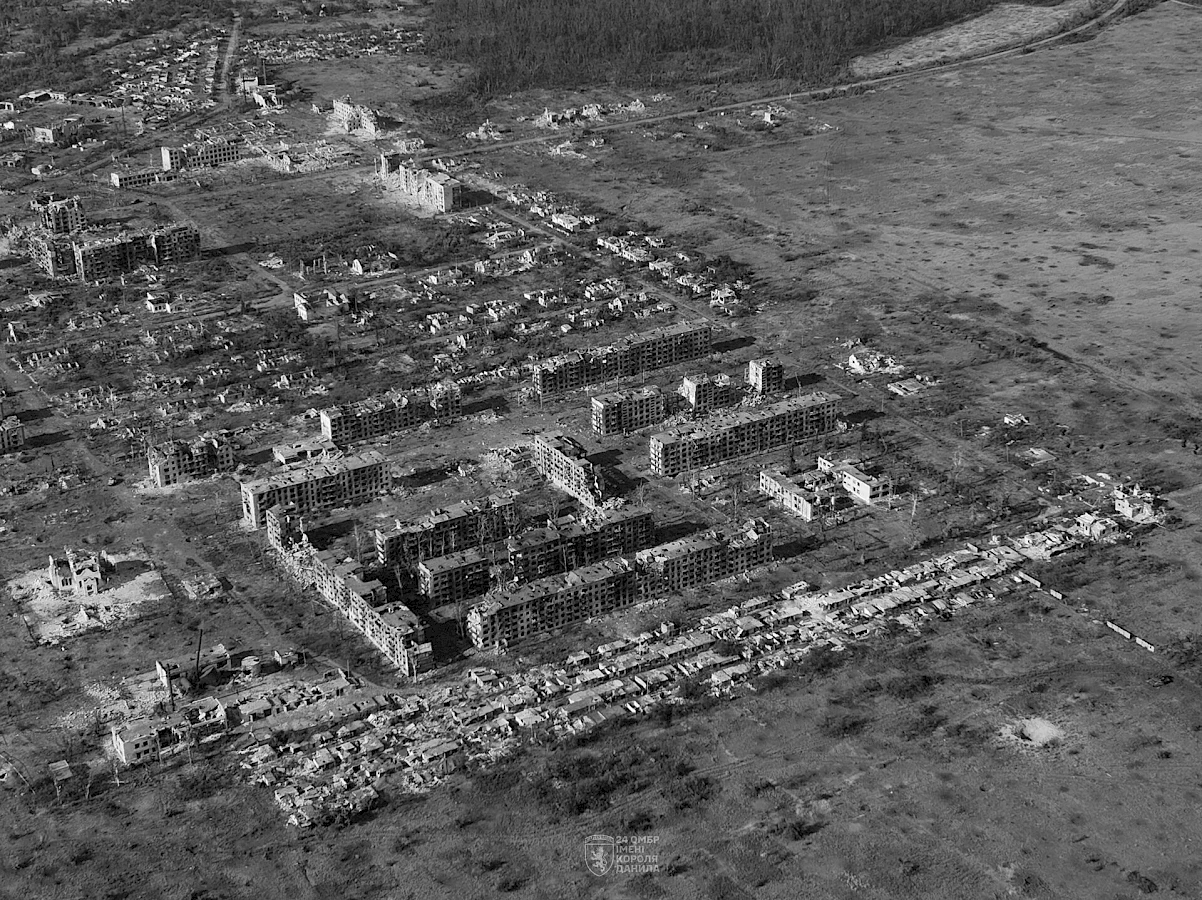
Chasiv Yar, Donetsk region, 2024. Image sourced from Telegram

The East became a kind of mysterious vacuum in which only oblivion was possible.9

Losing an object of great value, the tiny village of Ivanivske, made me think of other destroyed settlements whose names surface in the news only to announce their disappearance. Yet there is currently no comprehensive list dedicated to destroyed settlements as entities in their own right. I wanted to hold them longer in a form as intimate as touch and as convincing as evidence.
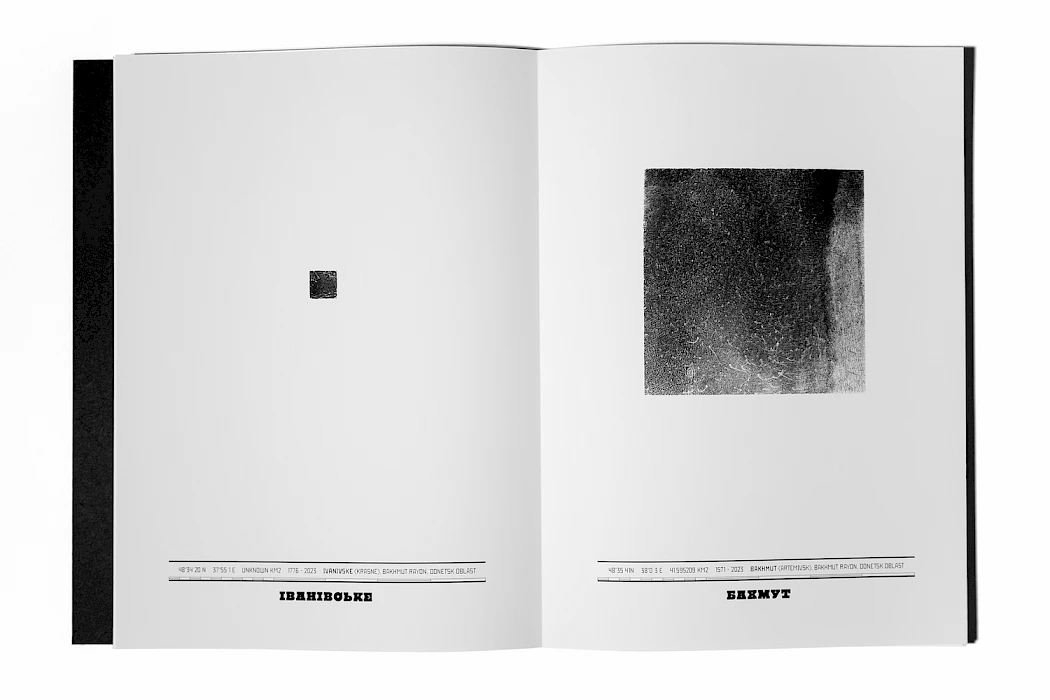
Slinko, The Registry, 2025-ongoing, book project
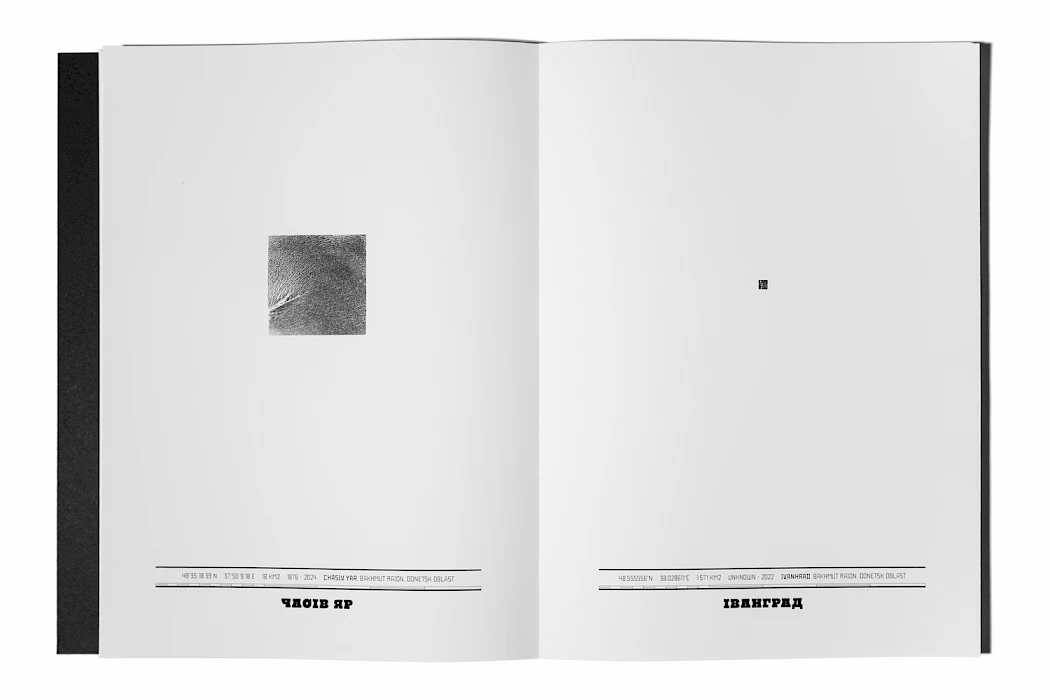
The Registry is a book proposal to record every destroyed settlement in Donbas. It wrestles with a paradox: can disappearance become proof of existence? Can this negative value be reversed through artistic gesture? To begin, I have devised a simple methodology. I gather verifiable information and compile a dossier for each site, including the settlement’s name, dates of establishment and destruction, a destruction-severity rating, GPS coordinates and land mass in square kilometres. Based on each settlement’s land mass and to scale, I assign it an individually sized square.

I then use the body to imprint black ink within each square area. This creates an indexical image that gestures to the bodies in and on the ground through specific mark-making. The Registry will assemble a systematic record while portraying each settlement individually. No matter how tiny, the Registry will attempt to anchor these places in history and remembrance.

Black Map Series (Ukraine): Kathy Prendergast

Something extraordinary happened to me in Ireland. It took place at the storage facility where Christina Kennedy arranged for me to see a work by Kathy Prendergast. The materials of this piece, Black Map Series (Ukraine) (2010), were described simply as ‘ink on a printed map’. It is a very accurate description, but I had to see it for myself.
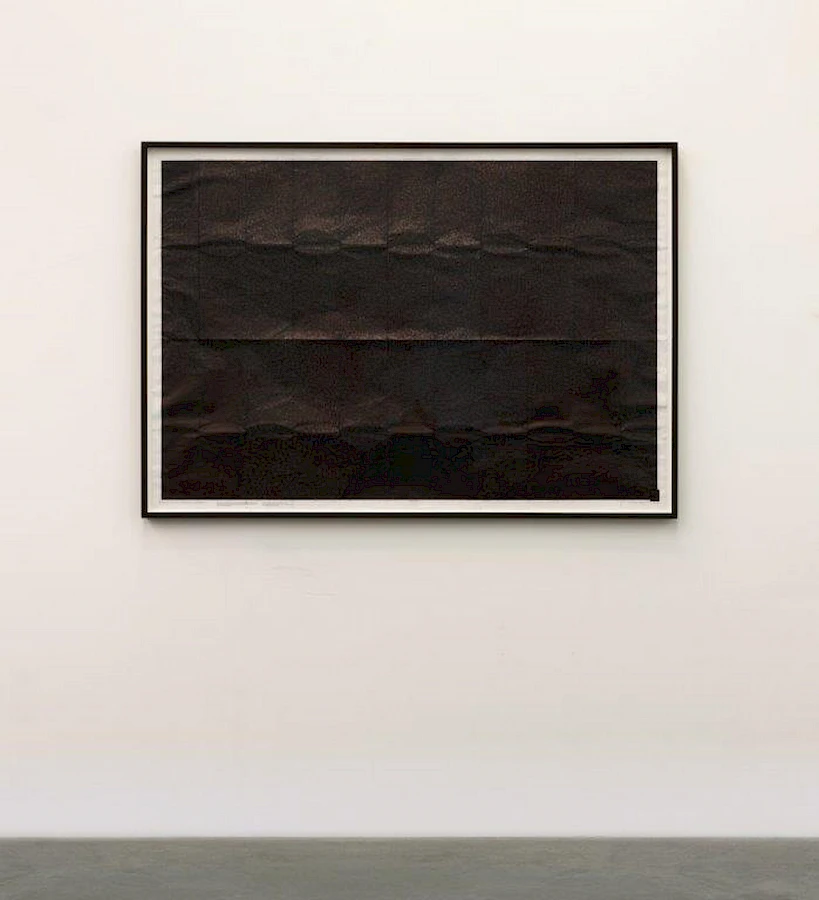
Kathy Prendergast, Black Map Series (Ukraine), 2010. Collection of Irish Museum of Modern Art

The artist had obliterated a found object – a map – with dense black India ink, then repainted small white dots to mark the settlements. The map appeared lit up at night, as if one were flying over a peaceful landscape, contradicting the facts on the ground in Donbas. By painting over the map, Kathy erased the borders in a kind of dark imperial Lebensraum growing to the edges of the map, overtaking Ukraine.
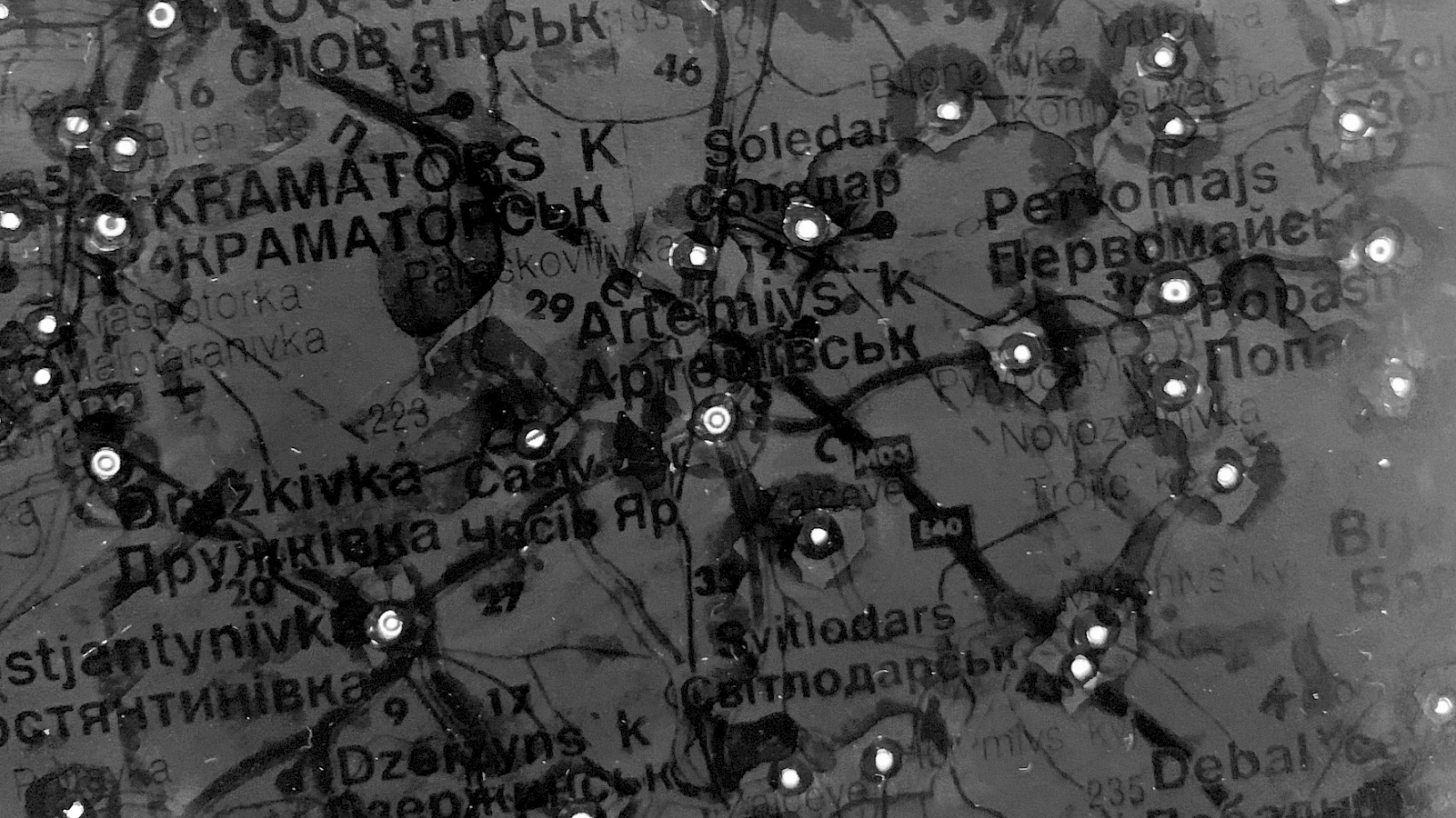
Kathy Prendergast, Black Map Series (Ukraine), 2010 (detail). Collection of Irish Museum of Modern Art

Lebensraum, or ‘living space’, was a territorial expansion concept at the heart of Nazi ideology. It envisioned the East (Poland, Belarus, Ukraine, the Baltics and parts of Western Russia) as a deindustrialized, depopulated farming utopia for the resettlement of ethnic Germans. Lebensraum was the soil policy of the future of the Greater German Reich. Perhaps this was not intended by the artist, but my geopolitical reading is coloured by this history.
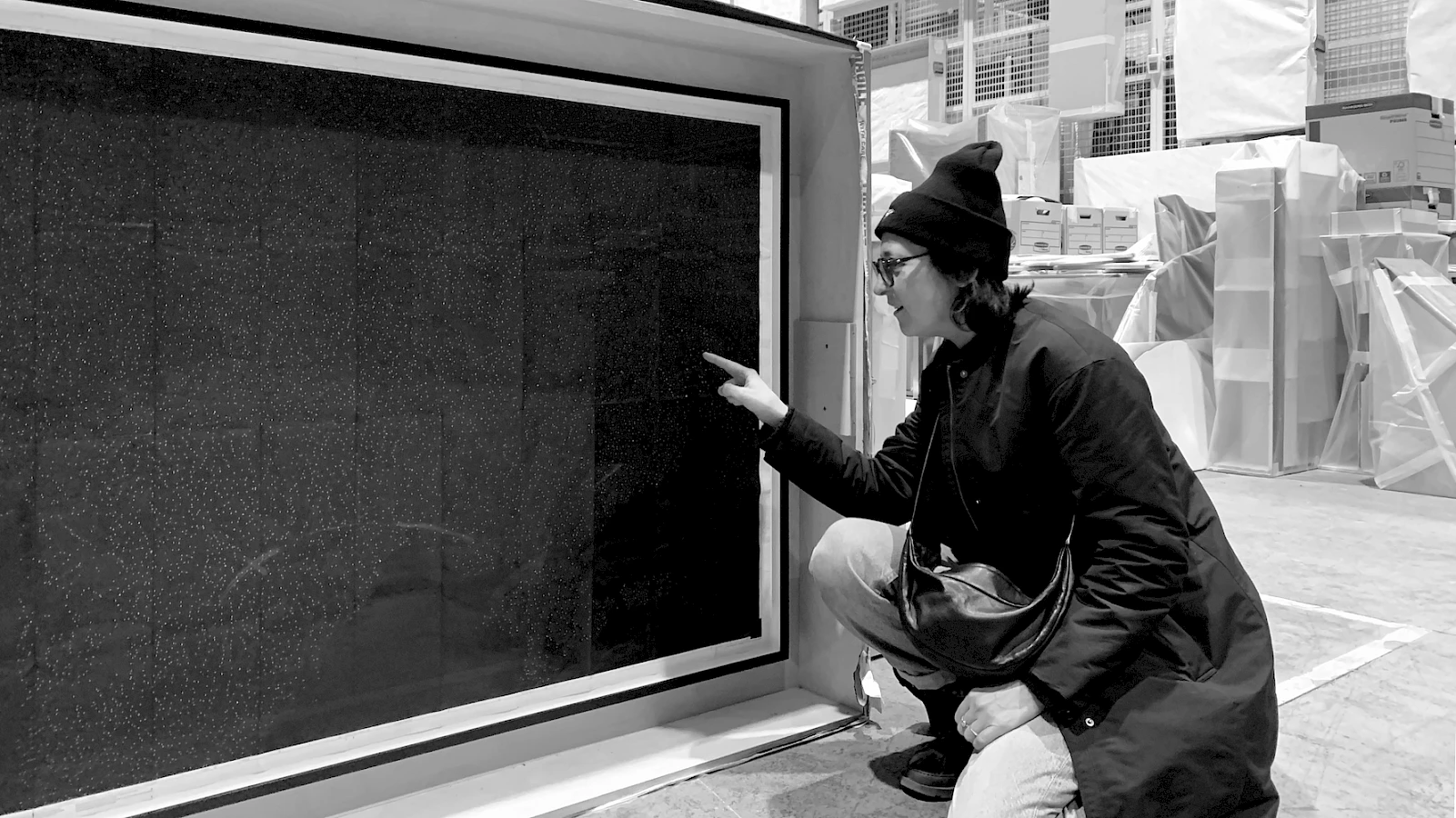
Visiting IMMA storage facility to see Kathy Prendergast’s Black Map Series (Ukraine), 2010. Photo: Christina Kennedy

Inching closer to Kathy’s map of Ukraine, I could make out the sheen of lithographic ink when it suddenly hit me – my birthplace was still there. It emerged from the darkness under its Soviet name, Artemivsk. Later renamed to its original toponym, Bakhmut, the city was completely destroyed in a six-month battle. Made in 2010, Black Map Series (Ukraine) has never stopped changing. An artwork, a document and a form of evidence, it exists in a state of indeterminacy. It looks remarkably Suprematist from a distance, but is full of objective materiality up close.

Later that day, consumed by reflections on Kathy’s piece, I stumbled to the grocery store near IMMA. I was contemplating the store’s provocative name, SuperValu, when I found myself face-to-face with a beer labelled ‘HELL’. It was indeed a super-value, contained in a medium-sized bottle. I spent the rest of that evening drinking HELL in my room.

A contaminated object: feral garden

According to experts, it will take hundreds of years to demine Ukraine. Areas in and around Bakhmut, the town where most of my family and I were born, are no longer usable for human habitation. In The Mushroom at the End of the World (2015), Anna Tsing explores survival and the ecologies of ruin. She writes:

Global landscapes today are strewn with this kind of ruin. Still, these places can be lively despite announcements of their death; abandoned asset fields sometimes yield new multispecies and multicultural life.10

Assemblages are open-ended gatherings. … They show us potential histories in the making.11

Our family home on the outskirts of Bakhmut was hit by a missile and burned down in 2023. When I think of what remains, I imagine assemblages of living and inanimate things tangled with the roots of the local weeds. It took my aunt almost two years to be able to speak about the place, but in time she made a hand-drawn map, and I learned about the incredible diversity of her environment before the war.

There were twelve kinds of fruit trees, an apple tree that tasted like honey and one she called Grandpa’s Apple. There was a tree called Melba, a variety developed in Ontario, Canada; its apples were yellow washed with crimson. My aunt identified her favourite tree, cut down by shrapnel, as the Simirenko apple, a variety cultivated by the Ukrainian scientist Leo Simirenko. This apple was so popular that it even travelled into outer space with the Soviet cosmonauts.

There were also at least five kinds of peppers: two sweet ones called Moldova and Stork, one bitter pepper, and one hot pepper she struggled to name. The peppers shared their patch with purple basil, very close to three kinds of cabbage: winter cabbage, a mid-season cabbage called Glory, and spring cabbage. She remembered a plum tree called Ugorka (Hungarian) and a pear tree called Conference; she recalled grapes named Vostorg (Delight) and an eggplant titled Almaz (Diamond). We were deep into the map when she began listing tomatoes: Volhohrad, Pink Giant, Khurma (Persimmon), Plum, De Barao, Kolkhozniy Urozhainiy (Kolkhoz / Collective Farm Harvest) and Kuban Newbie.
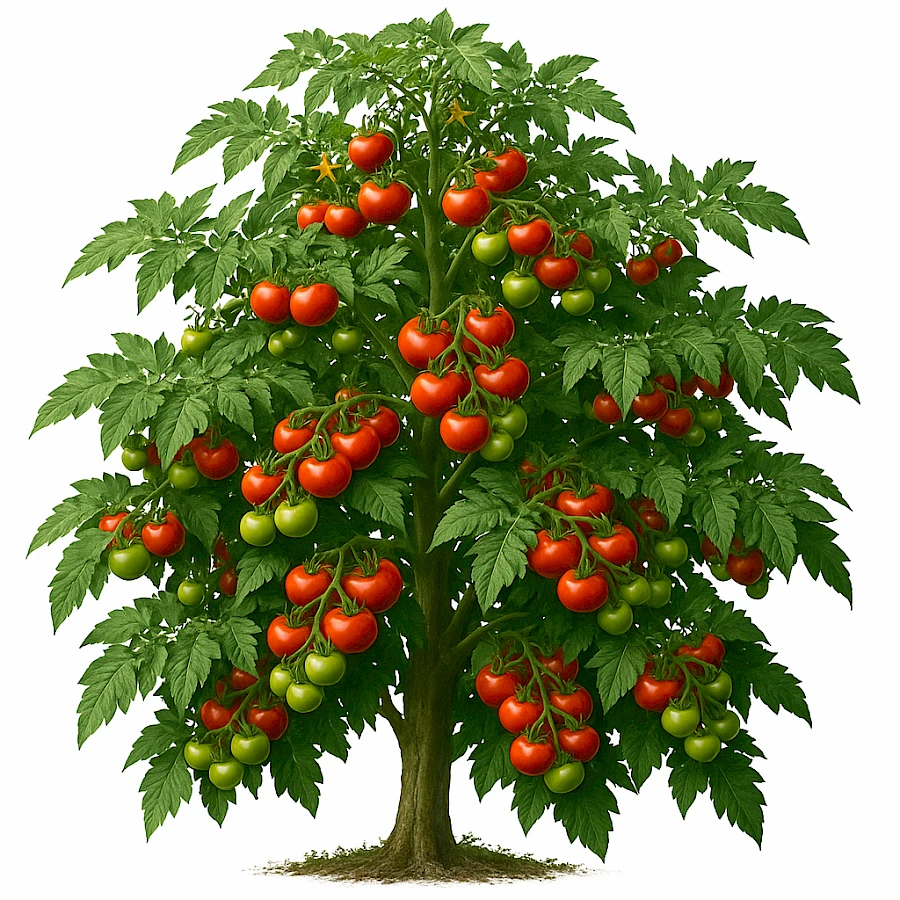
One particular variety, called the Donetskiy tomato, was developed in 1960 by the Vegetable and Melon Experimental Station in Opytne in the Donetsk region. It grows well in the steppes of Donbas and is sometimes referred to as ‘the tomato tree’ because of its sturdiness. Though Opytne village was destroyed during the counteroffensive, the Donetskiy tomato survives across the region and beyond.

My aunt’s hand-drawn map allowed me to travel back to the village, and Kathy’s map gave me ‘proof of life’ by redeeming town names from the nothingness of ruination. Now I wanted to know what else remains and persists in this damaged landscape. What kind of new multispecies gatherings take place in my aunt’s abandoned garden? What kind of freedom can be found in the rubble of Bakhmut? To use Anna Tsing’s words again:

I think it exists only in relation to ghosts. Freedom is the negotiation of ghosts on a haunted landscape; it does not exercise the haunting, but works to survive and negotiate it with flair.12

Even before the full-scale invasion, separatist authorities in Donetsk stopped the costly maintenance of the water pumps at several coal mines. The flooding that followed contaminated groundwater with chemicals including chlorine, sulphates, nitrates, iron, manganese, mercury, arsenic, copper and lead. This acid run-off displaces methane gas, raising the risk of explosions and ground subsidence. It also renders soil unsuitable for agriculture. One of the roughly 180 mines in the occupied territories is the Yunkom coal mine, the site of a 1979 underground nuclear explosion. The floodwater carries its radionuclides across the region.

The phenomenon of cultivated plants surviving with flair in post-human landscapes has been observed in Chernobyl and Syria, earning them the name of volunteer crops. In my aunt’s garden, so typical of the Ukrainian countryside, tomatoes, squashes, potatoes, peppers, sunflowers, beans, corn, garlic, beets and cabbage will likely reappear year after year.

Bereft of human care, these plants will grow in increasingly erratic patterns, edging toward remnants of compost piles and irrigation sources. Freed from human harvesting, their fruit will overripen and fall, depositing seeds into the memory bank of the soil. Over time, the vegetables will undergo de-domestication and produce smaller fruit with thicker skins. Some will venture even further, exchanging genetic material with wild relatives and altering their appearance in this environment.

The Donetskiy tomato will continue to show signs of drought tolerance and pest resistance. I imagine this tomato as a tomato forest unleashed in abundant overgrowth, exuding that distinct tomato-leaf perfume of terpenes and phenols. Growing in contaminated soil, this tomato will have to fight, but it will also do something else because, like sunflowers, tomatoes belong to a category of plants called hyperaccumulators.

In Chernobyl, sunflowers planted near the Exclusion Zone removed significant amounts of caesium-137 and strontium-90 from water and soil. The plants adapted to and persisted in radioactive abandoned agricultural plots, with volunteer and naturally regenerating crops showing remarkable survival skills. As Tsing writes:

Everyone carries a history of contamination. Purity is not an option.13

In thinking about the afterlife of my aunt’s garden, the Black Square makes its reappearance as quadrat sampling. It is a method in ecology that uses square framing to estimate the abundance, density and frequency of plants in a specific area, allowing an educated guess to made about a larger part of the land.

In this square of Donbas land, I inevitably drift toward a philosophy of vegetal agency. I want to imagine hybrid assemblages of volunteers, natives and feral relatives rewriting definitions of ‘wild’ and ‘cultivated’. I’m tempted to view plants not as objects of human needs, but as vegetal beings experiencing freedom on their own terms, capable of transforming landscape through ecological remediation, and through this, redeeming Donbas’s self-image as a Wild Field.
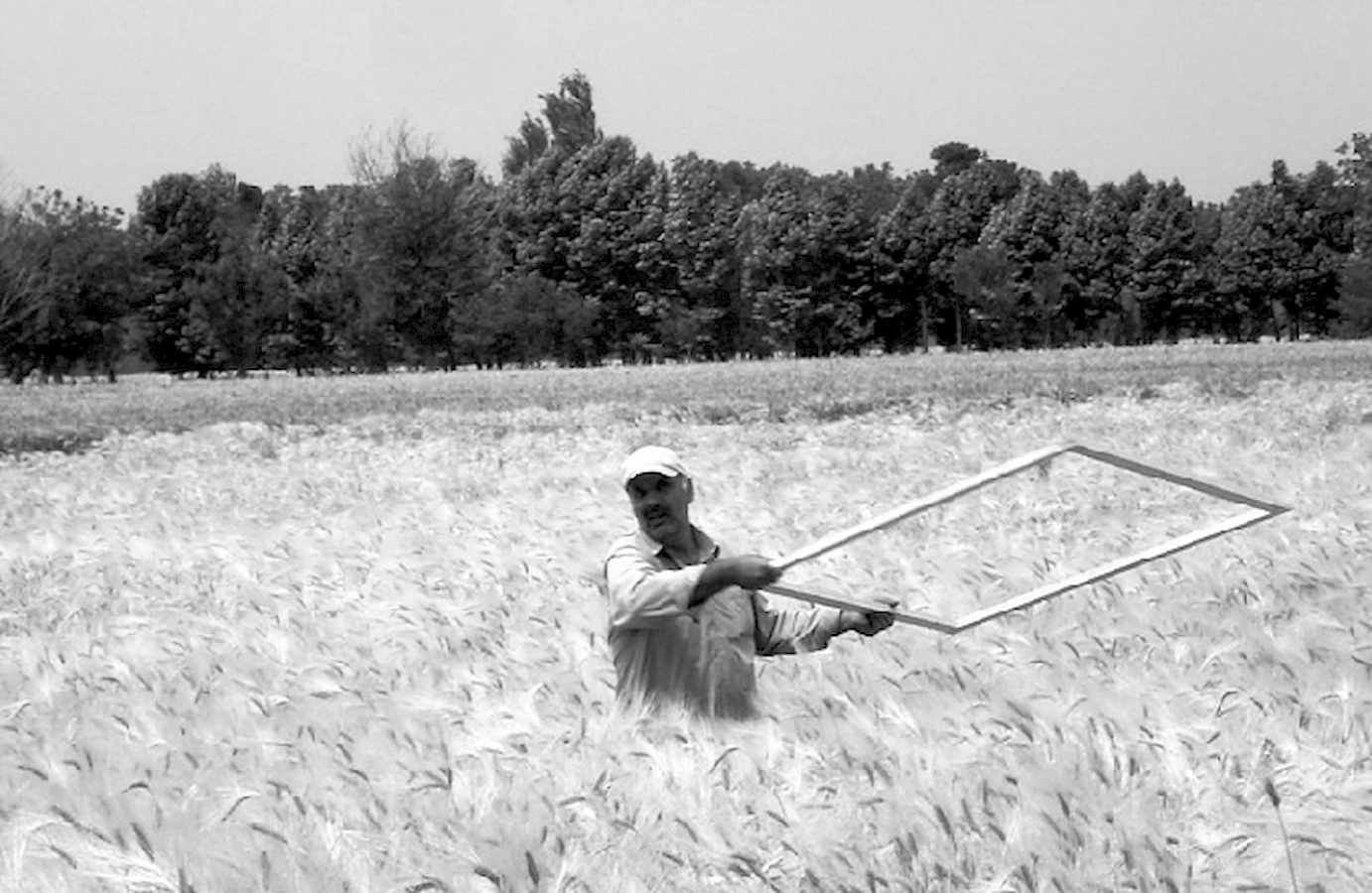
‘A quadrat, a meter square of wood, is being thrown randomly to take samples of the yield of crop for each tillage method’. Image source: A. Akbarnia and F. Farhani , 'Study of fuel consumption in three tillage', Research in Agricultural Engineering, Czech Academy of Agricultural Sciences, Vol. 60, 2014

Carl von Clausewitz, On War (ed. and trans. Michael Howard and Peter Paret), Princeton University Press, 1976 [1832], p. 92.Malevych is the romanized Ukrainian spelling.Kazymyr Malevych, The Non-Objective World: The Manifesto of Suprematism (trans. Howard Dearstyne), New York: Dover Publications, 2003 [1926], p. 67.Sarah Pierce, The Square (2017–). See Judith Wilkinson, ‘Sarah Pierce Destabilises the Spectatorship of Art’, ArtReview, 9 May 2023, artreview.com.OGPU (Ob’yedinyonnoye gosudarstvennoye politicheskoye upravleniye [Joint State Political Directorate]) arrest records, 20 September 1930. See Irina Vakar and Tatiana Mikhienko (ed.), Kazimir Malevich: Letters, Documents, Memoirs, Criticism, vol. 1, London: Tate, 2015, pp. 563 and 565; cited in Marie Gasper-Hulvat, ‘State-Sanctioned Trips of Soviet Artists to the West in the Late 1920s: The Unusual Case of Kazimir Malevich’, Scalar, vol. 15, 2019, scalar.usc.edu.Dyke Pole, the historical Ukrainian name for the region, translates as Wild Field. For a map of the region, see Wikimedia Commons: commons.wikimedia.org.Hiroaki Kuromiya, Freedom and Terror in the Donbas: A Ukrainian-Russian borderland, 1870s–1990s, Cambridge University Press, 1998, pp. 2–3.Oleksiy Radynski, ‘Maidan and Beyond, Part II: The Cacophony of Donbas’, e-flux, issue #56, June 2014, e-flux.comSnyder makes this statement in the context of explaining the killing fields across Poland, Ukraine, Belarus and Latvia during World War II, especially the murder of Jews in Eastern Europe. Snyder’s main point is the importance of remembrance and individual stories within the larger scale of genocidal policies of both Hitler and Stalin. Snyder also makes an argument for the propriety of comparing without equating, and the role of knowing history in the protection of democratic societies. Later in this afterword Snyder specifically makes this comparison with Putin's policy in Ukraine. Timothy Snyder, Bloodlands: Europe Between Hitler and Stalin, New York: Basic Books, Hachette Group, 2018 [2010], afterword. Basic Books audiobook version (2018), 10 h 56 m.Anna Lowenhaupt Tsing, The Mushroom at the End of the World: On the Possibility of Life in Capitalist Ruins, Princeton University Press, 2015, p. 6.Ibid., p. 23.Ibid., p. 91.Ibid., p. 27.Carl von Clausewitz, On War (ed. and trans. Michael Howard and Peter Paret), Princeton University Press, 1976 [1832], p. 92.Malevych is the romanized Ukrainian spelling.Kazymyr Malevych, The Non-Objective World: The Manifesto of Suprematism (trans. Howard Dearstyne), New York: Dover Publications, 2003 [1926], p. 67.Sarah Pierce, The Square (2017–). See Judith Wilkinson, ‘Sarah Pierce Destabilises the Spectatorship of Art’, ArtReview, 9 May 2023, artreview.com.OGPU (Ob’yedinyonnoye gosudarstvennoye politicheskoye upravleniye [Joint State Political Directorate]) arrest records, 20 September 1930. See Irina Vakar and Tatiana Mikhienko (ed.), Kazimir Malevich: Letters, Documents, Memoirs, Criticism, vol. 1, London: Tate, 2015, pp. 563 and 565; cited in Marie Gasper-Hulvat, ‘State-Sanctioned Trips of Soviet Artists to the West in the Late 1920s: The Unusual Case of Kazimir Malevich’, Scalar, vol. 15, 2019, scalar.usc.edu.Dyke Pole, the historical Ukrainian name for the region, translates as Wild Field. For a map of the region, see Wikimedia Commons: commons.wikimedia.org.Hiroaki Kuromiya, Freedom and Terror in the Donbas: A Ukrainian-Russian borderland, 1870s–1990s, Cambridge University Press, 1998, pp. 2–3.Oleksiy Radynski, ‘Maidan and Beyond, Part II: The Cacophony of Donbas’, e-flux, issue #56, June 2014, e-flux.comSnyder makes this statement in the context of explaining the killing fields across Poland, Ukraine, Belarus and Latvia during World War II, especially the murder of Jews in Eastern Europe. Snyder’s main point is the importance of remembrance and individual stories within the larger scale of genocidal policies of both Hitler and Stalin. Snyder also makes an argument for the propriety of comparing without equating, and the role of knowing history in the protection of democratic societies. Later in this afterword Snyder specifically makes this comparison with Putin's policy in Ukraine. Timothy Snyder, Bloodlands: Europe Between Hitler and Stalin, New York: Basic Books, Hachette Group, 2018 [2010], afterword. Basic Books audiobook version (2018), 10 h 56 m.Anna Lowenhaupt Tsing, The Mushroom at the End of the World: On the Possibility of Life in Capitalist Ruins, Princeton University Press, 2015, p. 6.Ibid., p. 23.Ibid., p. 91.Ibid., p. 27.Carl von Clausewitz, On War (ed. and trans. Michael Howard and Peter Paret), Princeton University Press, 1976 [1832], p. 92.Malevych is the romanized Ukrainian spelling.Kazymyr Malevych, The Non-Objective World: The Manifesto of Suprematism (trans. Howard Dearstyne), New York: Dover Publications, 2003 [1926], p. 67.Sarah Pierce, The Square (2017–). See Judith Wilkinson, ‘Sarah Pierce Destabilises the Spectatorship of Art’, ArtReview, 9 May 2023, artreview.com.OGPU (Ob’yedinyonnoye gosudarstvennoye politicheskoye upravleniye [Joint State Political Directorate]) arrest records, 20 September 1930. See Irina Vakar and Tatiana Mikhienko (ed.), Kazimir Malevich: Letters, Documents, Memoirs, Criticism, vol. 1, London: Tate, 2015, pp. 563 and 565; cited in Marie Gasper-Hulvat, ‘State-Sanctioned Trips of Soviet Artists to the West in the Late 1920s: The Unusual Case of Kazimir Malevich’, Scalar, vol. 15, 2019, scalar.usc.edu.Dyke Pole, the historical Ukrainian name for the region, translates as Wild Field. For a map of the region, see Wikimedia Commons: commons.wikimedia.org.Hiroaki Kuromiya, Freedom and Terror in the Donbas: A Ukrainian-Russian borderland, 1870s–1990s, Cambridge University Press, 1998, pp. 2–3.Oleksiy Radynski, ‘Maidan and Beyond, Part II: The Cacophony of Donbas’, e-flux, issue #56, June 2014, e-flux.comSnyder makes this statement in the context of explaining the killing fields across Poland, Ukraine, Belarus and Latvia during World War II, especially the murder of Jews in Eastern Europe. Snyder’s main point is the importance of remembrance and individual stories within the larger scale of genocidal policies of both Hitler and Stalin. Snyder also makes an argument for the propriety of comparing without equating, and the role of knowing history in the protection of democratic societies. Later in this afterword Snyder specifically makes this comparison with Putin's policy in Ukraine. Timothy Snyder, Bloodlands: Europe Between Hitler and Stalin, New York: Basic Books, Hachette Group, 2018 [2010], afterword. Basic Books audiobook version (2018), 10 h 56 m.Anna Lowenhaupt Tsing, The Mushroom at the End of the World: On the Possibility of Life in Capitalist Ruins, Princeton University Press, 2015, p. 6.Ibid., p. 23.Ibid., p. 91.Ibid., p. 27.Carl von Clausewitz, On War (ed. and trans. Michael Howard and Peter Paret), Princeton University Press, 1976 [1832], p. 92.Malevych is the romanized Ukrainian spelling.Kazymyr Malevych, The Non-Objective World: The Manifesto of Suprematism (trans. Howard Dearstyne), New York: Dover Publications, 2003 [1926], p. 67.Sarah Pierce, The Square (2017–). See Judith Wilkinson, ‘Sarah Pierce Destabilises the Spectatorship of Art’, ArtReview, 9 May 2023, artreview.com.OGPU (Ob’yedinyonnoye gosudarstvennoye politicheskoye upravleniye [Joint State Political Directorate]) arrest records, 20 September 1930. See Irina Vakar and Tatiana Mikhienko (ed.), Kazimir Malevich: Letters, Documents, Memoirs, Criticism, vol. 1, London: Tate, 2015, pp. 563 and 565; cited in Marie Gasper-Hulvat, ‘State-Sanctioned Trips of Soviet Artists to the West in the Late 1920s: The Unusual Case of Kazimir Malevich’, Scalar, vol. 15, 2019, scalar.usc.edu.Dyke Pole, the historical Ukrainian name for the region, translates as Wild Field. For a map of the region, see Wikimedia Commons: commons.wikimedia.org.Hiroaki Kuromiya, Freedom and Terror in the Donbas: A Ukrainian-Russian borderland, 1870s–1990s, Cambridge University Press, 1998, pp. 2–3.Oleksiy Radynski, ‘Maidan and Beyond, Part II: The Cacophony of Donbas’, e-flux, issue #56, June 2014, e-flux.comSnyder makes this statement in the context of explaining the killing fields across Poland, Ukraine, Belarus and Latvia during World War II, especially the murder of Jews in Eastern Europe. Snyder’s main point is the importance of remembrance and individual stories within the larger scale of genocidal policies of both Hitler and Stalin. Snyder also makes an argument for the propriety of comparing without equating, and the role of knowing history in the protection of democratic societies. Later in this afterword Snyder specifically makes this comparison with Putin's policy in Ukraine. Timothy Snyder, Bloodlands: Europe Between Hitler and Stalin, New York: Basic Books, Hachette Group, 2018 [2010], afterword. Basic Books audiobook version (2018), 10 h 56 m.Anna Lowenhaupt Tsing, The Mushroom at the End of the World: On the Possibility of Life in Capitalist Ruins, Princeton University Press, 2015, p. 6.Ibid., p. 23.Ibid., p. 91.Ibid., p. 27.Carl von Clausewitz, On War (ed. and trans. Michael Howard and Peter Paret), Princeton University Press, 1976 [1832], p. 92.Malevych is the romanized Ukrainian spelling.Kazymyr Malevych, The Non-Objective World: The Manifesto of Suprematism (trans. Howard Dearstyne), New York: Dover Publications, 2003 [1926], p. 67.Sarah Pierce, The Square (2017–). See Judith Wilkinson, ‘Sarah Pierce Destabilises the Spectatorship of Art’, ArtReview, 9 May 2023, artreview.com.OGPU (Ob’yedinyonnoye gosudarstvennoye politicheskoye upravleniye [Joint State Political Directorate]) arrest records, 20 September 1930. See Irina Vakar and Tatiana Mikhienko (ed.), Kazimir Malevich: Letters, Documents, Memoirs, Criticism, vol. 1, London: Tate, 2015, pp. 563 and 565; cited in Marie Gasper-Hulvat, ‘State-Sanctioned Trips of Soviet Artists to the West in the Late 1920s: The Unusual Case of Kazimir Malevich’, Scalar, vol. 15, 2019, scalar.usc.edu.Dyke Pole, the historical Ukrainian name for the region, translates as Wild Field. For a map of the region, see Wikimedia Commons: commons.wikimedia.org.Hiroaki Kuromiya, Freedom and Terror in the Donbas: A Ukrainian-Russian borderland, 1870s–1990s, Cambridge University Press, 1998, pp. 2–3.Oleksiy Radynski, ‘Maidan and Beyond, Part II: The Cacophony of Donbas’, e-flux, issue #56, June 2014, e-flux.comSnyder makes this statement in the context of explaining the killing fields across Poland, Ukraine, Belarus and Latvia during World War II, especially the murder of Jews in Eastern Europe. Snyder’s main point is the importance of remembrance and individual stories within the larger scale of genocidal policies of both Hitler and Stalin. Snyder also makes an argument for the propriety of comparing without equating, and the role of knowing history in the protection of democratic societies. Later in this afterword Snyder specifically makes this comparison with Putin's policy in Ukraine. Timothy Snyder, Bloodlands: Europe Between Hitler and Stalin, New York: Basic Books, Hachette Group, 2018 [2010], afterword. Basic Books audiobook version (2018), 10 h 56 m.Anna Lowenhaupt Tsing, The Mushroom at the End of the World: On the Possibility of Life in Capitalist Ruins, Princeton University Press, 2015, p. 6.Ibid., p. 23.Ibid., p. 91.Ibid., p. 27.Carl von Clausewitz, On War (ed. and trans. Michael Howard and Peter Paret), Princeton University Press, 1976 [1832], p. 92.Malevych is the romanized Ukrainian spelling.Kazymyr Malevych, The Non-Objective World: The Manifesto of Suprematism (trans. Howard Dearstyne), New York: Dover Publications, 2003 [1926], p. 67.Sarah Pierce, The Square (2017–). See Judith Wilkinson, ‘Sarah Pierce Destabilises the Spectatorship of Art’, ArtReview, 9 May 2023, artreview.com.OGPU (Ob’yedinyonnoye gosudarstvennoye politicheskoye upravleniye [Joint State Political Directorate]) arrest records, 20 September 1930. See Irina Vakar and Tatiana Mikhienko (ed.), Kazimir Malevich: Letters, Documents, Memoirs, Criticism, vol. 1, London: Tate, 2015, pp. 563 and 565; cited in Marie Gasper-Hulvat, ‘State-Sanctioned Trips of Soviet Artists to the West in the Late 1920s: The Unusual Case of Kazimir Malevich’, Scalar, vol. 15, 2019, scalar.usc.edu.Dyke Pole, the historical Ukrainian name for the region, translates as Wild Field. For a map of the region, see Wikimedia Commons: commons.wikimedia.org.Hiroaki Kuromiya, Freedom and Terror in the Donbas: A Ukrainian-Russian borderland, 1870s–1990s, Cambridge University Press, 1998, pp. 2–3.Oleksiy Radynski, ‘Maidan and Beyond, Part II: The Cacophony of Donbas’, e-flux, issue #56, June 2014, e-flux.comSnyder makes this statement in the context of explaining the killing fields across Poland, Ukraine, Belarus and Latvia during World War II, especially the murder of Jews in Eastern Europe. Snyder’s main point is the importance of remembrance and individual stories within the larger scale of genocidal policies of both Hitler and Stalin. Snyder also makes an argument for the propriety of comparing without equating, and the role of knowing history in the protection of democratic societies. Later in this afterword Snyder specifically makes this comparison with Putin's policy in Ukraine. Timothy Snyder, Bloodlands: Europe Between Hitler and Stalin, New York: Basic Books, Hachette Group, 2018 [2010], afterword. Basic Books audiobook version (2018), 10 h 56 m.Anna Lowenhaupt Tsing, The Mushroom at the End of the World: On the Possibility of Life in Capitalist Ruins, Princeton University Press, 2015, p. 6.Ibid., p. 23.Ibid., p. 91.Ibid., p. 27.Carl von Clausewitz, On War (ed. and trans. Michael Howard and Peter Paret), Princeton University Press, 1976 [1832], p. 92.Malevych is the romanized Ukrainian spelling.Kazymyr Malevych, The Non-Objective World: The Manifesto of Suprematism (trans. Howard Dearstyne), New York: Dover Publications, 2003 [1926], p. 67.Sarah Pierce, The Square (2017–). See Judith Wilkinson, ‘Sarah Pierce Destabilises the Spectatorship of Art’, ArtReview, 9 May 2023, artreview.com.OGPU (Ob’yedinyonnoye gosudarstvennoye politicheskoye upravleniye [Joint State Political Directorate]) arrest records, 20 September 1930. See Irina Vakar and Tatiana Mikhienko (ed.), Kazimir Malevich: Letters, Documents, Memoirs, Criticism, vol. 1, London: Tate, 2015, pp. 563 and 565; cited in Marie Gasper-Hulvat, ‘State-Sanctioned Trips of Soviet Artists to the West in the Late 1920s: The Unusual Case of Kazimir Malevich’, Scalar, vol. 15, 2019, scalar.usc.edu.Dyke Pole, the historical Ukrainian name for the region, translates as Wild Field. For a map of the region, see Wikimedia Commons: commons.wikimedia.org.Hiroaki Kuromiya, Freedom and Terror in the Donbas: A Ukrainian-Russian borderland, 1870s–1990s, Cambridge University Press, 1998, pp. 2–3.Oleksiy Radynski, ‘Maidan and Beyond, Part II: The Cacophony of Donbas’, e-flux, issue #56, June 2014, e-flux.comSnyder makes this statement in the context of explaining the killing fields across Poland, Ukraine, Belarus and Latvia during World War II, especially the murder of Jews in Eastern Europe. Snyder’s main point is the importance of remembrance and individual stories within the larger scale of genocidal policies of both Hitler and Stalin. Snyder also makes an argument for the propriety of comparing without equating, and the role of knowing history in the protection of democratic societies. Later in this afterword Snyder specifically makes this comparison with Putin's policy in Ukraine. Timothy Snyder, Bloodlands: Europe Between Hitler and Stalin, New York: Basic Books, Hachette Group, 2018 [2010], afterword. Basic Books audiobook version (2018), 10 h 56 m.Anna Lowenhaupt Tsing, The Mushroom at the End of the World: On the Possibility of Life in Capitalist Ruins, Princeton University Press, 2015, p. 6.Ibid., p. 23.Ibid., p. 91.Ibid., p. 27.Carl von Clausewitz, On War (ed. and trans. Michael Howard and Peter Paret), Princeton University Press, 1976 [1832], p. 92.Malevych is the romanized Ukrainian spelling.Kazymyr Malevych, The Non-Objective World: The Manifesto of Suprematism (trans. Howard Dearstyne), New York: Dover Publications, 2003 [1926], p. 67.Sarah Pierce, The Square (2017–). See Judith Wilkinson, ‘Sarah Pierce Destabilises the Spectatorship of Art’, ArtReview, 9 May 2023, artreview.com.OGPU (Ob’yedinyonnoye gosudarstvennoye politicheskoye upravleniye [Joint State Political Directorate]) arrest records, 20 September 1930. See Irina Vakar and Tatiana Mikhienko (ed.), Kazimir Malevich: Letters, Documents, Memoirs, Criticism, vol. 1, London: Tate, 2015, pp. 563 and 565; cited in Marie Gasper-Hulvat, ‘State-Sanctioned Trips of Soviet Artists to the West in the Late 1920s: The Unusual Case of Kazimir Malevich’, Scalar, vol. 15, 2019, scalar.usc.edu.Dyke Pole, the historical Ukrainian name for the region, translates as Wild Field. For a map of the region, see Wikimedia Commons: commons.wikimedia.org.Hiroaki Kuromiya, Freedom and Terror in the Donbas: A Ukrainian-Russian borderland, 1870s–1990s, Cambridge University Press, 1998, pp. 2–3.Oleksiy Radynski, ‘Maidan and Beyond, Part II: The Cacophony of Donbas’, e-flux, issue #56, June 2014, e-flux.comSnyder makes this statement in the context of explaining the killing fields across Poland, Ukraine, Belarus and Latvia during World War II, especially the murder of Jews in Eastern Europe. Snyder’s main point is the importance of remembrance and individual stories within the larger scale of genocidal policies of both Hitler and Stalin. Snyder also makes an argument for the propriety of comparing without equating, and the role of knowing history in the protection of democratic societies. Later in this afterword Snyder specifically makes this comparison with Putin's policy in Ukraine. Timothy Snyder, Bloodlands: Europe Between Hitler and Stalin, New York: Basic Books, Hachette Group, 2018 [2010], afterword. Basic Books audiobook version (2018), 10 h 56 m.Anna Lowenhaupt Tsing, The Mushroom at the End of the World: On the Possibility of Life in Capitalist Ruins, Princeton University Press, 2015, p. 6.Ibid., p. 23.Ibid., p. 91.Ibid., p. 27.Carl von Clausewitz, On War (ed. and trans. Michael Howard and Peter Paret), Princeton University Press, 1976 [1832], p. 92.Malevych is the romanized Ukrainian spelling.Kazymyr Malevych, The Non-Objective World: The Manifesto of Suprematism (trans. Howard Dearstyne), New York: Dover Publications, 2003 [1926], p. 67.Sarah Pierce, The Square (2017–). See Judith Wilkinson, ‘Sarah Pierce Destabilises the Spectatorship of Art’, ArtReview, 9 May 2023, artreview.com.OGPU (Ob’yedinyonnoye gosudarstvennoye politicheskoye upravleniye [Joint State Political Directorate]) arrest records, 20 September 1930. See Irina Vakar and Tatiana Mikhienko (ed.), Kazimir Malevich: Letters, Documents, Memoirs, Criticism, vol. 1, London: Tate, 2015, pp. 563 and 565; cited in Marie Gasper-Hulvat, ‘State-Sanctioned Trips of Soviet Artists to the West in the Late 1920s: The Unusual Case of Kazimir Malevich’, Scalar, vol. 15, 2019, scalar.usc.edu.Dyke Pole, the historical Ukrainian name for the region, translates as Wild Field. For a map of the region, see Wikimedia Commons: commons.wikimedia.org.Hiroaki Kuromiya, Freedom and Terror in the Donbas: A Ukrainian-Russian borderland, 1870s–1990s, Cambridge University Press, 1998, pp. 2–3.Oleksiy Radynski, ‘Maidan and Beyond, Part II: The Cacophony of Donbas’, e-flux, issue #56, June 2014, e-flux.comSnyder makes this statement in the context of explaining the killing fields across Poland, Ukraine, Belarus and Latvia during World War II, especially the murder of Jews in Eastern Europe. Snyder’s main point is the importance of remembrance and individual stories within the larger scale of genocidal policies of both Hitler and Stalin. Snyder also makes an argument for the propriety of comparing without equating, and the role of knowing history in the protection of democratic societies. Later in this afterword Snyder specifically makes this comparison with Putin's policy in Ukraine. Timothy Snyder, Bloodlands: Europe Between Hitler and Stalin, New York: Basic Books, Hachette Group, 2018 [2010], afterword. Basic Books audiobook version (2018), 10 h 56 m.Anna Lowenhaupt Tsing, The Mushroom at the End of the World: On the Possibility of Life in Capitalist Ruins, Princeton University Press, 2015, p. 6.Ibid., p. 23.Ibid., p. 91.Ibid., p. 27.Carl von Clausewitz, On War (ed. and trans. Michael Howard and Peter Paret), Princeton University Press, 1976 [1832], p. 92.Malevych is the romanized Ukrainian spelling.Kazymyr Malevych, The Non-Objective World: The Manifesto of Suprematism (trans. Howard Dearstyne), New York: Dover Publications, 2003 [1926], p. 67.Sarah Pierce, The Square (2017–). See Judith Wilkinson, ‘Sarah Pierce Destabilises the Spectatorship of Art’, ArtReview, 9 May 2023, artreview.com.OGPU (Ob’yedinyonnoye gosudarstvennoye politicheskoye upravleniye [Joint State Political Directorate]) arrest records, 20 September 1930. See Irina Vakar and Tatiana Mikhienko (ed.), Kazimir Malevich: Letters, Documents, Memoirs, Criticism, vol. 1, London: Tate, 2015, pp. 563 and 565; cited in Marie Gasper-Hulvat, ‘State-Sanctioned Trips of Soviet Artists to the West in the Late 1920s: The Unusual Case of Kazimir Malevich’, Scalar, vol. 15, 2019, scalar.usc.edu.Dyke Pole, the historical Ukrainian name for the region, translates as Wild Field. For a map of the region, see Wikimedia Commons: commons.wikimedia.org.Hiroaki Kuromiya, Freedom and Terror in the Donbas: A Ukrainian-Russian borderland, 1870s–1990s, Cambridge University Press, 1998, pp. 2–3.Oleksiy Radynski, ‘Maidan and Beyond, Part II: The Cacophony of Donbas’, e-flux, issue #56, June 2014, e-flux.comSnyder makes this statement in the context of explaining the killing fields across Poland, Ukraine, Belarus and Latvia during World War II, especially the murder of Jews in Eastern Europe. Snyder’s main point is the importance of remembrance and individual stories within the larger scale of genocidal policies of both Hitler and Stalin. Snyder also makes an argument for the propriety of comparing without equating, and the role of knowing history in the protection of democratic societies. Later in this afterword Snyder specifically makes this comparison with Putin's policy in Ukraine. Timothy Snyder, Bloodlands: Europe Between Hitler and Stalin, New York: Basic Books, Hachette Group, 2018 [2010], afterword. Basic Books audiobook version (2018), 10 h 56 m.Anna Lowenhaupt Tsing, The Mushroom at the End of the World: On the Possibility of Life in Capitalist Ruins, Princeton University Press, 2015, p. 6.Ibid., p. 23.Ibid., p. 91.Ibid., p. 27.Carl von Clausewitz, On War (ed. and trans. Michael Howard and Peter Paret), Princeton University Press, 1976 [1832], p. 92.Malevych is the romanized Ukrainian spelling.Kazymyr Malevych, The Non-Objective World: The Manifesto of Suprematism (trans. Howard Dearstyne), New York: Dover Publications, 2003 [1926], p. 67.Sarah Pierce, The Square (2017–). See Judith Wilkinson, ‘Sarah Pierce Destabilises the Spectatorship of Art’, ArtReview, 9 May 2023, artreview.com.OGPU (Ob’yedinyonnoye gosudarstvennoye politicheskoye upravleniye [Joint State Political Directorate]) arrest records, 20 September 1930. See Irina Vakar and Tatiana Mikhienko (ed.), Kazimir Malevich: Letters, Documents, Memoirs, Criticism, vol. 1, London: Tate, 2015, pp. 563 and 565; cited in Marie Gasper-Hulvat, ‘State-Sanctioned Trips of Soviet Artists to the West in the Late 1920s: The Unusual Case of Kazimir Malevich’, Scalar, vol. 15, 2019, scalar.usc.edu.Dyke Pole, the historical Ukrainian name for the region, translates as Wild Field. For a map of the region, see Wikimedia Commons: commons.wikimedia.org.Hiroaki Kuromiya, Freedom and Terror in the Donbas: A Ukrainian-Russian borderland, 1870s–1990s, Cambridge University Press, 1998, pp. 2–3.Oleksiy Radynski, ‘Maidan and Beyond, Part II: The Cacophony of Donbas’, e-flux, issue #56, June 2014, e-flux.comSnyder makes this statement in the context of explaining the killing fields across Poland, Ukraine, Belarus and Latvia during World War II, especially the murder of Jews in Eastern Europe. Snyder’s main point is the importance of remembrance and individual stories within the larger scale of genocidal policies of both Hitler and Stalin. Snyder also makes an argument for the propriety of comparing without equating, and the role of knowing history in the protection of democratic societies. Later in this afterword Snyder specifically makes this comparison with Putin's policy in Ukraine. Timothy Snyder, Bloodlands: Europe Between Hitler and Stalin, New York: Basic Books, Hachette Group, 2018 [2010], afterword. Basic Books audiobook version (2018), 10 h 56 m.Anna Lowenhaupt Tsing, The Mushroom at the End of the World: On the Possibility of Life in Capitalist Ruins, Princeton University Press, 2015, p. 6.Ibid., p. 23.Ibid., p. 91.Ibid., p. 27.Carl von Clausewitz, On War (ed. and trans. Michael Howard and Peter Paret), Princeton University Press, 1976 [1832], p. 92.Malevych is the romanized Ukrainian spelling.Kazymyr Malevych, The Non-Objective World: The Manifesto of Suprematism (trans. Howard Dearstyne), New York: Dover Publications, 2003 [1926], p. 67.Sarah Pierce, The Square (2017–). See Judith Wilkinson, ‘Sarah Pierce Destabilises the Spectatorship of Art’, ArtReview, 9 May 2023, artreview.com.OGPU (Ob’yedinyonnoye gosudarstvennoye politicheskoye upravleniye [Joint State Political Directorate]) arrest records, 20 September 1930. See Irina Vakar and Tatiana Mikhienko (ed.), Kazimir Malevich: Letters, Documents, Memoirs, Criticism, vol. 1, London: Tate, 2015, pp. 563 and 565; cited in Marie Gasper-Hulvat, ‘State-Sanctioned Trips of Soviet Artists to the West in the Late 1920s: The Unusual Case of Kazimir Malevich’, Scalar, vol. 15, 2019, scalar.usc.edu.Dyke Pole, the historical Ukrainian name for the region, translates as Wild Field. For a map of the region, see Wikimedia Commons: commons.wikimedia.org.Hiroaki Kuromiya, Freedom and Terror in the Donbas: A Ukrainian-Russian borderland, 1870s–1990s, Cambridge University Press, 1998, pp. 2–3.Oleksiy Radynski, ‘Maidan and Beyond, Part II: The Cacophony of Donbas’, e-flux, issue #56, June 2014, e-flux.comSnyder makes this statement in the context of explaining the killing fields across Poland, Ukraine, Belarus and Latvia during World War II, especially the murder of Jews in Eastern Europe. Snyder’s main point is the importance of remembrance and individual stories within the larger scale of genocidal policies of both Hitler and Stalin. Snyder also makes an argument for the propriety of comparing without equating, and the role of knowing history in the protection of democratic societies. Later in this afterword Snyder specifically makes this comparison with Putin's policy in Ukraine. Timothy Snyder, Bloodlands: Europe Between Hitler and Stalin, New York: Basic Books, Hachette Group, 2018 [2010], afterword. Basic Books audiobook version (2018), 10 h 56 m.Anna Lowenhaupt Tsing, The Mushroom at the End of the World: On the Possibility of Life in Capitalist Ruins, Princeton University Press, 2015, p. 6.Ibid., p. 23.Ibid., p. 91.Ibid., p. 27.Carl von Clausewitz, On War (ed. and trans. Michael Howard and Peter Paret), Princeton University Press, 1976 [1832], p. 92.Malevych is the romanized Ukrainian spelling.Kazymyr Malevych, The Non-Objective World: The Manifesto of Suprematism (trans. Howard Dearstyne), New York: Dover Publications, 2003 [1926], p. 67.Sarah Pierce, The Square (2017–). See Judith Wilkinson, ‘Sarah Pierce Destabilises the Spectatorship of Art’, ArtReview, 9 May 2023, artreview.com.OGPU (Ob’yedinyonnoye gosudarstvennoye politicheskoye upravleniye [Joint State Political Directorate]) arrest records, 20 September 1930. See Irina Vakar and Tatiana Mikhienko (ed.), Kazimir Malevich: Letters, Documents, Memoirs, Criticism, vol. 1, London: Tate, 2015, pp. 563 and 565; cited in Marie Gasper-Hulvat, ‘State-Sanctioned Trips of Soviet Artists to the West in the Late 1920s: The Unusual Case of Kazimir Malevich’, Scalar, vol. 15, 2019, scalar.usc.edu.Dyke Pole, the historical Ukrainian name for the region, translates as Wild Field. For a map of the region, see Wikimedia Commons: commons.wikimedia.org.Hiroaki Kuromiya, Freedom and Terror in the Donbas: A Ukrainian-Russian borderland, 1870s–1990s, Cambridge University Press, 1998, pp. 2–3.Oleksiy Radynski, ‘Maidan and Beyond, Part II: The Cacophony of Donbas’, e-flux, issue #56, June 2014, e-flux.comSnyder makes this statement in the context of explaining the killing fields across Poland, Ukraine, Belarus and Latvia during World War II, especially the murder of Jews in Eastern Europe. Snyder’s main point is the importance of remembrance and individual stories within the larger scale of genocidal policies of both Hitler and Stalin. Snyder also makes an argument for the propriety of comparing without equating, and the role of knowing history in the protection of democratic societies. Later in this afterword Snyder specifically makes this comparison with Putin's policy in Ukraine. Timothy Snyder, Bloodlands: Europe Between Hitler and Stalin, New York: Basic Books, Hachette Group, 2018 [2010], afterword. Basic Books audiobook version (2018), 10 h 56 m.Anna Lowenhaupt Tsing, The Mushroom at the End of the World: On the Possibility of Life in Capitalist Ruins, Princeton University Press, 2015, p. 6.Ibid., p. 23.Ibid., p. 91.Ibid., p. 27.Carl von Clausewitz, On War (ed. and trans. Michael Howard and Peter Paret), Princeton University Press, 1976 [1832], p. 92.Malevych is the romanized Ukrainian spelling.Kazymyr Malevych, The Non-Objective World: The Manifesto of Suprematism (trans. Howard Dearstyne), New York: Dover Publications, 2003 [1926], p. 67.Sarah Pierce, The Square (2017–). See Judith Wilkinson, ‘Sarah Pierce Destabilises the Spectatorship of Art’, ArtReview, 9 May 2023, artreview.com.OGPU (Ob’yedinyonnoye gosudarstvennoye politicheskoye upravleniye [Joint State Political Directorate]) arrest records, 20 September 1930. See Irina Vakar and Tatiana Mikhienko (ed.), Kazimir Malevich: Letters, Documents, Memoirs, Criticism, vol. 1, London: Tate, 2015, pp. 563 and 565; cited in Marie Gasper-Hulvat, ‘State-Sanctioned Trips of Soviet Artists to the West in the Late 1920s: The Unusual Case of Kazimir Malevich’, Scalar, vol. 15, 2019, scalar.usc.edu.Dyke Pole, the historical Ukrainian name for the region, translates as Wild Field. For a map of the region, see Wikimedia Commons: commons.wikimedia.org.Hiroaki Kuromiya, Freedom and Terror in the Donbas: A Ukrainian-Russian borderland, 1870s–1990s, Cambridge University Press, 1998, pp. 2–3.Oleksiy Radynski, ‘Maidan and Beyond, Part II: The Cacophony of Donbas’, e-flux, issue #56, June 2014, e-flux.comSnyder makes this statement in the context of explaining the killing fields across Poland, Ukraine, Belarus and Latvia during World War II, especially the murder of Jews in Eastern Europe. Snyder’s main point is the importance of remembrance and individual stories within the larger scale of genocidal policies of both Hitler and Stalin. Snyder also makes an argument for the propriety of comparing without equating, and the role of knowing history in the protection of democratic societies. Later in this afterword Snyder specifically makes this comparison with Putin's policy in Ukraine. Timothy Snyder, Bloodlands: Europe Between Hitler and Stalin, New York: Basic Books, Hachette Group, 2018 [2010], afterword. Basic Books audiobook version (2018), 10 h 56 m.Anna Lowenhaupt Tsing, The Mushroom at the End of the World: On the Possibility of Life in Capitalist Ruins, Princeton University Press, 2015, p. 6.Ibid., p. 23.Ibid., p. 91.Ibid., p. 27.Carl von Clausewitz, On War (ed. and trans. Michael Howard and Peter Paret), Princeton University Press, 1976 [1832], p. 92.Malevych is the romanized Ukrainian spelling.Kazymyr Malevych, The Non-Objective World: The Manifesto of Suprematism (trans. Howard Dearstyne), New York: Dover Publications, 2003 [1926], p. 67.Sarah Pierce, The Square (2017–). See Judith Wilkinson, ‘Sarah Pierce Destabilises the Spectatorship of Art’, ArtReview, 9 May 2023, artreview.com.OGPU (Ob’yedinyonnoye gosudarstvennoye politicheskoye upravleniye [Joint State Political Directorate]) arrest records, 20 September 1930. See Irina Vakar and Tatiana Mikhienko (ed.), Kazimir Malevich: Letters, Documents, Memoirs, Criticism, vol. 1, London: Tate, 2015, pp. 563 and 565; cited in Marie Gasper-Hulvat, ‘State-Sanctioned Trips of Soviet Artists to the West in the Late 1920s: The Unusual Case of Kazimir Malevich’, Scalar, vol. 15, 2019, scalar.usc.edu.Dyke Pole, the historical Ukrainian name for the region, translates as Wild Field. For a map of the region, see Wikimedia Commons: commons.wikimedia.org.Hiroaki Kuromiya, Freedom and Terror in the Donbas: A Ukrainian-Russian borderland, 1870s–1990s, Cambridge University Press, 1998, pp. 2–3.Oleksiy Radynski, ‘Maidan and Beyond, Part II: The Cacophony of Donbas’, e-flux, issue #56, June 2014, e-flux.comSnyder makes this statement in the context of explaining the killing fields across Poland, Ukraine, Belarus and Latvia during World War II, especially the murder of Jews in Eastern Europe. Snyder’s main point is the importance of remembrance and individual stories within the larger scale of genocidal policies of both Hitler and Stalin. Snyder also makes an argument for the propriety of comparing without equating, and the role of knowing history in the protection of democratic societies. Later in this afterword Snyder specifically makes this comparison with Putin's policy in Ukraine. Timothy Snyder, Bloodlands: Europe Between Hitler and Stalin, New York: Basic Books, Hachette Group, 2018 [2010], afterword. Basic Books audiobook version (2018), 10 h 56 m.Anna Lowenhaupt Tsing, The Mushroom at the End of the World: On the Possibility of Life in Capitalist Ruins, Princeton University Press, 2015, p. 6.Ibid., p. 23.Ibid., p. 91.Ibid., p. 27.Carl von Clausewitz, On War (ed. and trans. Michael Howard and Peter Paret), Princeton University Press, 1976 [1832], p. 92.Malevych is the romanized Ukrainian spelling.Kazymyr Malevych, The Non-Objective World: The Manifesto of Suprematism (trans. Howard Dearstyne), New York: Dover Publications, 2003 [1926], p. 67.Sarah Pierce, The Square (2017–). See Judith Wilkinson, ‘Sarah Pierce Destabilises the Spectatorship of Art’, ArtReview, 9 May 2023, artreview.com.OGPU (Ob’yedinyonnoye gosudarstvennoye politicheskoye upravleniye [Joint State Political Directorate]) arrest records, 20 September 1930. See Irina Vakar and Tatiana Mikhienko (ed.), Kazimir Malevich: Letters, Documents, Memoirs, Criticism, vol. 1, London: Tate, 2015, pp. 563 and 565; cited in Marie Gasper-Hulvat, ‘State-Sanctioned Trips of Soviet Artists to the West in the Late 1920s: The Unusual Case of Kazimir Malevich’, Scalar, vol. 15, 2019, scalar.usc.edu.Dyke Pole, the historical Ukrainian name for the region, translates as Wild Field. For a map of the region, see Wikimedia Commons: commons.wikimedia.org.Hiroaki Kuromiya, Freedom and Terror in the Donbas: A Ukrainian-Russian borderland, 1870s–1990s, Cambridge University Press, 1998, pp. 2–3.Oleksiy Radynski, ‘Maidan and Beyond, Part II: The Cacophony of Donbas’, e-flux, issue #56, June 2014, e-flux.comSnyder makes this statement in the context of explaining the killing fields across Poland, Ukraine, Belarus and Latvia during World War II, especially the murder of Jews in Eastern Europe. Snyder’s main point is the importance of remembrance and individual stories within the larger scale of genocidal policies of both Hitler and Stalin. Snyder also makes an argument for the propriety of comparing without equating, and the role of knowing history in the protection of democratic societies. Later in this afterword Snyder specifically makes this comparison with Putin's policy in Ukraine. Timothy Snyder, Bloodlands: Europe Between Hitler and Stalin, New York: Basic Books, Hachette Group, 2018 [2010], afterword. Basic Books audiobook version (2018), 10 h 56 m.Anna Lowenhaupt Tsing, The Mushroom at the End of the World: On the Possibility of Life in Capitalist Ruins, Princeton University Press, 2015, p. 6.Ibid., p. 23.Ibid., p. 91.Ibid., p. 27.Carl von Clausewitz, On War (ed. and trans. Michael Howard and Peter Paret), Princeton University Press, 1976 [1832], p. 92.Malevych is the romanized Ukrainian spelling.Kazymyr Malevych, The Non-Objective World: The Manifesto of Suprematism (trans. Howard Dearstyne), New York: Dover Publications, 2003 [1926], p. 67.Sarah Pierce, The Square (2017–). See Judith Wilkinson, ‘Sarah Pierce Destabilises the Spectatorship of Art’, ArtReview, 9 May 2023, artreview.com.OGPU (Ob’yedinyonnoye gosudarstvennoye politicheskoye upravleniye [Joint State Political Directorate]) arrest records, 20 September 1930. See Irina Vakar and Tatiana Mikhienko (ed.), Kazimir Malevich: Letters, Documents, Memoirs, Criticism, vol. 1, London: Tate, 2015, pp. 563 and 565; cited in Marie Gasper-Hulvat, ‘State-Sanctioned Trips of Soviet Artists to the West in the Late 1920s: The Unusual Case of Kazimir Malevich’, Scalar, vol. 15, 2019, scalar.usc.edu.Dyke Pole, the historical Ukrainian name for the region, translates as Wild Field. For a map of the region, see Wikimedia Commons: commons.wikimedia.org.Hiroaki Kuromiya, Freedom and Terror in the Donbas: A Ukrainian-Russian borderland, 1870s–1990s, Cambridge University Press, 1998, pp. 2–3.Oleksiy Radynski, ‘Maidan and Beyond, Part II: The Cacophony of Donbas’, e-flux, issue #56, June 2014, e-flux.comSnyder makes this statement in the context of explaining the killing fields across Poland, Ukraine, Belarus and Latvia during World War II, especially the murder of Jews in Eastern Europe. Snyder’s main point is the importance of remembrance and individual stories within the larger scale of genocidal policies of both Hitler and Stalin. Snyder also makes an argument for the propriety of comparing without equating, and the role of knowing history in the protection of democratic societies. Later in this afterword Snyder specifically makes this comparison with Putin's policy in Ukraine. Timothy Snyder, Bloodlands: Europe Between Hitler and Stalin, New York: Basic Books, Hachette Group, 2018 [2010], afterword. Basic Books audiobook version (2018), 10 h 56 m.Anna Lowenhaupt Tsing, The Mushroom at the End of the World: On the Possibility of Life in Capitalist Ruins, Princeton University Press, 2015, p. 6.Ibid., p. 23.Ibid., p. 91.Ibid., p. 27.Carl von Clausewitz, On War (ed. and trans. Michael Howard and Peter Paret), Princeton University Press, 1976 [1832], p. 92.Malevych is the romanized Ukrainian spelling.Kazymyr Malevych, The Non-Objective World: The Manifesto of Suprematism (trans. Howard Dearstyne), New York: Dover Publications, 2003 [1926], p. 67.Sarah Pierce, The Square (2017–). See Judith Wilkinson, ‘Sarah Pierce Destabilises the Spectatorship of Art’, ArtReview, 9 May 2023, artreview.com.OGPU (Ob’yedinyonnoye gosudarstvennoye politicheskoye upravleniye [Joint State Political Directorate]) arrest records, 20 September 1930. See Irina Vakar and Tatiana Mikhienko (ed.), Kazimir Malevich: Letters, Documents, Memoirs, Criticism, vol. 1, London: Tate, 2015, pp. 563 and 565; cited in Marie Gasper-Hulvat, ‘State-Sanctioned Trips of Soviet Artists to the West in the Late 1920s: The Unusual Case of Kazimir Malevich’, Scalar, vol. 15, 2019, scalar.usc.edu.Dyke Pole, the historical Ukrainian name for the region, translates as Wild Field. For a map of the region, see Wikimedia Commons: commons.wikimedia.org.Hiroaki Kuromiya, Freedom and Terror in the Donbas: A Ukrainian-Russian borderland, 1870s–1990s, Cambridge University Press, 1998, pp. 2–3.Oleksiy Radynski, ‘Maidan and Beyond, Part II: The Cacophony of Donbas’, e-flux, issue #56, June 2014, e-flux.comSnyder makes this statement in the context of explaining the killing fields across Poland, Ukraine, Belarus and Latvia during World War II, especially the murder of Jews in Eastern Europe. Snyder’s main point is the importance of remembrance and individual stories within the larger scale of genocidal policies of both Hitler and Stalin. Snyder also makes an argument for the propriety of comparing without equating, and the role of knowing history in the protection of democratic societies. Later in this afterword Snyder specifically makes this comparison with Putin's policy in Ukraine. Timothy Snyder, Bloodlands: Europe Between Hitler and Stalin, New York: Basic Books, Hachette Group, 2018 [2010], afterword. Basic Books audiobook version (2018), 10 h 56 m.Anna Lowenhaupt Tsing, The Mushroom at the End of the World: On the Possibility of Life in Capitalist Ruins, Princeton University Press, 2015, p. 6.Ibid., p. 23.Ibid., p. 91.Ibid., p. 27.

Related activities

Related contributions and publications