Dispatch: Haunting, cataloging and the phenomena of disintegration
In her dispatch from the summer school 'Landscape (post) Conflict' artist Coco Goran uses text and image to move between different sites of institutional violence, encountering manifold residues, bodies and ghosts.
‘To punish something is to point it out.’ Meaning that to imprison someone for a crime, to process it institutionally, is to make what is previously hidden and secret manifest, to name it and bring it into the light and into society.
This is one of the first things our tour guide at Kilmainham gaol tells us. He takes us through the prison’s hallways, where we can peer through the tiny holes in the doors, made of eroded wood, into the cells. It is very difficult to see their full spaces and details, and it occurs to me in retrospect that the cells would have been the domain of the prisoners, and the hallways would have been the domain of the guards. Those spaces, while previously occupied, are kept partially invisible behind shut doors, hidden from the eyes of peering tourists, even if our group is here for academic purposes.
While retracing the guard’s pathways I keep thinking about The Poetics of Space and how Bachelard writes about intimate spaces that may be categorized through both attraction and repulsion. While Bachelard is interested in the childhood home and spaces of daydream, I wonder what he would think about this particular set of spaces. The repetition of the cells, its doors locked off to the public (save for the few cells painted white, doors wide open, in the prison’s newer panopticon building), and how each cell as a ‘superimposed box’, a ‘geometrical site’ has been inhabited over and over again throughout the decades the prison has been open and overpopulated.
If rooms and houses are places where memory/thought is stored/embodied (‘not only our memories, but the things we have forgotten are “housed”. Our soul is an abode.’), then these cells must be densely populated by memories and thoughts of past prisoners. They must be spilling out. They must be so plentiful that the people who have transformed this prison to a museum must have sensed these memories squirming and locked them in lest they bother the visitors too much.
Our tour guide tells us that prisons came from the enlightenment era of switching from corporal to institutional punishment. That prisons were meant to be sites of transformation, so that a prisoner could reflect on his wrongs and come out a better person. ‘Passions simmer and resimmer in solitude: the passionate being prepares his explosions and his exploits in this solitude’ (Bachelard). But if a building is a body, and space houses the memory of lived experience, then must institutional punishment also be corporal?
I notice the institution’s corporality in how its walls crumble. Wood erodes from dampness. Pieces of concrete peel away from itself.
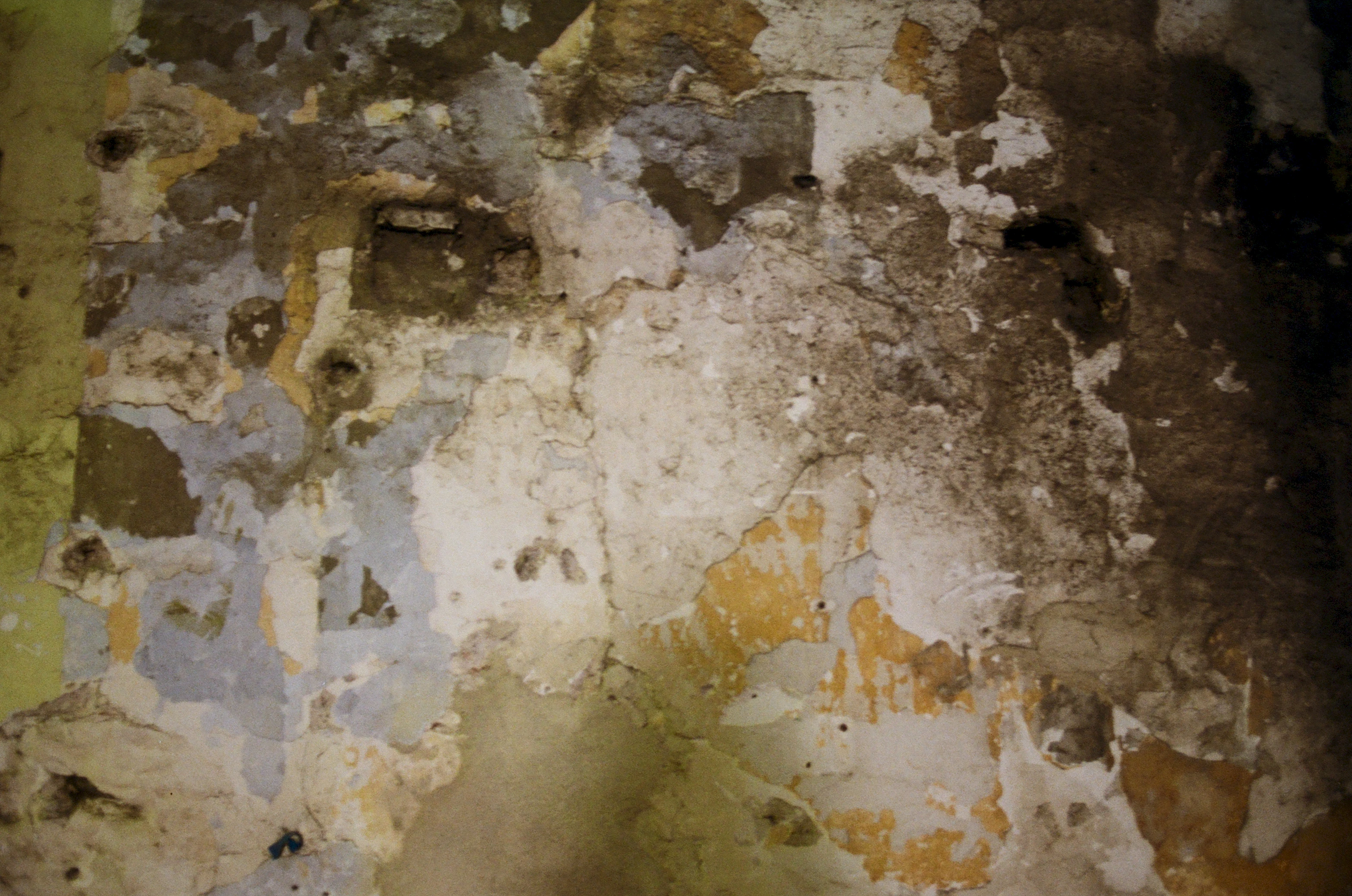
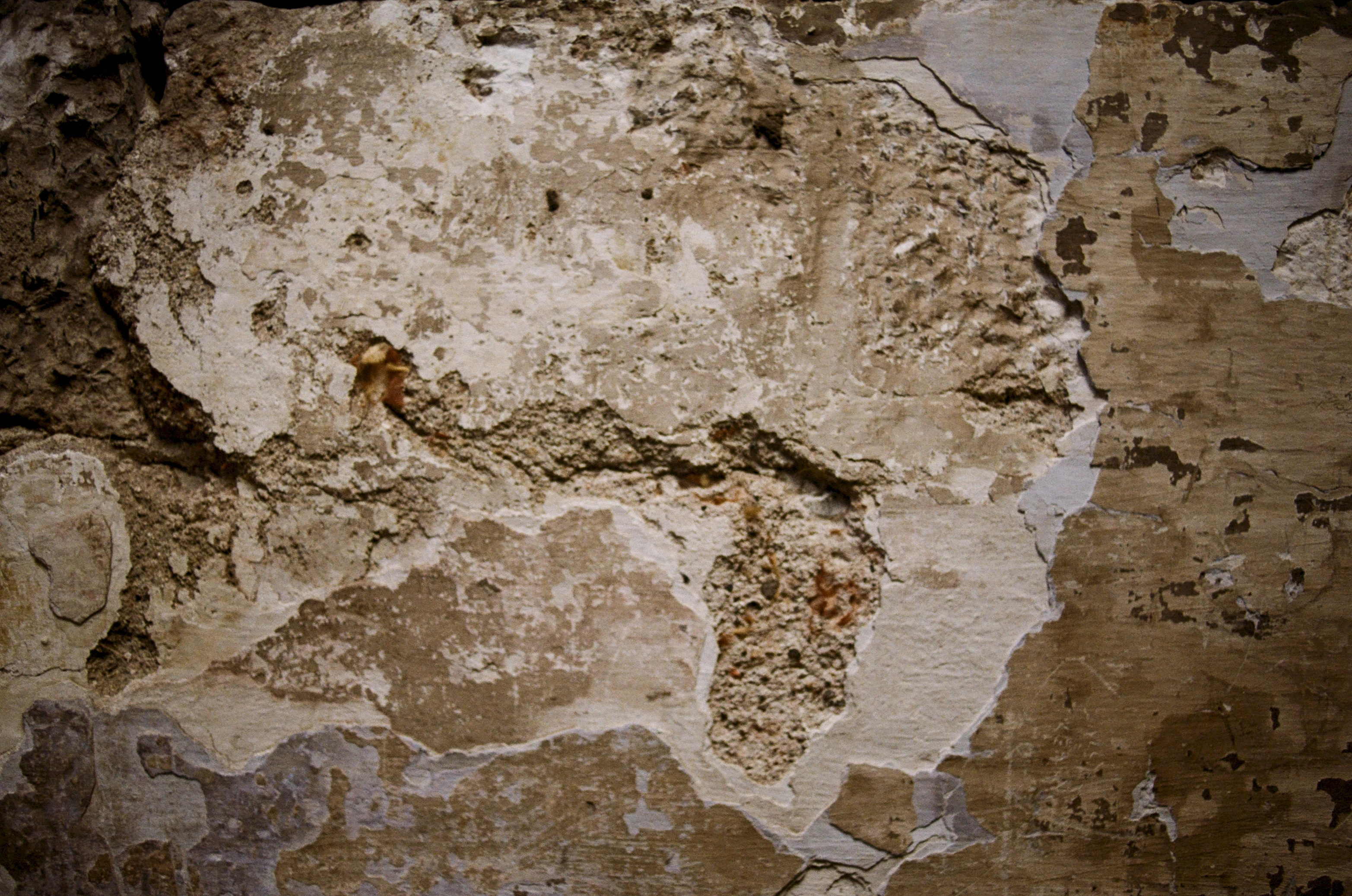
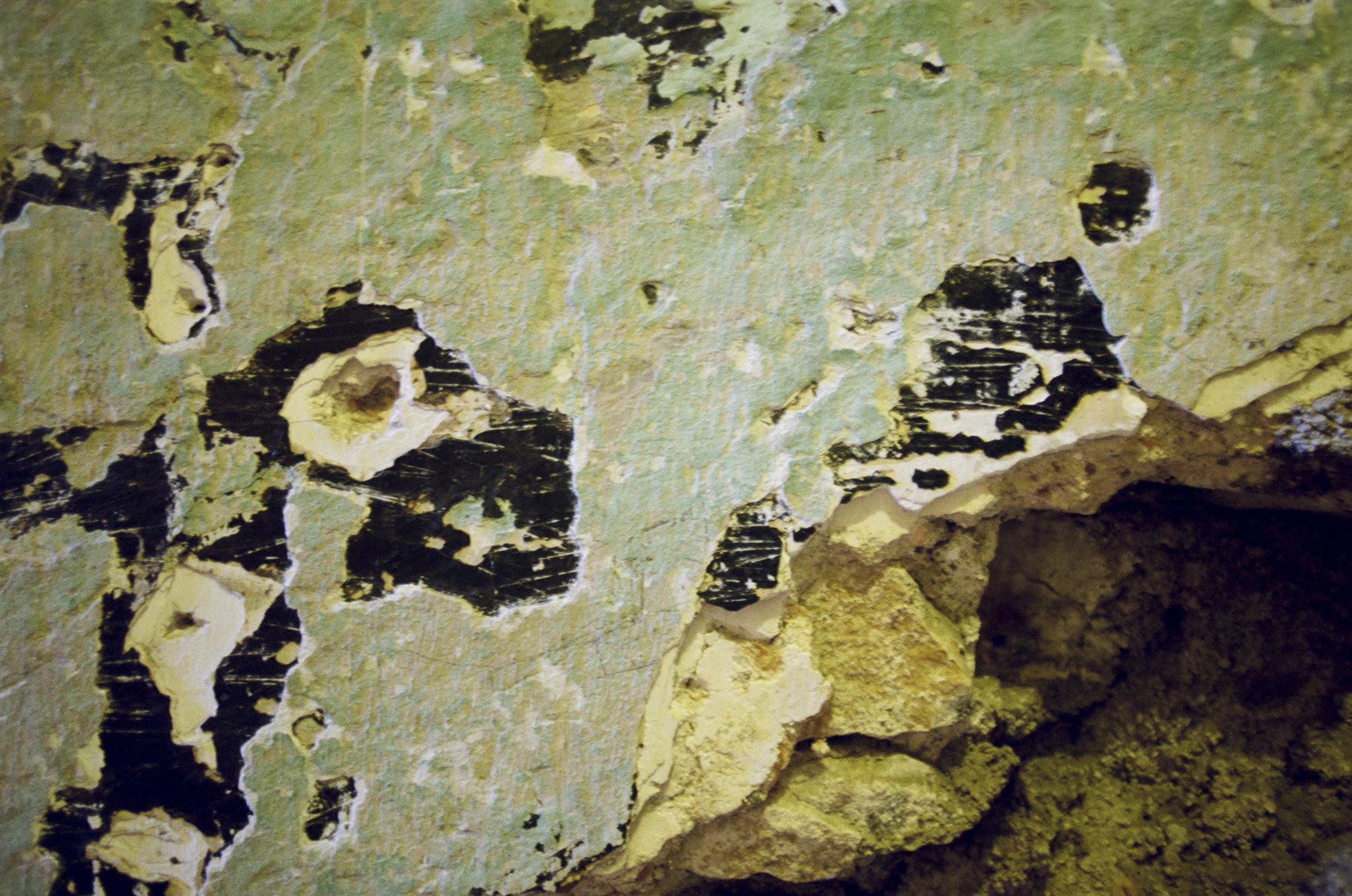
Like the squirming memories have leaked out into the walls. Like the disintegration of bodies through famines, hunger strikes, tortures, isolation, homelessness, poverty, extends outside of the body. The residue of this corporal/institutional violence begins to disintegrate its walls. Walls do not hold memory in very well: they are subject to seepage.
Other evidences of disintegration:
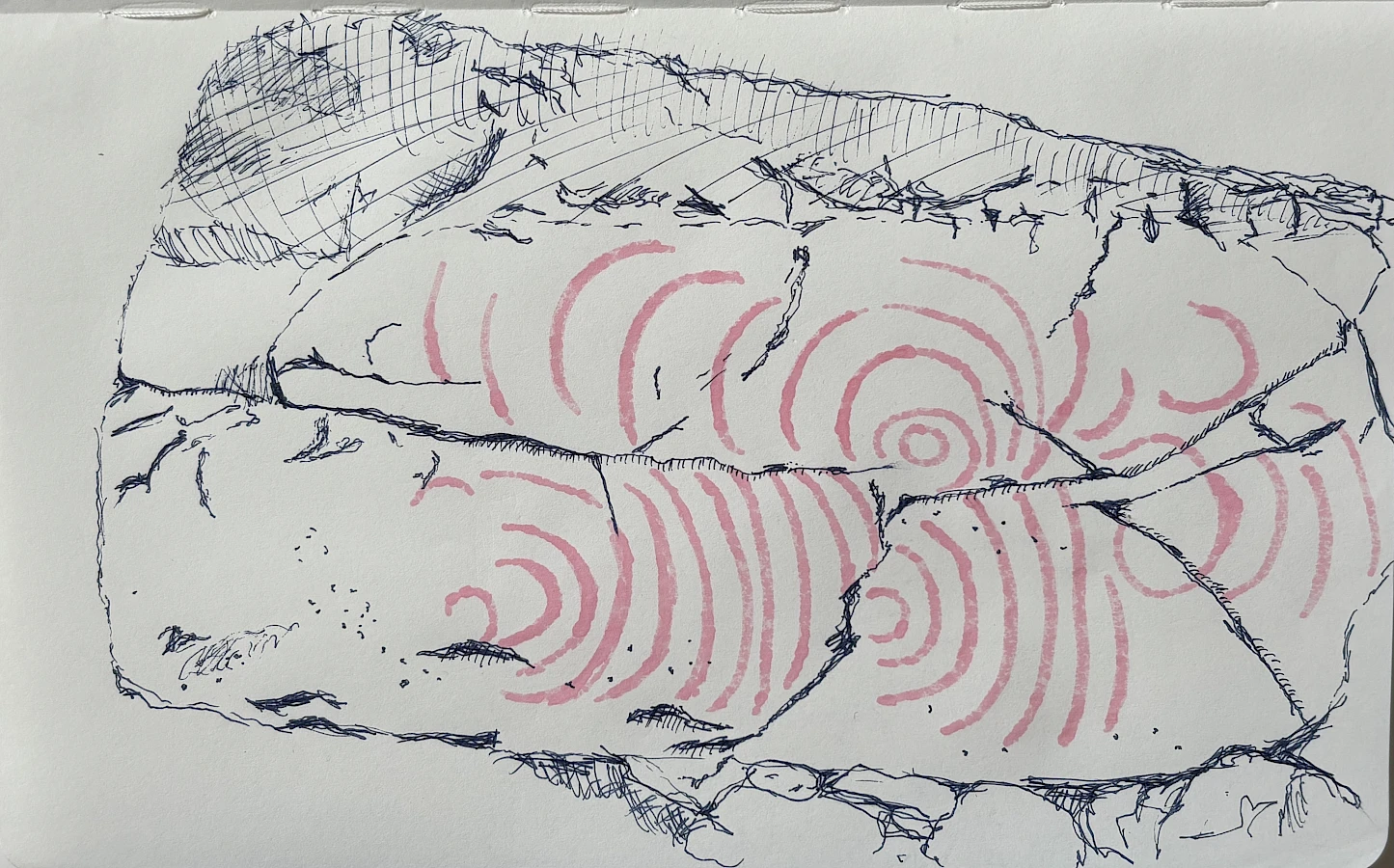
Drawing of rock in Knowth
- The neolithic engravings touch and shape themselves around the cracks in the rock, suggesting the cracks were already there when the carvings were being made.
- Evidence of disintegration preserved through artistic and archeological practices.
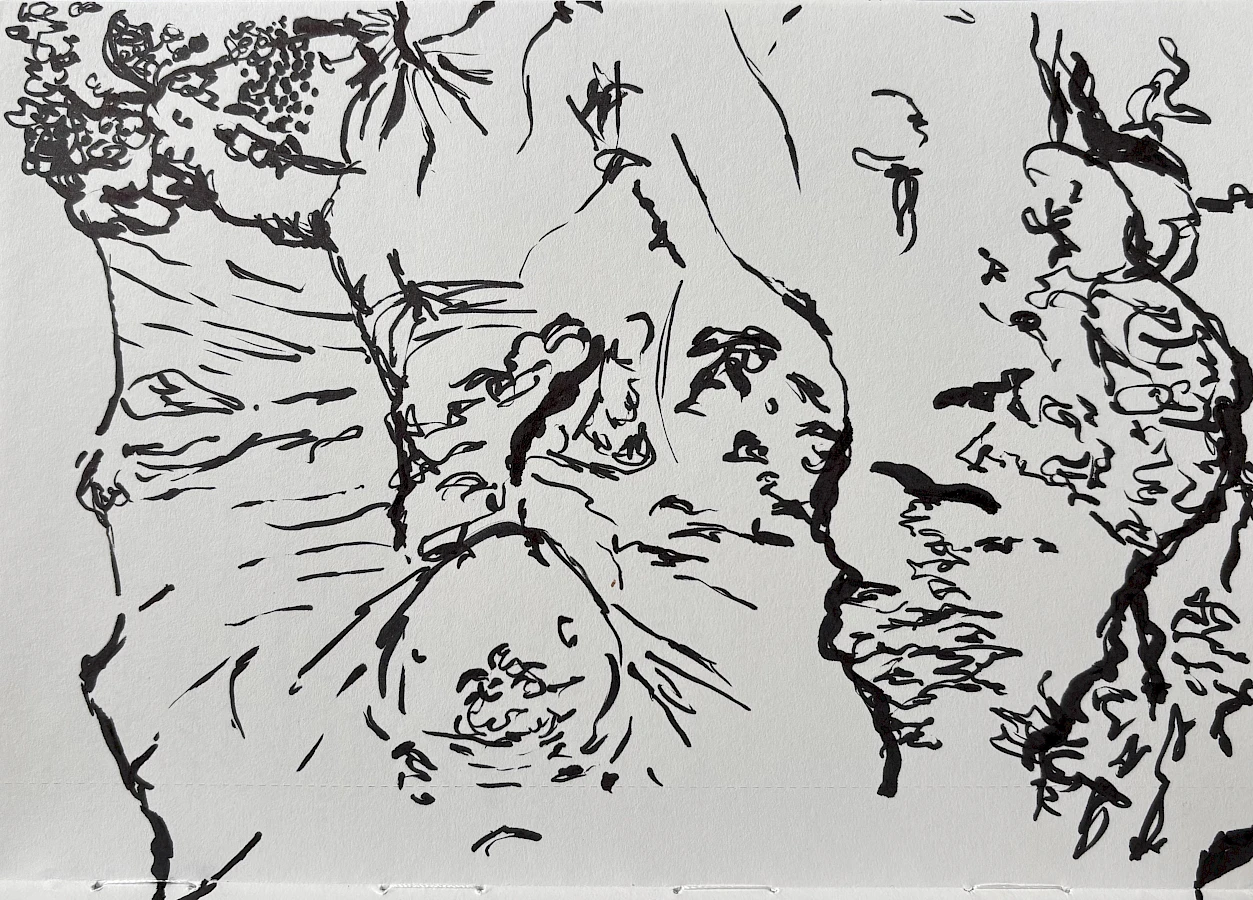
Drawing of a tree
- When drawing the beech tree in Goldenbridge cemetery I was fascinated by the wrinkles, the eye-like scars of its severed limbs, its cracks and marks and pimples. Yet its expansive canopy and invisible roots that spread throughout the terrestrial and aerial space represents the interconnectedness of everything in the cemetery’s garden.
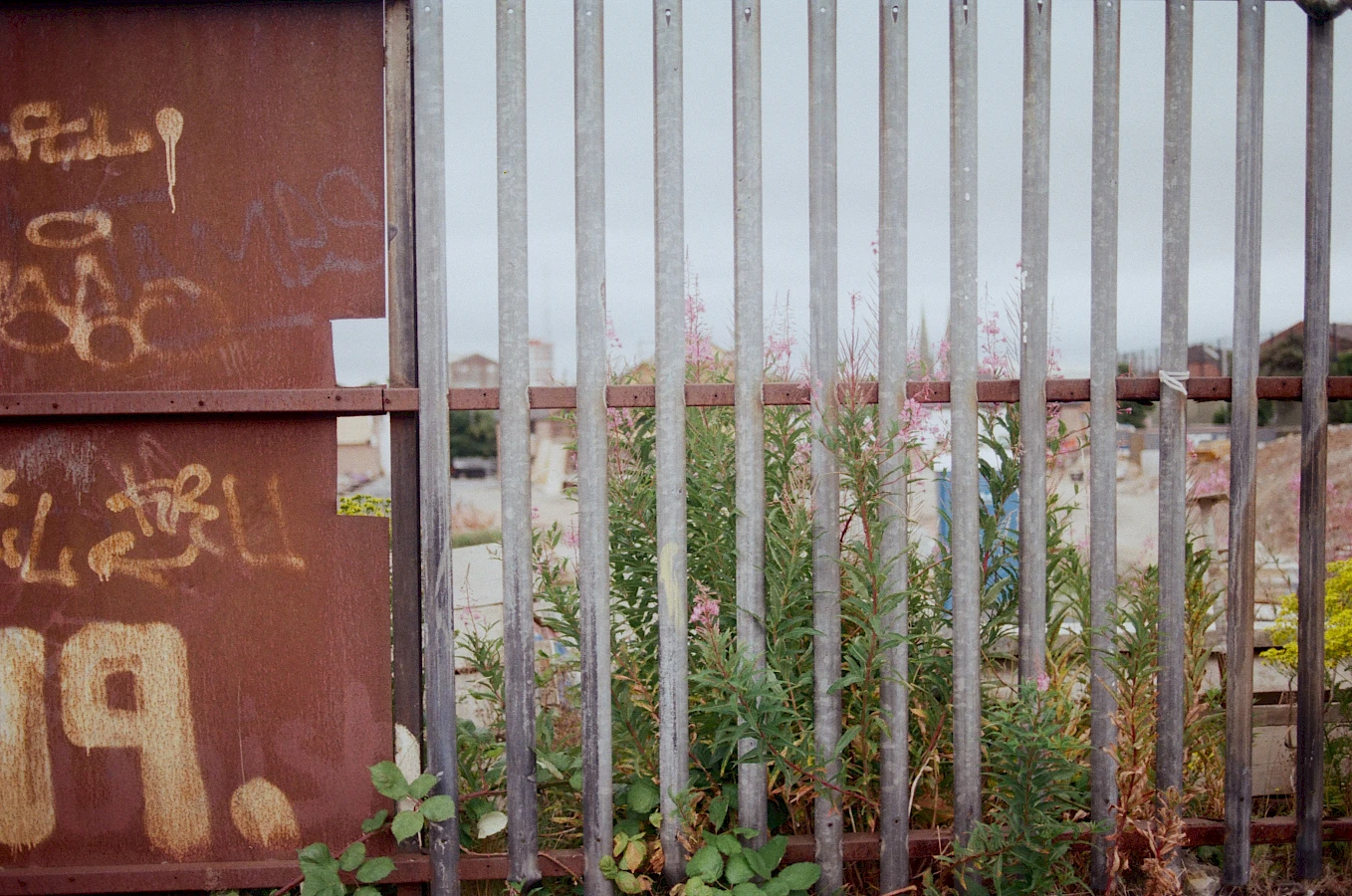
Photos of Belfast
- Ideological/arbitrary borders manifest as physical blockades and fences, whose structures erode through the passage of time.
Disintegration is made extra visible by preservation practices (in museum, garden, city spaces). It is almost as if this act of revisiting, retracing paths, ambulation through spaces affected by trauma (such as the gaol), seems to amplify and spread eroding energy. While the ambulatory revisiting act is typically done with the purpose of preserving and remembering history, does it really erode the experience of space?
Willie Doherty’s short film Ghost Story (2007) and Chantal Ackerman's documentary Sud (1999) both practice this retracing/revisiting paths where atrocities occurred in their cinematic forms. In Ghost Story, a camera moves slowly along an empty path and a voice emanates from it, describing the revisiting of a place of a massacre and finding no traces of it. It is unclear whether this speaker/seer is showing us the space or exploring for itself. Sud is an experimental documentary about the lynching of James Byrd in Jasper, Texas in 1998. Dispersed throughout Ackerman’s interviews with locals involved in the investigation or witnesses to the evidence of the crime, tableaus of Jasper’s landscapes, are a series of haunting scenes shot from the back of a car, retracing the asphalt road along which Byrd was dragged for three miles. What is Ackerman trying to tell us by revisiting the path of Byrd’s death? How does re-witnessing this haunted space connect the past to the present?
I come to these inquisitory and unfinished conclusions about paths and buildings and bodies:
a. By seeing the leftovers of a space where an atrocity happened (the remaining concrete, the empty paved roads), we become hyper aware of what is missing/absent/over.
b. The act of retracing steps amplifies erosion → energy spills out into walls and perhaps can get on you. A space that once held disintegration will itself disintegrate.
c. A rock touched and rubbed, repeatedly, for years will eventually wear away.
d. The revisiting of paths in the two films (and in Kilmainham gaol) erodes the sense of distance between the current moment and history. By retracing their steps, we allow ghosts to briefly flicker into being.
Related contributions and publications
-
Dispatch: Reenacting the loop. Notes on conflict and historiography
Giulia TerralavoroSchoolsLand RelationsIMMANCAD -
Reading List: Summer School, Landscape (post) Conflict
Summer School - Landscape (post) ConflictSchoolsLand RelationsPast in the PresentIMMANCAD -
Decolonial aesthesis: weaving each other
Charles Esche, Rolando Vázquez, Teresa Cos RebolloLand RelationsClimate -
Climate Forum I – Readings
Nkule MabasoEN esLand RelationsClimateHDK-Valand -
…and the Earth along. Tales about the making, remaking and unmaking of the world.
Martin PogačarLand RelationsClimatePast in the Present -
Art for Radical Ecologies Manifesto
Institute of Radical ImaginationLand RelationsClimateInstitute of Radical Imagination -
Ecologising Museums
Land Relations -
Climate: Our Right to Breathe
Land RelationsClimate
Related activities
-
HDK-Valand
Climate Forum I
The Climate Forum is a space of dialogue and exchange with respect to the concrete operational practices being implemented within the art field in response to climate change and ecological degradation. This is the first in a series of meetings hosted by HDK-Valand within L'Internationale's Museum of the Commons programme.
-
–Van Abbemuseum
The Soils Project
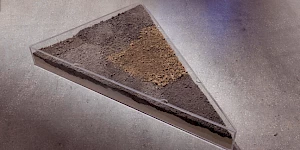
‘The Soils Project’ is part of an eponymous, long-term research initiative involving TarraWarra Museum of Art (Wurundjeri Country, Australia), the Van Abbemuseum (Eindhoven, Netherlands) and Struggles for Sovereignty, a collective based in Yogyakarta, Indonesia. It works through specific and situated practices that consider soil, as both metaphor and matter.
Seeking and facilitating opportunities to listen to diverse voices and perspectives around notions of caring for land, soil and sovereign territories, the project has been in development since 2018. An international collaboration between three organisations, and several artists, curators, writers and activists, it has manifested in various iterations over several years. The group exhibition ‘Soils’ at the Van Abbemuseum is part of Museum of the Commons. -
–MACBA
Where are the Oases?
PEI OBERT seminar
with Kader Attia, Elvira Dyangani Ose, Max Jorge Hinderer Cruz, Emily Jacir, Achille Mbembe, Sarah Nuttall and Françoise VergèsAn oasis is the potential for life in an adverse environment.
-
–Museo Reina Sofia
Team of Teams
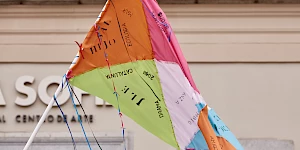
This project researches citizen participation as a fundamental pillar in the creation of community.
-
–tranzit.ro
Non-Western Technologies for the Good Life
The experimental course ‘Non-Western Technologies for the Good Life’ (November 2023–May 2024) celebrates as its starting point the anniversary of 50 years since the publication of Tools for Conviviality, considering that Ivan Illich’s call is as relevant as ever.
-
–Moderna galerijaZRC SAZU
Summer School: Our Many Easts
Our Many Easts summer school is organised by Moderna galerija in Ljubljana in partnership with ZRC SAZU (the Research Centre of the Slovenian Academy of Sciences and Arts) as part of the L’Internationale project Museum of the Commons.