Dispatch: Belonging, Dialogue, and Co-Learning
In her dispatch from the School of Commond Knowledge in Madrid and Barcelona scholar Nurgul Balac moves between written reflection, a close reading of a mural and poetry to consider questions, and experiences of belonging, othering, and dialogue in co-learning spaces.
I. Participation as Privilege: A Reflexive Account
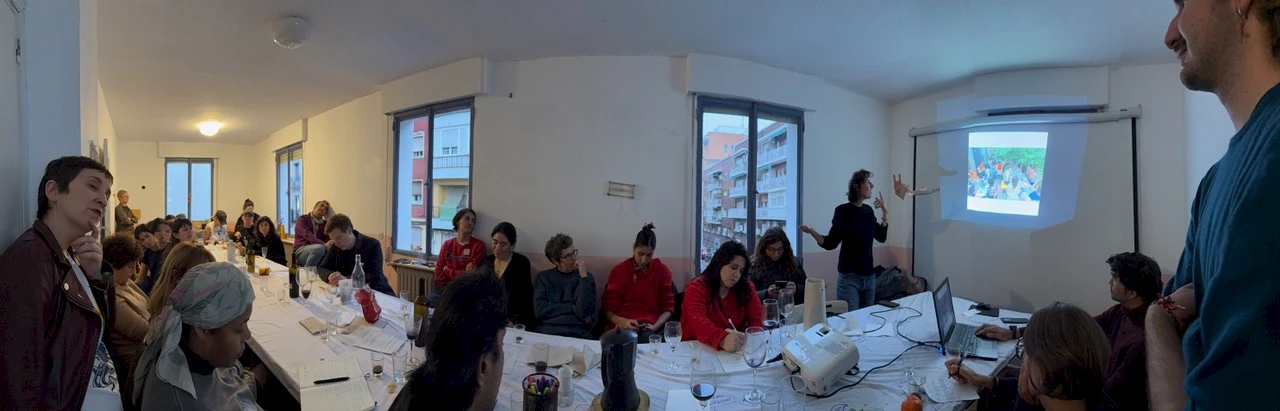
This reflexive account examines my participation in the School of Common Knowledge through the lens of critical pedagogy, attending to how participation, belonging, and dialogue are unevenly constituted within co-learning environments. Writing as an immigrant artist, educator, and doctoral researcher, I understand participation not as a neutral act but as a form of privilege shaped by institutional affiliation, geopolitical mobility, and colonial histories of access. This awareness echoes Sara Ahmed’s (2012) assertion that inclusion within progressive institutions often operates conditionally, allowing presence while regulating the terms under which one may speak, disrupt, or be heard.
All photos Nurgul Balac
Becoming reflexively attentive to my own participation as privilege did not produce a shared recognition within the group. Instead, my willingness to name this privilege appeared to unsettle some participants. In collective discussions, I encountered moments of misrecognition in which my positionality was not fully understood or was affectively resisted. Ahmed (2012) describes this dynamic as the ‘non-performative’ nature of inclusion, where institutional commitments to openness do not necessarily translate into lived experiences of belonging. Despite being formally included, I experienced an affective withdrawal of belonging – an embodied sense that my presence no longer comfortably fitted the space.
This experience compelled me to differentiate sharply between inclusion and belonging. Inclusion granted me access and visibility; belonging required relational openness and dialogical reciprocity. When my reflexive engagement with privilege was received as disturbance rather than invitation, participation ceased to function as recognition. Instead, it exposed the fragile and conditional nature of belonging within learning environments that aspire to horizontality yet remain structured by unspoken affective norms.
From a Freirean perspective, this rupture illuminates the limits of dialogue in spaces where discomfort is not collectively held. For Paulo Freire (1970), dialogue is not merely conversation, but a praxis grounded in humility, mutual recognition, and an ethical commitment to becoming-with others. Dialogue cannot exist where participants fear losing affective comfort or where certain forms of speech are quietly discouraged. In the absence of belonging, dialogue collapses into silence or parallel monologues – conditions I experienced firsthand during moments when relational openness withdrew.
As an immigrant scholar familiar with occupying spaces of partial belonging, this experience was not entirely new. However, it was newly disorienting within a program explicitly framed around co-learning, common knowledge, and collective inquiry. This dissonance sharpened my understanding that critical language alone does not guarantee critical pedagogy. As bell hooks (1994) reminds us, engaged pedagogy demands not only intellectual rigor but emotional presence and care. Without these, learning spaces risk reproducing the very exclusions they seek to contest.
This moment of non-belonging became analytically significant for my dissertation. It revealed how co-learning environments, even when grounded in emancipatory intent, can reproduce subtle forms of othering. Othering here did not manifest as overt exclusion but as an affective boundary – marking whose discomfort is accommodated, whose reflexivity is welcomed, and whose presence becomes difficult to hold. Critical pedagogy, in this sense, requires ongoing reflexivity not only from participants but from the structures that shape participation itself.
Re-framing this experience through critical pedagogy also reshaped my understanding of togetherness. Togetherness cannot be assumed as a natural outcome of co-presence or shared political commitments. Rather, it must be cultivated as an ethical and relational practice attentive to asymmetry, power, and vulnerability. Togetherness, as I now understand it, is enacted through sustained listening, a willingness to remain with discomfort, and a collective responsibility to repair moments of mis-recognition.
Ultimately, this reflexive engagement clarified that co-learning is not inherently just by virtue of its intentions. It becomes a meaningful pedagogical practice only when belonging is treated as a prerequisite for dialogue rather than its byproduct. Without belonging, dialogue cannot take place; without dialogue, togetherness remains aspirational rather than lived. Carrying this insight into my dissertation, I position reflexivity not as self-disclosure but as a critical pedagogical responsibility – one that demands attentiveness to how learning spaces include, exclude, and shape who can speak, who is heard, and who belongs.
II. Belonging as Image, Belonging as Practice
To accompany this reflection, I read an image visually and performatively:
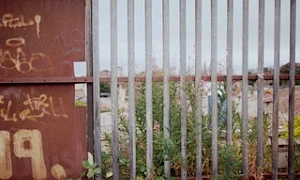
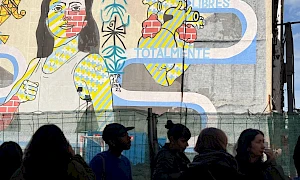
A monumental mural rises above a temporary fence. Painted bodies are enlarged, fragmented, patterned – faces crossed with stripes, torsos tiled like architecture, a heart lifted outside the body, exposed and held. Words curve across the wall: LIBRES, TOTALMENTE. Freedom appears as declaration, not condition.
Below the mural, real bodies pass such smaller, darker, partially obscured. Heads turn, conversations continue, movement does not stop. The fence quietly reorganizes space. Above: symbolism, permanence. Below: transience, negotiation. The mural performs belonging as image; the street performs belonging as practice. Ahmed reminds us that walls do not simply block; they orient.
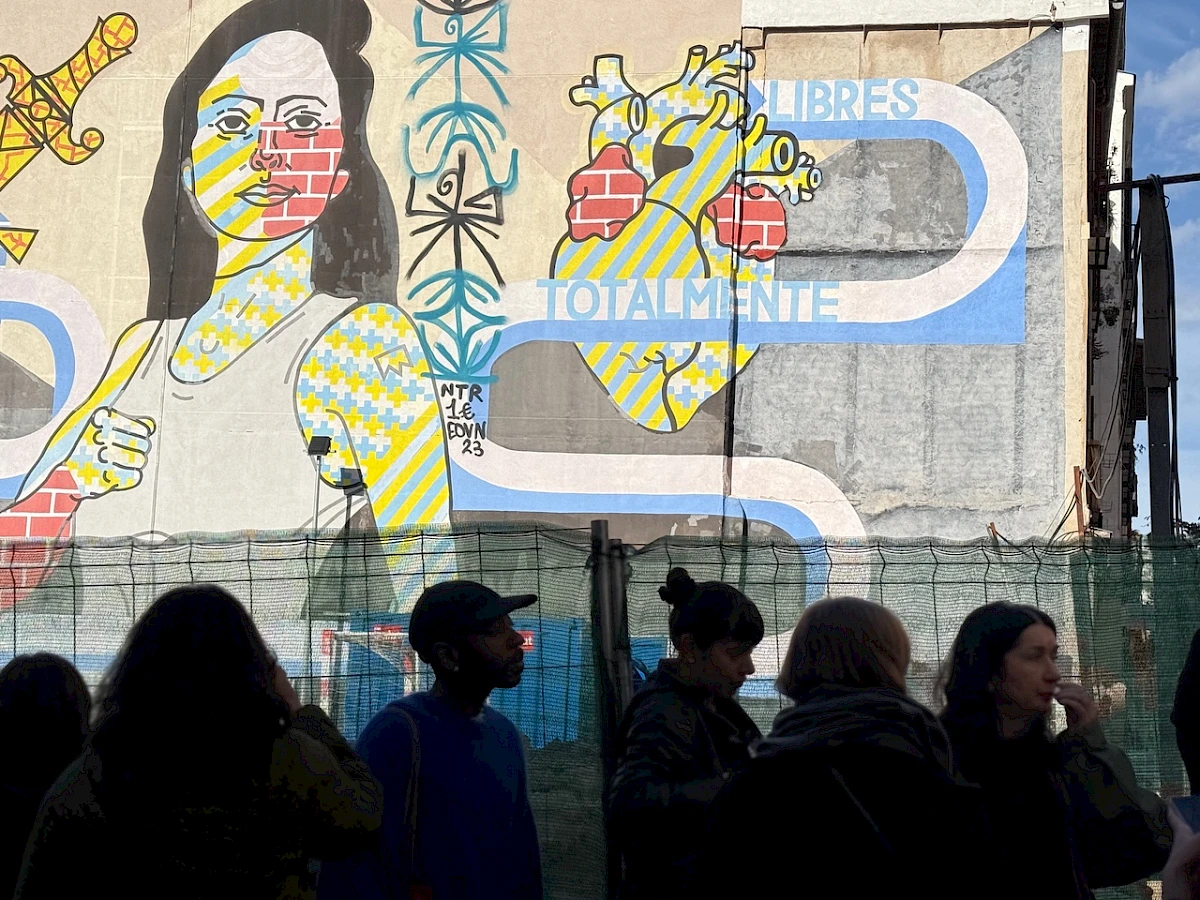
The painted heart—fixed, exposed—suggests care and vulnerability but cannot respond. Below it, people carry their own hearts differently: guarded, folded inward, moving through the city. Liberation is not announced; it is enacted collectively. The mural names freedom; belonging emerges in the slow, relational work of presence, attention, and care.
This image mirrors co-learning: inclusion invites us in, but belonging must be nurtured, enacted, and continually attended to. Dialogue, participation, and relational openness flourish when guided by ethical attentiveness, generosity, and love.
III. Belonging Before Dialogue
What remains after analysis is bodily.
I arrive carrying a passport, a grant letter, a name on a list.
I sit in the circle.
I speak.
Participation looks like presence.
It looks like a chair pulled close to the table, a badge, a shared meal.
But participation is also weight—
the weight of access, of mobility, of permission.
At the School of Common Knowledge, I begin to notice how my ability to be here is not neutral.
To travel.
To listen.
To speak without translation.
To be recognized.
Naming this does not open the room.
It tightens it.
I feel it in the air before I understand it intellectually:
a pause that stretches too long,
eyes that drift,
bodies that turn slightly away.
I am still included.
But I am no longer held.
Sara Ahmed writes that inclusion often asks us to be present without disturbing the space.
You may enter,
but do not rearrange the furniture.
Do not name the cracks in the floor.
When I speak of participation as privilege, the circle holds its breath.
Dialogue falters.
Paulo Freire reminds us that dialogue is not talk—it is relation.
It requires humility, trust, and a shared willingness to stay with discomfort.
Without these, words fall flat.
They land, but they do not meet.
Belonging is felt before it is spoken.
It lives in the body:
in how long silence lasts,
in whether interruption is care or erasure,
in whether difference is met with curiosity or containment.
As an immigrant scholar, I know this choreography well.
I have learned how to read rooms.
How to soften my edges.
How to decide when to speak and when silence will cost less.
Still, it unsettles me to feel othering emerge in a space committed to co-learning.
Not through refusal,
but through withdrawal.
Othering here is subtle.
It looks like politeness.
It sounds like moving on.
Togetherness, I realize, is not agreement.
It is not shared language or common politics.
It is a practice—fragile, unfinished—
of staying with each other when things become uncomfortable.
Belonging does not follow dialogue.
Belonging makes dialogue possible.
Without it, we speak near one another,
not with one another.
This dispatch is not a conclusion.
It is a gesture—
a hand extended,
asking how co-learning might look if belonging were treated not as an outcome,
but as a responsibility.
References
Sara Ahmed, On being included: Racism and diversity in institutional life, Durham: Duke University Press, 2012.
Paulo Freire, Pedagogy of the oppressed (M. B. Ramos, Trans.), London and New York: Continuum, 1979.
bell hooks, Teaching to transgress: Education as the practice of freedom, London: Routledge, 1994.
Related activities
-
–MACBA
The Open Kitchen. The fermented seed, colonialism and extractivism
The MACBA Kitchen is a working group situated against the backdrop of ecosocial crisis. Participants in the group aim to highlight the importance of intuitively imagining an ecofeminist kitchen, and take a particular interest in the wisdom of individuals, projects and experiences that work with dislocated knowledge in relation to food sovereignty.
-
MACBA
The Kitchen: Workshop by Marina Monsonís
The Kitchen is a meeting place open to the participation of all, especially people and organizations that want to share their knowledge and experiences around the kitchen.
-
–MACBA
Where are the Oases?
PEI OBERT seminar
with Kader Attia, Elvira Dyangani Ose, Max Jorge Hinderer Cruz, Emily Jacir, Achille Mbembe, Sarah Nuttall and Françoise VergèsAn oasis is the potential for life in an adverse environment.
-
MACBA
Mobile Garden. A Place to Meet
An open space, a social space. How could the Museum be more open to the needs of the neighbourhood?
-
MACBA
Anti-imperialism in the 20th century and anti-imperialism today: similarities and differences
PEI OBERT seminar
Lecture by Ramón GrosfoguelIn 1956, countries that were fighting colonialism by freeing themselves from both capitalism and communism dreamed of a third path, one that did not align with or bend to the politics dictated by Washington or Moscow. They held their first conference in Bandung, Indonesia.
-
Museo Reina Sofia
School of Commoning Practices
This exchange programme gathers different schools organized by volunteers and migrant communities in Athens (Open School for Migrants) and Madrid (School of Rights, Escuela de Español and Situated mediation School) in order to share their knowledge, exchange strategies and reflect on the experience of working together with migrant communities.
-
–Museo Reina Sofia
Team of Teams
This project researches citizen participation as a fundamental pillar in the creation of community.
-
–Museo Reina Sofia
Sustainable Art Production
The Studies Center of Museo Reina Sofía will publish an open call for four residencies of artistic practice for projects that address the emergencies and challenges derived from the climate crisis such as food sovereignty, architecture and sustainability, communal practices, diasporas and exiles or ecological and political sustainability, among others.
-
–tranzit.ro
Non-Western Technologies for the Good Life
The experimental course ‘Non-Western Technologies for the Good Life’ (November 2023–May 2024) celebrates as its starting point the anniversary of 50 years since the publication of Tools for Conviviality, considering that Ivan Illich’s call is as relevant as ever.
-
–Moderna galerijaZRC SAZU
Summer School: Our Many Easts
Our Many Easts summer school is organised by Moderna galerija in Ljubljana in partnership with ZRC SAZU (the Research Centre of the Slovenian Academy of Sciences and Arts) as part of the L’Internationale project Museum of the Commons.
-
–MACBA
Song for Many Movements: Scenes of Collective Creation
An ephemeral experiment in which the ground floor of MACBA becomes a stage for encounters, conversations and shared listening.
-
–MSU ZagrebVan AbbemuseumModerna galerijaZRC SAZU
Open Call – School of Common Knowledge 2024
MSU (Zagreb), Van Abbemuseum (Eindhoven), MG+MSUM (Ljubljana), ZRC SAZU (Ljubljana) and L'Internationale invite applications for the new School of Common Knowledge (SCK) to be held in Zagreb and Ljubljana 24–29 May 2024. The School of Common Knowledge draws on the network, knowledge and experience of the L’Internationale museum confederation. Its ambition is to be both nomadic and situated, looking at specific cultural and geopolitical situations while exploring their relations and interdependencies with the rest of the world. The SCK is built on the basis laid by the Glossary of Common Knowledge project initiated by Zdenka Badovinac and Moderna galerija (Ljubljana) and continues its co-learning methodology.
-
–MSU ZagrebModerna galerijaZRC SAZU
School of Common Knowledge 2024
School of Common Knowledge draws on the network, knowledge and experience of the L’Internationale museum confederation. Built on the basis laid by the Glossary of Common Knowledge, a project initiated by Zdenka Badovinac and Moderna Galerija in Ljubljana, it continues its co-learning methodology. Its ambition is to be both nomadic and situated, looking at specific cultural and geopolitical situations while exploring their relations and interdependencies with the rest of the world.
-
Museo Reina Sofia
Palestine Is Everywhere
‘Palestine Is Everywhere’ is an encounter and screening at Museo Reina Sofía organised together with Cinema as Assembly as part of Museum of the Commons. The conference starts at 18:30 pm (CET) and will also be streamed on the online platform linked below.
-
–MACBA
Before We Go Down in History (we have to make a living) I. Class Composition
Two-day seminar organised by MACBA as part of Museum of the Commons and the year-long project ‘[contra]panorama’.
-
–Museo Reina Sofia
Open Call: Research Residencies
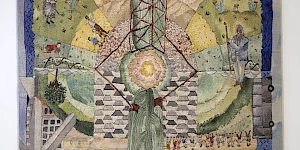
The Centro de Estudios of Museo Reina Sofía releases its open call for research residencies as part of the climate thread within the Museum of the Commons programme.
-
MACBA
The Open Kitchen. Map of edible tensions
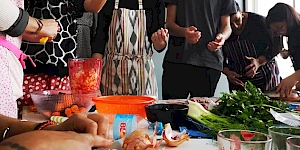
with Marina Monsonís, Paisanaje and Ruralitzem
The MACBA Kitchen is a working group situated against the backdrop of ecosocial crisis. Participants in the group aim to highlight the importance of intuitively imagining an ecofeminist kitchen, and take a particular interest in the wisdom of individuals, projects and experiences that work with dislocated knowledge in relation to food sovereignty. -
MACBA
The Open Kitchen. Food networks in an emergency situation
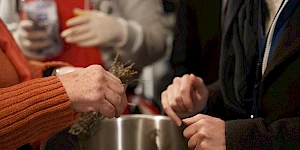
with Marina Monsonís, the Cabanyal cooking, Resistencia Migrante Disidente and Assemblea Catalana per la Transició Ecosocial
The MACBA Kitchen is a working group situated against the backdrop of ecosocial crisis. Participants in the group aim to highlight the importance of intuitively imagining an ecofeminist kitchen, and take a particular interest in the wisdom of individuals, projects and experiences that work with dislocated knowledge in relation to food sovereignty. -
MACBA
Spiral of Time
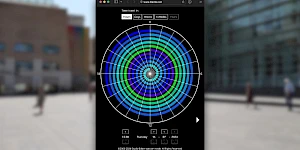
Sound is intangible and ephemeral, yet it can be one of the most distinguishing characteristics of the places it inhabits. Spiral of Time is a site-specific work, created and developed by the Dutch artist, composer, and researcher Edwin van der Heide, that explores sound and its relationship with space and time. This is a participatory time-based work, where meaning is created through active listening and the navigation of each person. The work is integrated in this page and can be accessed below. Furthermore, it will also be presented as an installation towards the end of 2025.
-
–MACBA
Project a Black Planet: The Art and Culture of Panafrica

Curated by MACBA director Elvira Dyangani Ose, along with Antawan Byrd, Adom Getachew and Matthew S. Witkovsky, Project a Black Planet: The Art and Culture of Panafrica is the first major international exhibition to examine the cultural manifestations of Pan-Africanism from the 1920s to the present.
-
–MACBAMuseo Reina Sofia
School of Common Knowledge 2025
The second iteration of the School of Common Knowledge will bring together international participants, faculty from the confederation and situated organizations in Barcelona and Madrid.
-
Museo Reina Sofia
School of Commoning Practices: Publication
Students, teachers and organizations of self-managed language and cultural mediation schools for migrants in Florence, Athens and Madrid share their experiences.
-
–Museo Reina Sofia
Sustainable Art Production. Research Residencies
The projects selected in the first call of the Sustainable Art Practice research residencies are A hores d'ara. Experiences and memory of the defense of the Huerta valenciana through its archive by the group of researchers Anaïs Florin, Natalia Castellano and Alba Herrero; and Fundamental Errors by the filmmaker and architect Mauricio Freyre.
-
Museo Reina Sofia
Poetry readings: Culture for Peace – Art and Poetry in Solidarity with Palestine
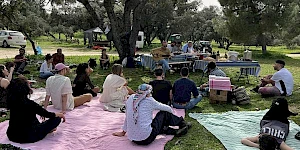
Casa de Campo, Madrid
-
–Museo Reina SofiaMACBA
Open Call – School of Common Knowledge 2025
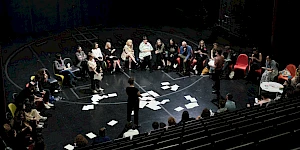
Museo Reina Sofía and MACBA Museu d’Art Contemporani de Barcelona (MACBA) invite applications for the 2025 iteration of the School of Common Knowledge, which will take place in Madrid and Barcelona 11-16 November 2025. The School of Common Knowledge (SCK) draws on the network, knowledge and experience of L’Internationale. Its ambition is to be both nomadic and situated, looking at specific cultural and geopolitical situations while exploring their relations and interdependencies with the rest of the world. This year, the SCK program focuses on the contested and dynamic notions of rooting and uprooting in the framework of present – colonial, migrant, situated, and ecological – complexities. Building on the legacy of the Glossary of Common Knowledge and the current European program Museum of the Commons, the SCK invites participants to reflect on the power of language to shape our understanding of art and society through a co-learning methodology.
-
–IMMANCAD
Summer School: Landscape (post) Conflict
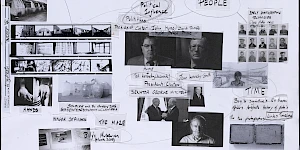
The Irish Museum of Modern Art and the National College of Art and Design, as part of L’internationale Museum of the Commons, is hosting a Summer School in Dublin between 7-11 July 2025. This week-long programme of lectures, discussions, workshops and excursions will focus on the theme of Landscape (post) Conflict and will feature a number of national and international artists, theorists and educators including Jill Jarvis, Amanda Dunsmore, Yazan Kahlili, Zdenka Badovinac, Marielle MacLeman, Léann Herlihy, Slinko, Clodagh Emoe, Odessa Warren and Clare Bell.
-
–Museo Reina Sofia
Study Group: Aesthetics of Peace and Desertion Tactics
In a present marked by rearmament, war, genocide, and the collapse of the social contract, this study group aims to equip itself with tools to, on one hand, map genealogies and aesthetics of peace – within and beyond the Spanish context – and, on the other, analyze strategies of pacification that have served to neutralize the critical power of peace struggles.
-
MACBA
PEI Obert: The Brighter Nations in Solidarity: Even in the Midst of a Genocide, a New World Is Being Born
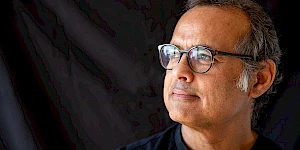
PEI Obert presents a lecture by Vijay Prashad. The Colonial West is in decay, losing its economic grip on the world and its control over our minds. The birth of a new world is neither clear nor easy. This talk envisions that horizon, forged through the solidarity of past and present anticolonial struggles, and heralds its inevitable arrival.
-
MACBA
PEI Obert: Bodies of Evidence. A lecture by Ido Nahari and Adam Broomberg
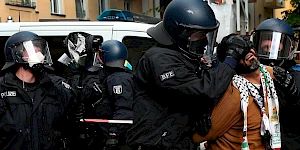
In the second day of Open PEI, writer and researcher Ido Nahari and artist, activist and educator Adam Broomberg bring us Bodies of Evidence, a lecture that analyses the circulation and functioning of violent images of past and present genocides. The debate revolves around the new fundamentalist grammar created for this documentation.
-
MACBA
School of Common Knowledge: Fred Moten
Fred Moten gives the lecture Some Prœposicions (On, To, For, Against, Towards, Around, Above, Below, Before, Beyond): the Work of Art. As part of the Project a Black Planet exhibition, MACBA presents this lecture on artworks and art institutions in relation to the challenge of blackness in the present day.
-
–MACBA
Visions of Panafrica. Film programme
Visions of Panafrica is a film series that builds on the themes explored in the exhibition Project a Black Planet: The Art and Culture of Panafrica, bringing them to life through the medium of film. A cinema without a geographical centre that reaffirms the cultural and political relevance of Pan-Africanism.
-
MACBA
Farah Saleh. Balfour Reparations (2025–2045)
As part of the Project a Black Planet exhibition, MACBA is co-organising Balfour Reparations (2025–2045), a piece by Palestinian choreographer Farah Saleh included in Hacer Historia(s) VI (Making History(ies) VI), in collaboration with La Poderosa. This performance draws on archives, memories and future imaginaries in order to rethink the British colonial legacy in Palestine, raising questions about reparation, justice and historical responsibility.
-
MACBA
Project a Black Planet: The Art and Culture of Panafrica OPENING EVENT
A conversation between Antawan I. Byrd, Adom Getachew, Matthew S. Witkovsky and Elvira Dyangani Ose. To mark the opening of Project a Black Planet: The Art and Culture of Panafrica, the curatorial team will delve into the exhibition’s main themes with the aim of exploring some of its most relevant aspects and sharing their research processes with the public.
-
MACBA
Palestine Cinema Days 2025: Al-makhdu’un (1972)
Since 2023, MACBA has been part of an international initiative in solidarity with the Palestine Cinema Days film festival, which cannot be held in Ramallah due to the ongoing genocide in Palestinian territory. During the first days of November, organizations from around the world have agreed to coordinate free screenings of a selection of films from the festival. MACBA will be screening the film Al-makhdu’un (The Dupes) from 1972.
-
Museo Reina Sofia
Cinema Commons #1: On the Art of Occupying Spaces and Curating Film Programmes
On the Art of Occupying Spaces and Curating Film Programmes is a Museo Reina Sofía film programme overseen by Miriam Martín and Ana Useros, and the first within the project The Cinema and Sound Commons. The activity includes a lecture and two films screened twice in two different sessions: John Ford’s Fort Apache (1948) and John Gianvito’s The Mad Songs of Fernanda Hussein (2001).
-
HDK-Valand
MA Forum in collaboration with LIO: Cathryn Klasto

In this MA Forum we welcome artist and researcher Cathryn Klasto. This talk will share some working insight into Klasto’s ongoing book project ‘Space Trekking’. The book is a collection of visual essays which tries to reveal the relationship between artistic research, ethics and interstellar spatial phenomena storied within the Star Trek universe.
-
Museo Reina Sofia
Sonic and Cinema Commons
Sonic and Cinema Commons is a research, programming and publishing project that explores how cinema and sonic experiences generate spaces for the formation of interpretive communities, foster collective debate and prefigure proposals for the commons. Co-organised with L’Internationale Online, 2025 and 2026.
-
MACBA
PEI Obert: Until Liberation: A Collective Reading and Listening Session by Learning Palestine
PEI Obert presents a collective session with Learning Palestine. At this historical juncture – amid the ongoing genocide in Gaza and the censorship and repression of all things Palestinian – Learning Palestine invites us to gather not only in refusal but also in affirmation.
Related contributions and publications
-
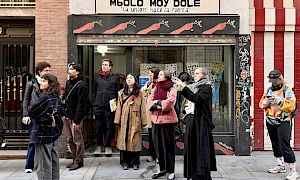
Dispatch: Notes On Generosity
Amanda Macedo MacedoSchoolsMuseo Reina SofiaMACBA -
Dispatch: The first and obvious separation is between
KroplyaSchoolsMuseo Reina SofiaMACBA -
Activating Pink Triangle. Didactic materials and pedagogical proposals for a diverse school
Museo Reina Sofia -
Glossary of Common Knowledge, Vol. 2
Schools -
Glossary of Common Knowledge
Schools -
Prácticas lumbung para resistir y colaborar desde el arte
Constanza Yévenes BiénzobasEN eslumbungSituated OrganizationsMuseo Reina Sofia -
Algunos términos que guían a lumbung press: Definiendo “edición”
Erick BeltránEN eslumbungSituated OrganizationsMACBA -
In the Battles of Language / En las batallas del lenguaje
Marina Garcés, Silvia Rivera CusicanquiDialoguesMACBA -
Populism. A Dialogue on Art, Representation and Institutions in the Crisis of Democracy
Chantal Mouffe, Didier EribonDialoguesMuseo Reina Sofia -
Evidence, Activism And The Law in the Age of Post-Truth
Baltasar Garzón, Eyal Weizman, Yolanda Álvarez, Manuel VergaraDialoguesMACBA -
Congresso Internacional Extraordinário dos Críticos de Arte, 1959
DialoguesMuseo Reina Sofia -
Art Museums and Democracy
Charles Esche, Manuel Borja-Villel, Bart de BaereDialoguesM HKAVan AbbemuseumMuseo Reina Sofia -
THE MUSEUM YET TO COME. Exercises of institutional imagination
Pablo MartínezHDK-ValandMACBA -
L’Internationale Public Statement on the recent events at MACBA
L’Internationale ConfederationStatements and editorialsMACBA -
L'Internationale statement in support of the decision to open "La Bestia y el soberano" (The Beast and the Sovereign)
L’Internationale ConfederationStatements and editorialsMACBA -
L'Internationale statement in support of MNCARS
L’Internationale ConfederationEN es sl nl trStatements and editorialsMuseo Reina Sofia -
On Riots, Grief and Parties
MACBA -
Triángulo Rosa / Pink Triangle
Alicia Bernardos, Trinidad A. Labrador, Carolina León, Mercedes Sánchez Sáinz, Marco Antonio Theis Fuentes, Miquel MisséMuseo Reina Sofia -
Diaspora. Art Stories from Barcelona
Tania Safura Adam, Aldemar MatiasMACBA -
Hard Gelatin. Hidden Stories from the 80s
MACBA -
Really Useful Knowledge
Museo Reina Sofia -
Minimal Resistance. Between Late Modernism and Globalisation: Artistic Practices During the 80s and 90s
Museo Reina Sofia -
Opening Performance: Song for Many Movements, live on Radio Alhara
Jokkoo with/con Miramizu, Rasheed Jalloul & Sabine SalaméEN esInternationalismsSonic and Cinema CommonsPast in the PresentMACBA -
Mix tape: Let's funk up all genders!
Materia Hache / Others to the FrontEN esSonic and Cinema CommonsSituated OrganizationsMuseo Reina Sofia -
Towards Collective Learning, or, Decompartmentalizing Education
María Berríos, Fran MM Cabeza de Vaca, Yolande Zola Zoli van der Heide, Nick AikensSchoolsSituated Organizations -
Dispatch: Harvesting Non-Western Epistemologies (ongoing)
Adelina LuftLand RelationsSchoolsClimatetranzit.ro -
Dispatch: From the Eleventh Session of Non-Western Technologies for the Good Life
Ana KunLand RelationsSchoolstranzit.ro -
Reading list: School of Common Knowledge 2024
School of Common KnowledgeSchoolsSituated OrganizationsMSU ZagrebModerna galerijaZRC SAZU -
Dispatch: Practicing Conviviality
Ana BarbuClimateSchoolsLand Relationstranzit.ro -
Dispatch: Notes on Separation and Conviviality
Raluca PopaLand RelationsSchoolsSituated OrganizationsClimatetranzit.ro -
Dispatch: A Shared Dialogue
Irina Botea Bucan, Jon DeanLand RelationsSchoolsClimatetranzit.ro -
Live set: Una carta de amor a la intifada global
PrecolumbianEN esInternationalismsSonic and Cinema CommonsPast in the PresentMACBA -
Dispatch: In between the lessons. Staying together in uncertain times, laughing in the face of trouble, and disobeying; the future belongs to us
Antonela SoleničkiSchoolsSituated OrganizationsMSU ZagrebModerna galerijaZRC SAZU -
Dispatch: The Commonsverse and Situated Organisations – or why the era of big institutions will come to an end
Denise PolliniSchoolsSituated OrganizationsMSU ZagrebModerna galerijaZRC SAZU -
Dispatch: A Buriti Tree
Lucas PrettiSchoolsSituated OrganizationsMSU ZagrebModerna galerijaZRC SAZU -
Poner el nombre a una causa en tierra extraña
Dagmary Olívar Graterol, Paola de la Vega VelasteguiEN esSchoolsSituated OrganizationsMuseo Reina Sofia -
Dispatch: To whom it may concern – the voice of the censor and re-calibrating words as an act of survival
AnonymousSchoolsSituated OrganizationsMSU ZagrebModerna galerijaZRC SAZU -
Rethinking Comradeship from a Feminist Position
Leonida KovačSchoolsInternationalismsSituated OrganizationsMSU ZagrebModerna galerijaZRC SAZU -
Reading list - Summer School: Our Many Easts
Summer School - Our Many EastsSchoolsPast in the PresentModerna galerija -
Dispatch: ‘I don't believe in revolution, but sometimes I get in the spirit.’
Megan HoetgerSchoolsPast in the Present -
Dispatch: Notes on (de)growth from the fragments of Yugoslavia's former alliances
Ava ZevopSchoolsPast in the Present -
Dispatch: A Silent Conversation
Anela DumonjićSchoolsModerna galerija -
Taking Part. A Guide to Participatory Tools and Techniques
EN esSchoolsSituated OrganizationsMuseo Reina Sofia -

Atención: participar en el Museo de los Comunes
Fran MM Cabeza de VacaEN esSchoolsSituated Organizations -
Reading List: Summer School, Landscape (post) Conflict
Summer School - Landscape (post) ConflictSchoolsLand RelationsPast in the PresentIMMANCAD -
Dispatch: Reenacting the loop. Notes on conflict and historiography
Giulia TerralavoroSchoolsLand RelationsIMMANCAD -
Dispatch: Haunting, cataloging and the phenomena of disintegration
Coco GoranSchoolsLand RelationsIMMANCAD -
Dispatch: Landescape – bending words or what a new terminology on post-conflict could be
Amanda CarneiroSchoolsLand RelationsIMMANCAD -
Dispatch: Landscape (Post) Conflict – Mediating the In-Between
Janine DavidsonSchoolsLand RelationsIMMANCAD -
Dispatch: Excerpts from the six days and sixty one pages of the black sketchbook
Sabine El ChamaaSchoolsLand RelationsIMMANCAD -
Dispatch: Withstanding. Notes on the material resonance of the archive and its practice
Giulio GonellaSchoolsLand RelationsIMMANCAD -
Schools: Editorial
L'Internationale Online Editorial BoardSchools -
Dispatch: Between Pages and Borders – (post) Reflection on Summer School ‘Landscape (post) Conflict’
Daria RiabovaSchoolsLand RelationsIMMANCAD -
Reading list: October School. Reimagining Institutions
October SchoolSchoolsSituated OrganizationsClimateMSU Zagreb -
Dispatch: Belonging, Dialogue, and Co-Learning
Nurgul BalacSchoolsMuseo Reina SofiaMACBA